

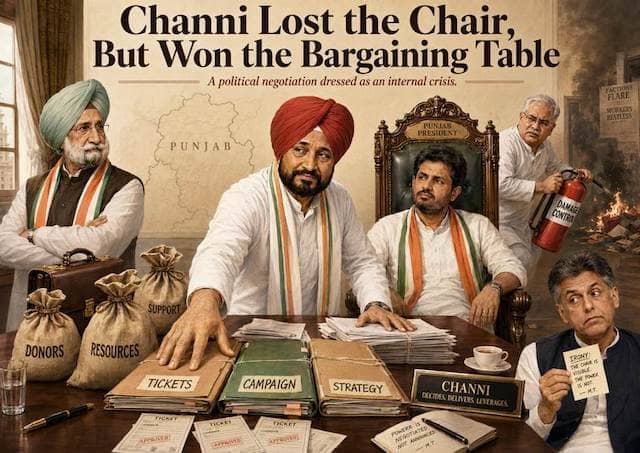

Power Distribution Without Control
The Congress high command attempted to balance power by distributing various committee roles across Punjab. The leadership structure included retaining Amarinder Singh Raja Warring as PPCC president and appointing Partap Singh Bajwa as Leader of Opposition. Charanjit Singh Channi was designated chairman of the campaign committee. Sukhjinder Singh Randhawa received assignment for the core committee, Vijay Inder Singla took charge of election management, and Dr Amar Singh led the manifesto committee.
On paper, this arrangement appeared to represent a balance within the party hierarchy. In reality, observers noted it functioned as a distribution of chairs without settling the fundamental question of power control. The analysis suggested that a chair without actual authority serves merely as decoration rather than functional leadership.
The Morinda Gathering and Strategic Signaling
Charanjit Singh Channi's residence in Morinda became the focal point for a significant political gathering on July 6, 2026. Approximately 74 former ministers, sitting and former MLAs, along with senior leaders attended the event at his home.
The attendance was interpreted by analysts as more than an opportunity to sip tea or engage in casual conversation. Reports indicated the assembly served a specific purpose: sending a signal regarding Channi's continued importance within the party structure. The gathering demonstrated the breadth of his support base and functioned as a mechanism to increase his bargaining power.
Before this meeting, political observers characterized Channi's position as one where he was merely accommodated by higher authorities. Following the Morinda event, assessments shifted to describe him as an unavoidable figure in party decisions. The transition from accommodation to necessity represents a shift in how influence is generated within the organization.
Negotiation Versus Rebellion
Political commentary characterized Charanjit Singh Channi's actions not as rebellion but as loud negotiation. This distinction was central to understanding the outcome of the Morinda meeting and his subsequent standing with the Congress high command.
The high command had initially operated under the assumption that it had settled Punjab by installing Raja Warring in key positions. However, this arrangement faced immediate scrutiny from internal factions. Reports published by The Tribune and The Federal indicated that the dissident camp was not inclined to back down following the committee assignments.
Several leaders openly voiced demands for Channi to replace Amarinder Singh Raja Warring as PPCC president during discussions at Morinda. These statements were categorized by analysts as price discovery rather than indiscipline or disloyalty. The process involved questioning a year-long exercise characterized by marathon meetings and committees with objectives that remained unachieved.
Daily Ajit Analysis of Public Sentiment
Media coverage from Daily Ajit captured the prevailing mood regarding these internal power dynamics. Supporters of Channi articulated the line that the public does not support Raja Warring in Punjab.
The source context notes this sentiment was a critical factor influencing negotiations within the party leadership circles, suggesting external pressure plays a role in determining who holds actual control versus nominal titles.
From Accommodation to Unavoidable Influence
The outcome of the Morinda meeting suggested that Charanjit Singh Channi has moved from being merely accommodated by the high command to becoming an unavoidable figure in party decisions. This evolution reflects a strategic approach where influence is created from below rather than given from above.
Analysts noted that while committees were established with specific objectives, these goals were never fully achieved during the year-long exercise preceding this period of tension and negotiation. The distribution of roles without settling power questions left the party structure in a state where Channi's leverage became evident through his ability to convene such a large gathering.
The real meaning of the Morinda meeting, according to Hill Post analysis by Gurpartap Singh Mann dated July 6, 2026, lies in this successful negotiation despite losing the specific chairmanship sought. Channi has not rebelled against the party structure but instead utilized his support base to negotiate a position that ensures continued relevance.
The gathering at Morinda signaled that while he lost the first round regarding the PPCC chair assignment, he secured a second round of influence based on bargaining power derived from his supporters and former ministers. This dynamic underscores the complexity of internal party politics where formal titles may not equate to actual decision-making authority.
Reports continue to highlight that Channi's actions are characterized by loud negotiation rather than open rebellion, indicating a strategic approach aimed at regaining influence within the Congress organization in Punjab without fracturing along traditional lines. The presence of 74 former ministers and senior leaders suggests deep roots among the party base which can be leveraged during future committee formations or leadership elections.