

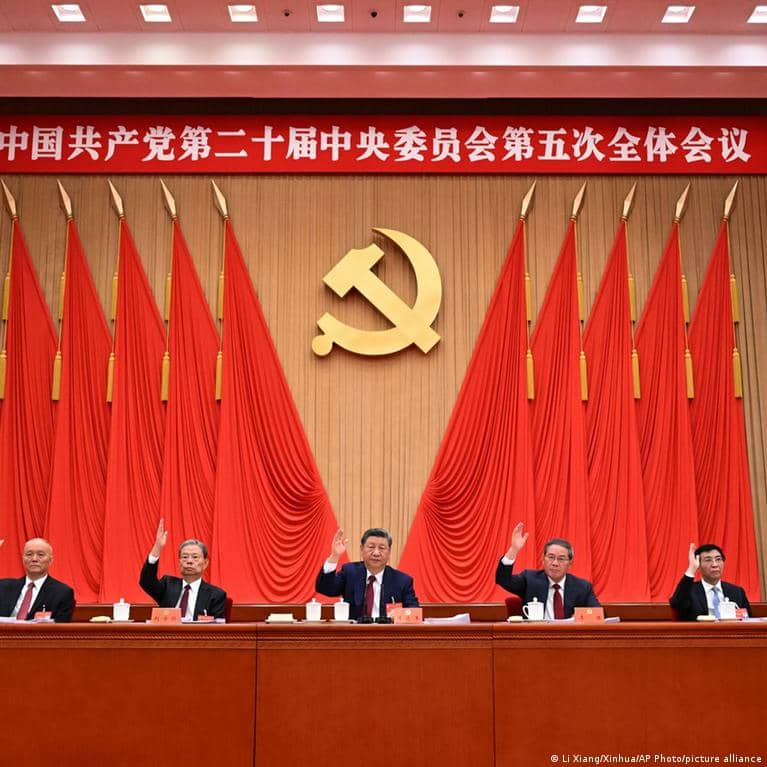

CCP Session Focuses on Strict Discipline
\nThe top echelon of the Chinese Communist Party (CCP) held a four-day closed-door session in Beijing this week, with discussions centering on strict leadership and discipline within the ruling party. Xi Jinping, who serves as both the CCP's general secretary and the head of state, used the gathering to signal that he would deepen existing anti-corruption efforts while demanding increased loyalty and initiative from officials at all levels.
\nA committee resolution published following the session praised Xi for his \"enormous political courage and strong sense of responsibility\" in tackling corruption and addressing the weakening of the Party's governance. The statement emphasized the need to \"consistently advance comprehensive and strict Party leadership,\" according to a press release issued on Thursday.
\nThe session also addressed the issue of internal dissent, with Xi recently calling for the identification and removal of \"two-faced functionaries.\" In a mid-October speech published in Qiushi Magazine, Xi described these individuals as \"political opportunists\" who profess loyalty but work against central instructions or pursue individualistic goals. He criticized officials who use harmony as an excuse to avoid addressing problems.
\n\nXi's Demand for Proactive Implementation
\nPolitical scientists note that while Xi wants officials to act proactively and decisively, this mandate is strictly limited to the implementation of specific tasks rather than decision-making. Chong Ja Ian, a political scientist at the National University of Singapore, stated that party functionaries under Xi have limited space to make independent decisions.
\n\"Xi wants officials to act proactively and decisively in implementing specific tasks but does not want them questioning the prescribed agenda,\" Chong told DW. This \"proactivity\" is therefore confined to execution, leaving the strategic direction firmly under central control.
\n\nConcerns Over Stability and Control
\nThe push for stricter discipline comes as the party faces a complex geopolitical landscape and domestic economic challenges. Kerry Brown, head of the Lau China Institute at King's College London, stated that Xi wants to minimize potential sources of instability amid international tensions and internal economic difficulties.
\nBrown told DW that if the CCP is not disciplined and united, it risks becoming disunited and unstable like other global entities. He added that Xi appears willing to sacrifice operational flexibility for greater control and stability, noting, \"As long as you have unity, you live for another day... But if you have disunity, you probably die the same day.\"
\nBrown also pointed out that the party is \"very, very risk averse.\" He argued that demanding innovation and courage from officials could weaken party control and boost corruption, while ramping up pressure on rank-and-file members risks suppressing initiative, potentially affecting the military.
\n\nAssessment of Current Approach
\nDespite the heightened demands for loyalty, Brown described the current approach as \"kind of works.\" He noted that the economy is not disastrous despite not being great, and contrasted China's situation with the \"mess\" of the outside world.
\nThe four-day session concluded without addressing the question of Xi Jinping's successor, leaving the leadership transition timeline unanswered. The party's focus remains on maintaining internal cohesion as it navigates cooling economic indicators and rising geopolitical tensions.
"