

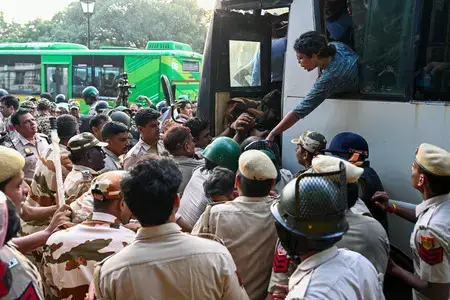

Mass Detentions at Airport and Gurugram Preempt Protest
The Central Vigilance Commission (CJP) protest against Chief Election Commissioner Gyanesh Kumar faced immediate obstruction on Saturday as authorities moved to detain key organizers before they could reach the capital. According to reports from Bhaskar Live, over 3,000 anti-CEC protesters were detained across Delhi, including prominent CJP leaders Abhijeet Dipke and politicians Mamata Banerjee and Arvind Kejriwal.
The initial wave of detentions occurred around 10:30 a.m. at the Indira Gandhi International Airport. Police intercepted CJP leaders Abhijeet Dipke, Saurav Das, and Ashutosh Ranka while they were traveling to stage a protest demanding Gyanesh Kumar’s resignation over alleged irregularities in the Special Intensive Revision (SIR) of electoral rolls. The group had intended to arrive in Delhi to lead demonstrations against the election commission's actions.
Simultaneously, social media influencer Dhruv Rathee was detained at his residence in Gurugram around 8 a.m. by approximately 50 plainclothes police personnel, according to a CJP post on X. These coordinated arrests were part of a broader strategy to prevent the protest from gaining momentum.
Leadership Shift and Organizational Ties
With the primary leaders in custody, the responsibility for leading the demonstration fell to Ajinkya Shinde. Livemint reported that CJP Organisation In-Charge Ajinkya Shinde would lead the Jantar Mantar 2.0 protest while Abhijeet Dipke, Saurav Das, and Ashutosh Ranka remained in detention. Dipke announced via a pre-recorded video that Shinde would continue the protest against CEC Gyanesh Kumar as long as he and two other leaders remained detained.
Shinde, 35, is a native of Maharashtra appointed as National Organisation In-Charge of CJP. His background has drawn scrutiny; previously, he worked for the Aam Aadmi Party (AAP) as a social media coordinator and convener for the party’s Maharashtra Youth Wing. Social media posts showing photographs of Shinde with AAP leaders and a July 2022 poster have fueled allegations that CJP is linked to AAP.
The CJP condemned the detention of Dipke, Das, and Ranka as a pre-planned move to prevent leaders from reaching the protest site. The party called it a violation of freedom of movement and demanded their immediate release. Despite these obstacles, Shinde announced that protesters would march toward Jantar Mantar on Sunday and rest only after the CEC’s resignation.
Security Lockdown and Infrastructure Shutdowns
To prevent a repeat of the violent July protest at Jantar Mantar, authorities imposed strict security measures. More than 30,000 police and paramilitary personnel were deployed across the city. The Delhi Metro implemented significant disruptions, closing 45 Metro stations around Jantar Mantar. Internet curbs were imposed in central Delhi, and schools, colleges, and courts shifted to online mode to minimize public gathering.
Authorities denied permission for the demonstration, imposing roadblocks and traffic diversions. Despite these restrictions, minor clashes occurred during the day. Stones were pelted at a bus in Jhandewalan, and protesters clashed with police near Akashwani Bhavan after breaking barricades. Detained protesters were taken to Chhatrasal Stadium and various police stations before being released later in the evening.
Political Reactions and Legal Challenges
The crackdown sparked sharp criticism from opposition leaders. Delhi Chief Minister Rekha Gupta criticized Congress leader Rahul Gandhi, AAP leader Arvind Kejriwal, and CJP for disrupting peace, stating, “Delhi will not be held hostage.” Conversely, Congress MP Priyanka Gandhi Vadra criticized the detention of young men and women exercising their right to protest, claiming security curbs showed the government was “terrified” of its “illegitimacy” being exposed.
Congress President Mallikarjun Kharge posted on X criticizing the regime for targeting youth, students, lawyers, journalists, activists, and content creators questioning the BJP government. The controversy extended to the judiciary, with the Supreme Court likely to hold a special sitting on Sunday to hear a contempt petition by petitioner Shailendra Mani Tripathi. The petition alleges that the blanket closure of Delhi Metro stations violated the Court's order. The bench for this hearing includes Justice Joymalya Bagchi and Justice V. Mohana.