


Police Deny "Impending Crackdown" Rumors
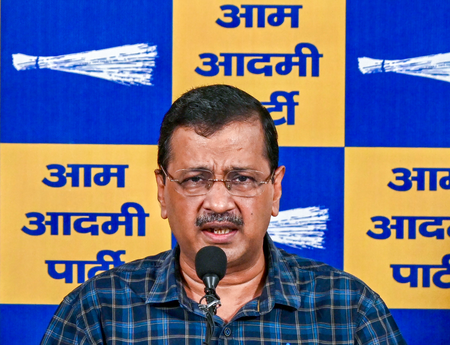
New Delhi, July 23 (IANS) — The Delhi Police issued a pointed message via its official X account on Thursday, directly criticizing Aam Aadmi Party (AAP) National Convenor Arvind Kejriwal for allegedly circulating rumors about an "impending crackdown" on students protesting at Jantar Mantar. In a swift and public response, police authorities categorically denied any plans for a forceful dispersal of the demonstration, particularly past midnight.
The official communication from law enforcement was a direct rebuttal to allegations that had begun to gain traction in public discourse, largely fueled by Kejriwal's social media activity. The police statement aimed to quell growing apprehension, asserting that no such operation was being contemplated. "There is no plan of Delhi Police to crack down on the ongoing protest tonight as is being conveyed," the message read, urging public figures like Kejriwal to exercise caution. "You are advised to refrain from spreading or circulating any misleading/unverified information." This directive underscored the police's concern over the potential for unverified claims to incite panic or further unrest among the demonstrators and the wider public.
The police's intervention came amidst a climate of heightened tension, following social media posts that had suggested a significant deployment of force was imminent against the students gathered at the prominent protest site near Parliament House.
Kejriwal's Social Media Activity Fuels Speculation
The controversy gained significant momentum following a series of posts made by AAP National Convenor Arvind Kejriwal on his official X account earlier on Thursday. These posts, which included sharing a specific document and posing a provocative question, were central to the Delhi Police's subsequent criticism.
Trader Advisory Shared Amidst Security Concerns
One key element of Kejriwal's social media activity was his decision to share a letter originating from the New Delhi Traders' Association. This advisory had been circulated among member shopkeepers in the bustling Connaught Place area, recommending that they close their establishments by 6:30 p.m. on Thursday evening. The sharing of such a letter by a prominent political figure, particularly in the context of ongoing protests, was perceived by many as a subtle, yet potent, signal of anticipated disruption or potential unrest.
Questioning Government's Intentions Towards Protesters
In a separate, more direct message posted on X around the same time, Kejriwal explicitly questioned the motives behind the security arrangements at Jantar Mantar. His post highlighted what he described as "intense security" and the presence of "piles of ambulances" at the protest site. He then posed a rhetorical question directly challenging the central government: "Will the Modi government once again brutally attack its own children at Jantar Mantar today?" This statement, laden with strong emotional language, was widely interpreted as an insinuation that a violent police action against the student demonstrators was not only possible but perhaps imminent, thereby contributing significantly to the rumors that the Delhi Police later sought to dispel.
BJP Leaders Accuse Opposition of Political Opportunism
The escalating situation at Jantar Mantar and the subsequent police statement also drew sharp condemnation from the ruling Bharatiya Janata Party (BJP). Delhi BJP President Harsh Malhotra launched a scathing critique of the opposition, including Arvind Kejriwal, accusing them of lacking genuine political vision and engaging in opportunistic tactics.
Questioning Opposition's Strategic Intent
In a detailed statement released to the media, Malhotra questioned the efficacy and intent behind the actions of prominent opposition figures. He specifically challenged leaders like Rahul Gandhi and Arvind Kejriwal, asking what tangible achievements they could claim from incidents involving alleged security breaches at sensitive locations such as the Prime Minister's residence and the Indian Parliament. This line of questioning suggested that the opposition's actions were not constructive but rather aimed at creating disruption or drawing attention through controversial means.
Malhotra further expressed his dismay that these leading political figures, instead of engaging in substantive debates, appeared to be "running away from discussions on specific policy issues affecting the nation." He asserted that this avoidance of policy-centric discourse highlighted a fundamental flaw in their approach. "The Opposition in the country today has no political vision," Malhotra declared, painting a picture of a political landscape devoid of meaningful alternatives. He went on to characterize these groups as merely "personality-driven parties" that, according to him, had been "rejected by voters over a 12-year period," implying a consistent lack of public mandate and a focus on individual leaders rather than collective ideology or policy.
Targeting Key Opposition Figures
Malhotra's criticism was not generalized but specifically targeted several high-profile opposition leaders. He named Rahul Gandhi, Arvind Kejriwal, Samajwadi Party Chief Akhilesh Yadav, and Shiv Sena-UBT President Uddhav Thackeray. Malhotra described these individuals as "defeated and frustrated leaders," suggesting a state of political despondency that informs their current strategies.
A central tenet of Malhotra's argument was the perceived disconnect between these leaders and the very demographic they were seemingly trying to champion. He contended that these politicians "lack any genuine connection with student politics." Despite this alleged detachment, Malhotra argued, these same figures were actively seeking to exploit the student activism for their own benefit. "Yet today, they see political gains in student politics," he stated, implying that their involvement at Jantar Mantar and similar venues was driven by a cynical pursuit of political advantage rather than a sincere commitment to the students' cause.
Mobile Internet Services Suspended Near Protest Site
Adding another layer of control and response to the volatile situation, the Union Home Ministry implemented a significant measure aimed at managing information flow and potential crowd coordination around the protest site. A directive was issued ordering the temporary suspension of mobile internet services in the vicinity of Jantar Mantar.
This interruption was specified to last for an eight-hour period, commencing from 4 p.m. on Thursday. The order precisely targeted the geographical areas surrounding Jantar Mantar, where a substantial number of students had gathered for their ongoing demonstrations. The rationale behind this pre-emptive measure was multifaceted.
Primarily, the suspension aimed to disrupt and prevent real-time coordination among the protesters, which could potentially lead to an escalation of the demonstration or organized resistance. Furthermore, it sought to effectively limit the rapid dissemination of unverified information, particularly concerning police movements or any potential crackdowns. In an environment already rife with rumors, as highlighted by the Delhi Police's earlier statement, controlling the spread of such information was deemed crucial to prevent the incitement of further unrest or panic among the demonstrators and the general public, before any official action could be taken by law enforcement agencies operating under government directives.