

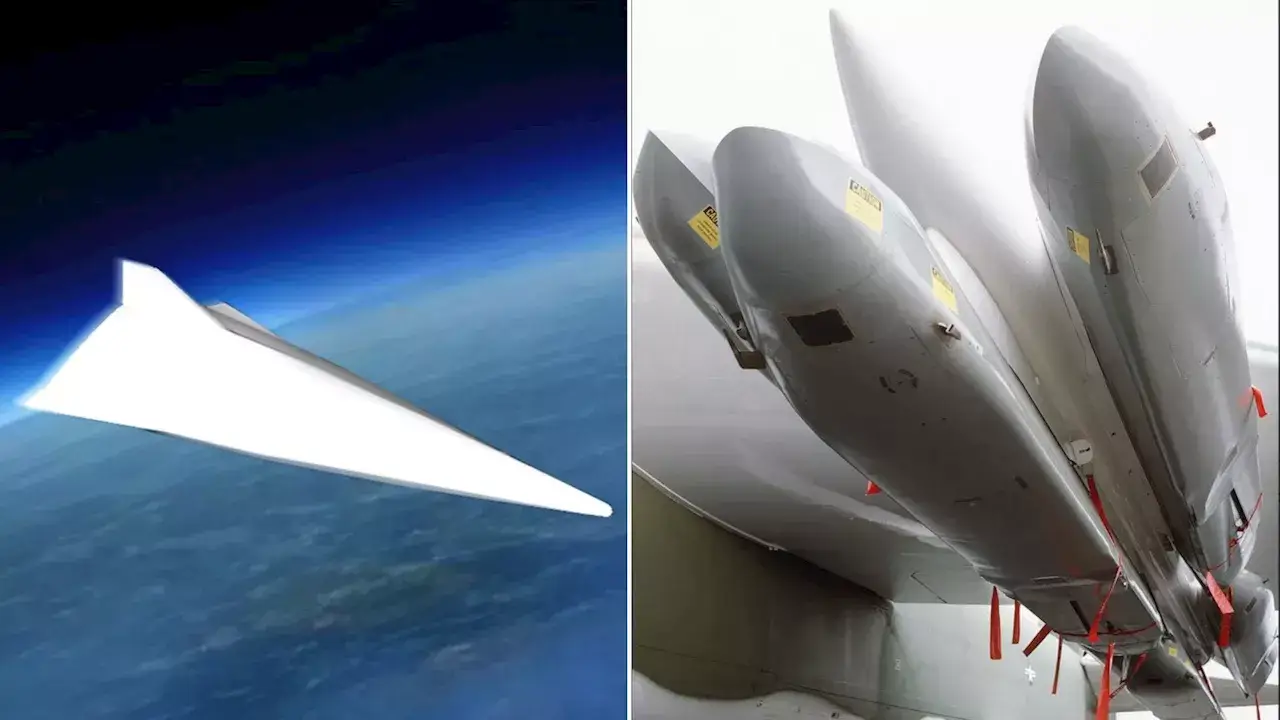

Propulsion Systems Define Weapon Classes
Hypersonic glide vehicles (HGVs) and hypersonic cruise missiles (HCMs) are designed to travel at speeds of Mach 5 or higher, which is at least five times the speed of sound. While both weapon types exceed this velocity threshold, their methods for achieving and sustaining flight differ fundamentally.
The primary distinction lies in their propulsion mechanisms. An HGV is accelerated by a rocket booster before it is released to glide toward its target. Once separated from the booster, the vehicle glides through the atmosphere without relying on a powered engine for sustained flight. In contrast, an HCM uses an air-breathing engine to generate thrust throughout its powered cruise phase, allowing it to sustain hypersonic flight.
The engineering requirements for these propulsion systems create different operational constraints. Hypersonic cruise missiles often rely on scramjet technology, which uses the missile's forward motion to compress incoming air before mixing it with fuel and igniting it. Because scramjets cannot operate efficiently from a standstill, a rocket booster or another propulsion system must first accelerate the missile to the required speed before the air-breathing engine takes over.
Flight Profiles and Maneuverability
The flight paths of these weapons further differentiate them from conventional ballistic missiles. An HGV functions as an aircraft-like body carried by a rocket booster to high speed. After release, it generates aerodynamic lift and can maneuver during its descent. This ability to change direction makes the trajectory of an HGV more difficult to predict than that of a traditional ballistic missile, which follows a relatively predictable arcing path.
Both HGVs and HCMs can maneuver during flight, a characteristic that complicates missile defense systems. Conventional ballistic missile defenses are designed to track relatively predictable trajectories, whereas the maneuverability of hypersonic threats disrupts these tracking capabilities. HGVs generally travel at high altitudes where the thinner atmosphere reduces drag, but their extreme speeds produce intense heating that requires specialized materials and guidance systems.
Operational Examples and Strategic Implications
Several prominent military programs illustrate the deployment of these distinct technologies. The DF-17 is a missile system specifically designed to carry a hypersonic glide vehicle, representing a key component in modern strategic arsenals. Similarly, Russia’s Avangard system utilizes an intercontinental ballistic missile to deliver a strategic glide vehicle intended for nuclear delivery.
In the realm of air-breathing hypersonic weapons, the US Air Force has developed the Hypersonic Attack Cruise Missile program as an example of efforts to create operational air-breathing hypersonic weapons. Prior experimental work in this domain includes the Boeing X-51A Waverider, which successfully demonstrated scramjet-powered hypersonic flight but remained an experimental demonstrator rather than an operational missile.
The combination of speed, maneuverability, and unique flight profiles presents significant challenges for existing defense architectures. While conventional ballistic missiles also reach hypersonic speeds during parts of their flight, the specific integration of these factors in hypersonic weapons creates a greater challenge for interception. Neither HGVs nor HCMs are invulnerable; however, the energy consumed by maneuvering and the substantial heating and drag produced during atmospheric flight remain critical engineering hurdles.
To counter these threats, the US Missile Defense Agency is actively developing the Glide Phase Interceptor, a system designed to engage hypersonic threats specifically during their glide phase. The complexity of these weapons extends beyond just the missile itself; historical contexts such as the mounting of six AGM-86B air-launched subsonic cruise missiles on B-52G Stratofortress aircraft highlight the evolution of launch platforms, though modern hypersonic systems require distinct delivery mechanisms to achieve their unique performance characteristics.