

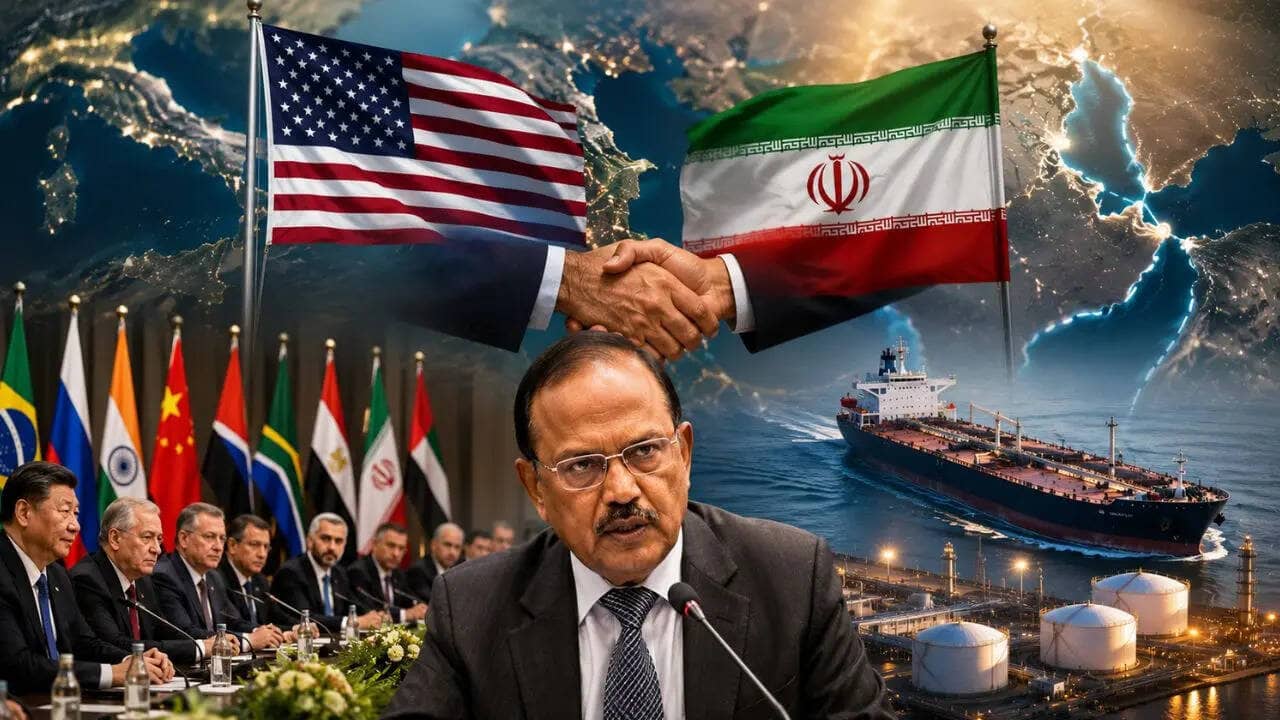

India Welcomes US-Iran Consensus on Regional Tensions
New Delhi has officially welcomed a consensus reached between the United States and Iran aimed at reducing tensions in West Asia. The statement was delivered by National Security Advisor Ajit Doval during a meeting of National Security Advisors from BRICS countries. According to reports, India expressed satisfaction with the diplomatic development, viewing it as a step toward stabilizing a region critical to global energy markets.
Doval addressed the gathering of security chiefs from Brazil, Russia, India, China, and South Africa, highlighting the broader implications of the US-Iran agreement. The Indian government’s position underscores its interest in de-escalation efforts that directly impact international trade routes and energy supplies. By publicly supporting the consensus, New Delhi signaled its alignment with diplomatic solutions to regional conflicts.
Strait of Hormuz Reopening Critical for Supply Chains
Ajit Doval asserted that the reopening of the Strait of Hormuz would provide significant benefits to the global economy. The National Security Advisor stated that this development would strengthen global energy security, a claim attributed directly to his remarks at the BRICS summit.
Impact on Oil and Essential Goods
Doval specified that the reopening of the strait is expected to reduce pressure on supply chains for oil, fertilizers, and other essential goods. The Strait of Hormuz serves as a vital chokepoint for global energy transport, and its accessibility is closely monitored by international markets. Doval’s comments linked the physical opening of the waterway directly to the alleviation of logistical pressures faced by nations dependent on these imports.
The assertion implies that current restrictions or tensions affecting the strait have contributed to supply chain vulnerabilities. By stating that the reopening would alleviate these pressures, Doval identified a direct correlation between geopolitical stability in West Asia and the operational efficiency of global commodity markets.
BRICS Role Amidst Geopolitical Challenges
Addressing the broader security landscape, Doval emphasized the necessity of multilateral cooperation. He outlined a backdrop characterized by ongoing geopolitical tensions, persistent economic challenges, and emerging security threats. In this context, he argued that coordinated action among nations is essential to maintain stability.
Strategic Importance of Multilateralism
Doval highlighted the crucial role that BRICS plays in addressing these global challenges. He stated that the bloc is positioned to contribute significantly to resolving the complex issues facing the international community. The remarks were made during a session focused on collective security strategies, where Doval advocated for unified approaches rather than isolated national responses.
The National Security Advisor’s speech framed BRICS not merely as an economic coalition but as a strategic entity capable of influencing global security dynamics. By linking the organization’s utility to the resolution of immediate crises such as those in West Asia, Doval reinforced the group’s relevance in contemporary diplomatic discourse.
Implications for Global Energy Security
The discussion on energy security was central to Doval’s address. He connected the stability of the US-Iran relationship directly to the robustness of global energy infrastructure. The statement that global energy security would be strengthened by the consensus between Washington and Tehran reflects India’s strategic interest in uninterrupted energy flows.
India, as one of the world’s largest importers of crude oil, has a vested interest in the smooth operation of maritime routes through the Middle East. Doval’s comments at the BRICS meeting served to articulate this national interest within a multilateral framework, suggesting that regional peace is a prerequisite for economic prosperity.
The National Security Advisor did not provide specific timelines for the implementation of the US-Iran consensus or the reopening of the Strait. However, his assertions regarding the economic benefits were presented as immediate expectations contingent upon the fulfillment of diplomatic agreements. The remarks underscored the interdependence of political stability and economic performance in the current global order.