

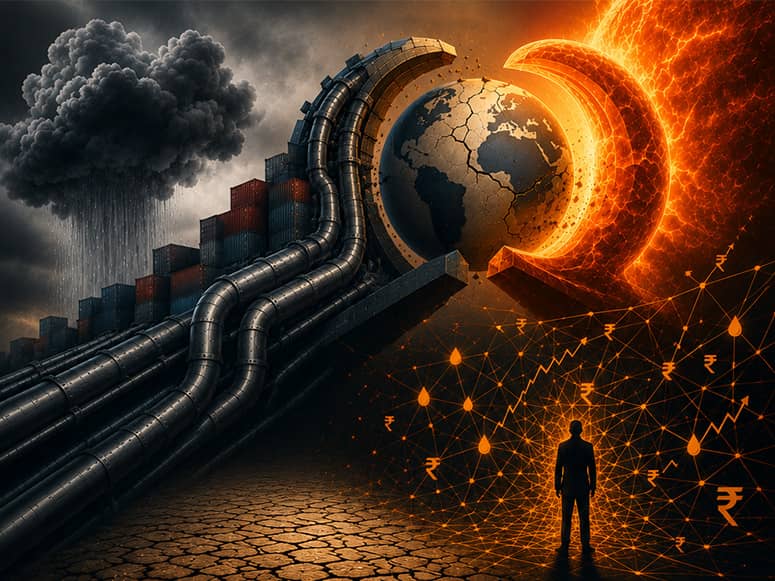

Geopolitical Shifts Driven by Policy and Conflict
The international order has undergone significant alteration due to a combination of economic policies and military actions, according to reporting by K T Jagannathan. In an article published on July 1, 2026, titled "El Nino, A Bigger Worry!" for the publication Industrial Economist, Jagannathan described a landscape where nation-states are facing unprecedented pressure from multiple simultaneous crises.
Jagannathan wrote that problems rarely occur in isolation, highlighting how global events intertwine to create complex challenges. He noted that just as the world was processing the impact of trade policies orchestrated by U.S. President Donald Trump regarding tariffs, the geopolitical arena was simultaneously reshaped by military conflict. The author characterized these developments as a "wide oscillation" on the tariff front, marked by significant economic disruption, and an "extraordinarily unilateral and largely avoidable one-sided war initiated by Uncle Sam against Tehran in West Asia."
According to Jagannathan, these two distinct events—the aggressive trade disputes and the military engagement—have "completely reset the geopolitical playing arena." The convergence of these trade tensions and regional warfare has created a complex environment where uncertainties are pervasive, affecting global stability and economic forecasts. The author stated that this combination has pushed nation-states into what he described as a "pincer-like situation," leaving them with limited strategic options and forcing difficult choices in an increasingly unpredictable world.
The article suggests that world leaders are currently struggling to navigate this new reality, which is defined by a lack of clear pathways forward. Jagannathan wrote that leaders are "at their wits’ end to discover a solution to quickly wriggle out of the cobweb." This imagery underscores the profound difficulty of addressing these overlapping crises, noting that as attention turns to critical climate phenomena like El Niño, it collides with existing geopolitical instability, further complicating the search for effective governance and diplomatic solutions.
Recurring Cycles of Global Instability
The notion that current disruptions are part of a recurring cycle is supported by analysis from Zaki Laïdi. In an opinion piece published on June 29, 2026, in the Bangkok Post titled "International disorder follows a familiar pattern," Laïdi argued that the current state of global diplomacy reflects established historical precedents rather than being an entirely novel phenomenon. This perspective suggests that while the specifics of contemporary crises may differ, the underlying dynamics of international disorder often echo past periods of instability.
Laïdi pointed to the diplomatic interactions between the United States and Iran as a primary example of this pattern. He described the diplomacy between U.S. President Donald Trump's administration and Iran as "shambolic," indicating a chaotic and ineffective approach that contributed to heightened tensions. This specific diplomatic breakdown, Laïdi suggested, is not an anomaly but rather a manifestation of a familiar pattern of international disorder, where unilateral actions and a lack of coherent strategy lead to predictable escalations and widespread instability.
Diplomatic Failures and Regional Fallout
The tangible consequences of this "shambolic diplomacy" and broader geopolitical failures were starkly illustrated through referenced reporting. Laïdi's article referenced reporting from David Guttenfelder of The New York Times, which documented the remains of a destroyed street in Mayfadoun, Lebanon, on June 22. This destruction followed recent fighting between Israel and Hezbollah, serving as a powerful visual testament to the real-world impact of diplomatic breakdowns and regional conflicts. This imagery was used to illustrate the tangible consequences of broader diplomatic failures, emphasizing how political rhetoric and policy decisions translate into human suffering and physical devastation on the ground.
The article implies that the chaos observed in West Asia, exemplified by such events, is consistent with previous cycles of geopolitical instability. Laïdi's analysis suggests that when major powers engage in unilateral actions and diplomacy falters, the resulting disorder often follows a recognizable trajectory, leading to regional conflicts and a pervasive sense of insecurity that impacts numerous stakeholders beyond the immediate combatants.
Climate Pressures Amidst Political Turmoil
The Industrial Economist article further explores the intersection of environmental factors and political turmoil, underscoring how these distinct challenges converge to exacerbate global difficulties. Jagannathan noted that the world must contend with both climatic events and geopolitical shocks simultaneously, creating a layered crisis that demands attention on multiple fronts. The very title of his article, "El Nino, A Bigger Worry!", indicates a focus on how climate oscillations, such as the El Niño phenomenon, compound existing political and economic difficulties, adding another layer of complexity to an already strained international system.
While the Industrial Economist piece emphasizes the immediate shock of tariff policies and the war in West Asia, framing them as direct catalysts for current disorder, the Bangkok Post article contextualizes these events within longer-term diplomatic trends. Laïdi's analysis suggests that the "shambolic diplomacy" leading to conflict is a recognizable feature of international relations, particularly when major powers engage in unilateral actions that disrupt established norms and create power vacuums or confrontational environments.
Intersecting Crises and the Search for Solutions
Both sources indicate that the current period is defined by a profound lack of clear solutions, leaving world leaders grappling with interconnected problems. Jagannathan’s assertion that leaders are searching for ways to escape the "cobweb" aligns with Laïdi’s observation that disorder follows a pattern, implying that breaking the cycle requires more than temporary fixes or isolated policy adjustments. The reporting from both publications underscores a global environment where economic policy, military conflict, and environmental shifts are deeply intertwined, creating a landscape of widespread uncertainty for nation-states and their populations. This intricate web of challenges necessitates a comprehensive and coordinated approach, which leaders are currently struggling to formulate amidst the ongoing instability.