

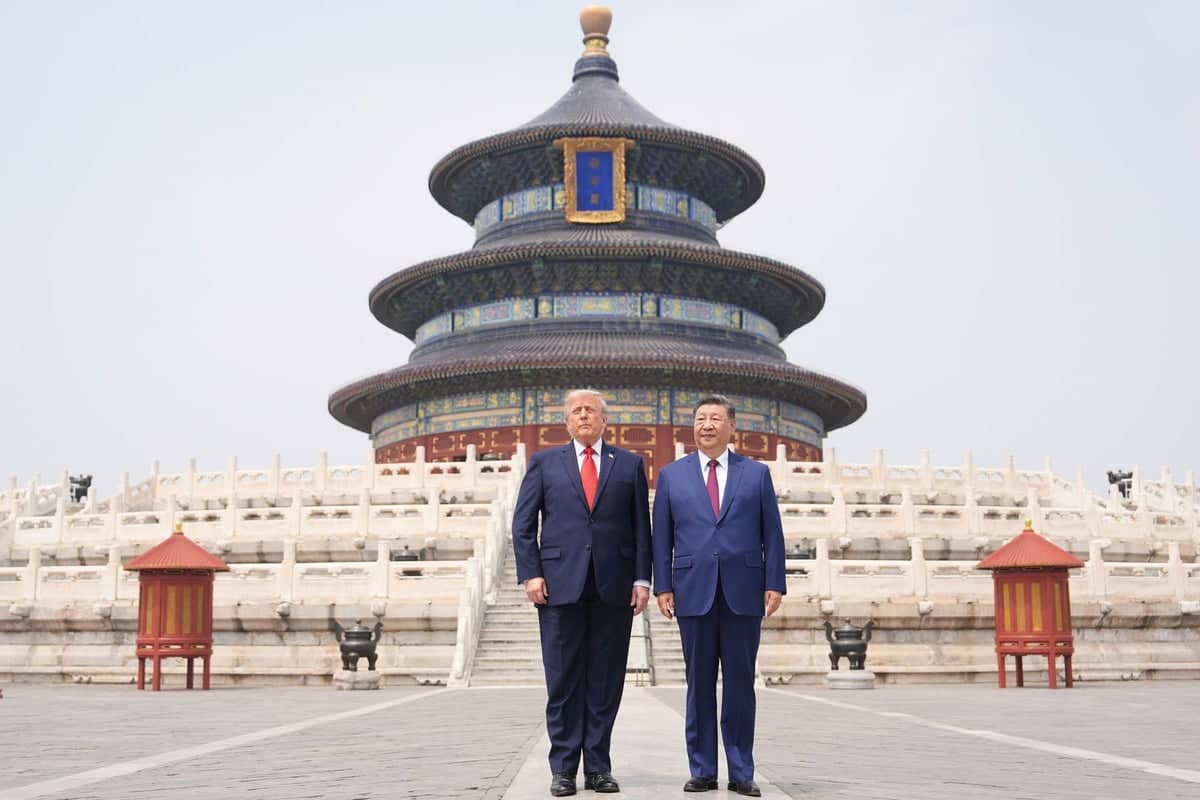

Economist Esmond Birnie on Geopolitical Dynamics
Economist Esmond Birnie has put forth an analysis suggesting that policies associated with Donald Trump's "Make America Great Again" (MAGA) agenda may be contributing to an acceleration of China's global influence. Concurrently, Birnie indicates that these same policies could be hastening a decline in the United States' position as a global superpower. His analysis underscores the inherent complexities of superpower summits, even when addressing seemingly technical economic matters such as exchange rates and trade deficits.
Birnie's Analysis of MAGA Policies and Global Impact
Birnie's perspective centers on how specific tenets often attributed to the MAGA framework—primarily a focus on domestic interests, protectionist trade measures, and a re-evaluation of international alliances—could have unintended geopolitical consequences. He posits that while these policies are designed to bolster American strength and prosperity, their execution might inadvertently create conditions that benefit competing global powers, particularly China.
According to Birnie, a key aspect of this dynamic lies in trade policy. Policies characterized by the imposition of tariffs and a general move towards protectionism, while aimed at safeguarding domestic industries, could lead to a restructuring of global supply chains. Birnie suggests that such shifts might prompt other nations to seek alternative trade partners and economic frameworks, potentially strengthening China's role as a central hub in a reconfigured global economy. This reorientation, he argues, could enhance China's economic leverage and diplomatic standing on the international stage.
Potential Acceleration of China's Global Influence
Birnie's analysis further elaborates on how a perceived reduction in the United States' engagement with multilateral institutions and international agreements, often associated with an "America First" approach, could create strategic vacuums. He suggests that China has demonstrated a willingness to fill such voids, expanding its influence in areas where the U.S. might retract. This could manifest in increased Chinese leadership in international organizations, greater participation in global governance frameworks, and the expansion of its economic initiatives, such as the Belt and Road Initiative, into regions previously dominated by Western influence.
Furthermore, Birnie indicates that a strain on traditional alliances, resulting from a more transactional approach to international relations, could diminish the collective power and cohesion of blocs that have historically served as counterbalances to rising powers. He suggests that if allies perceive a weakening of commitment from the United States, they may seek to diversify their diplomatic and economic relationships, potentially gravitating towards China as an alternative partner. This fragmentation of alliances, Birnie argues, could indirectly contribute to China's ability to project power and influence globally without facing a unified front.
Implications for the United States' Superpower Status
Regarding the United States' superpower status, Birnie's analysis suggests that the long-term effects of MAGA policies could include a gradual erosion of its global leadership. He points to several factors, including potential economic isolation if protectionist measures lead to retaliatory tariffs and reduced market access for U.S. goods and services. Such economic shifts, Birnie argues, could impact American competitiveness and innovation, which are fundamental pillars of its superpower standing.
Moreover, Birnie highlights the importance of soft power and diplomatic credibility. He suggests that a perceived withdrawal from international cooperation, a questioning of established norms, and a focus on unilateral action could diminish the United States' moral authority and its ability to rally international consensus on critical global issues. This, in turn, could reduce its effectiveness in shaping global agendas and responding to transnational challenges, thereby weakening its overall influence.
Birnie concludes that the complex interplay of these factors—economic reorientation, shifts in alliance dynamics, and changes in diplomatic engagement—could collectively contribute to a geopolitical environment where China's ascent is accelerated, while the United States experiences a relative decline in its long-held position as the preeminent global superpower. He emphasizes that the outcomes of superpower interactions are rarely straightforward, a reality evident even in historical summits dealing with specific economic parameters.