


Shifting Priorities in African Diplomacy
African countries are redirecting their diplomatic focus from European Union-championed political governance frameworks toward economic pragmatism offered by emerging powers, according to a recent analysis by Modern Diplomacy. This shift reflects a broader realignment in how the continent engages with global partners as the international order becomes more multipolar.
Beijing views a multipolar world with Africa at its heart as a strategic means to counter Western influence on the continent. Through the BRICS coalition and the Global South, China seeks to challenge perceived Western hegemony by expanding its influence across Africa’s political, information, cultural, and education spaces.
African nations are actively seeking strategic partnerships that prioritize economic pragmatism over traditional political governance conditions. These emerging relationships favor models based on trade, large-scale infrastructure development, and non-interference in internal affairs. This approach contrasts with the EU’s traditional stance, which demands political governance, respect for human rights, and democratic reforms.
The analysis suggests that the EU’s traditional approach is losing influence due to structural limitations. To remain a leading partner, the European Union must abandon what it describes as a patronizing stance and build relationships on an equal footing centered on mutually beneficial strategic investments.
Global Gateway Investment Package
In response to these geopolitical shifts, the European Commission has positioned its Global Gateway initiative as a core component of its strategy. The Africa-Europe Investment Package aims to support Africa’s strong, inclusive, green, and digital recovery by accelerating green and digital transitions, fostering sustainable growth, creating decent jobs, and strengthening health systems and education.
The European Commission and World Bank Group are deepening their strategic partnership to drive connectivity projects. An initial pipeline includes 18 high-impact investments in energy, transport, and digital infrastructure across Africa, Asia, and other regions.
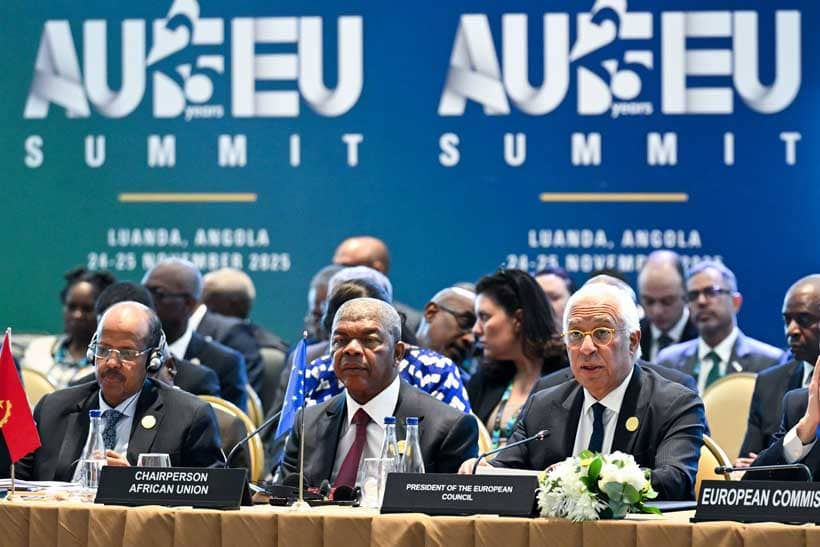
At the 3rd EU-AU Ministerial Meeting, institutions reviewed progress on joint commitments from the 2022 Summit and the Global Gateway Europe-Africa Investment package. A first milestone of the Global Gateway was an Africa-Europe Investment Package with approximately €150 billion dedicated to strengthening partnerships with Africa.
FurtherAfrica reports that the EU has committed €400 billion through the Global Gateway initiative to transform Africa’s economic landscape. Transport corridors announced in February 2022 at the EU-AU summit are currently operational in over 30 African countries as part of the Global Gateway strategy to boost connections in digital, energy, and transport sectors.
Financial Deployment and Strategic Links
The European Investment Bank Group has significantly increased its financial footprint in the region, deploying more than €9 billion through EIB Global in 2025. Africa received €3.1 billion of this total, with funds primarily directed toward SME credit lines and venture capital funds to support local business ecosystems.
Strategic alignment between European digitalization efforts and resource needs was highlighted at a June 2025 High-Level Summit in Rome on 'The Mattei Plan for Africa and Global Gateway'. European Commission President Ursula von der Leyen underscored the strategic link between Africa’s digitalization and Europe’s demand for critical raw materials during this event.
As African nations continue to shift focus from EU-championed political governance toward economic pragmatism offered by emerging powers including China, India, Brazil, Turkey, the United Arab Emirates, Saudi Arabia, and Malaysia, the EU’s ability to maintain influence depends on delivering tangible economic outcomes through initiatives like Global Gateway.