

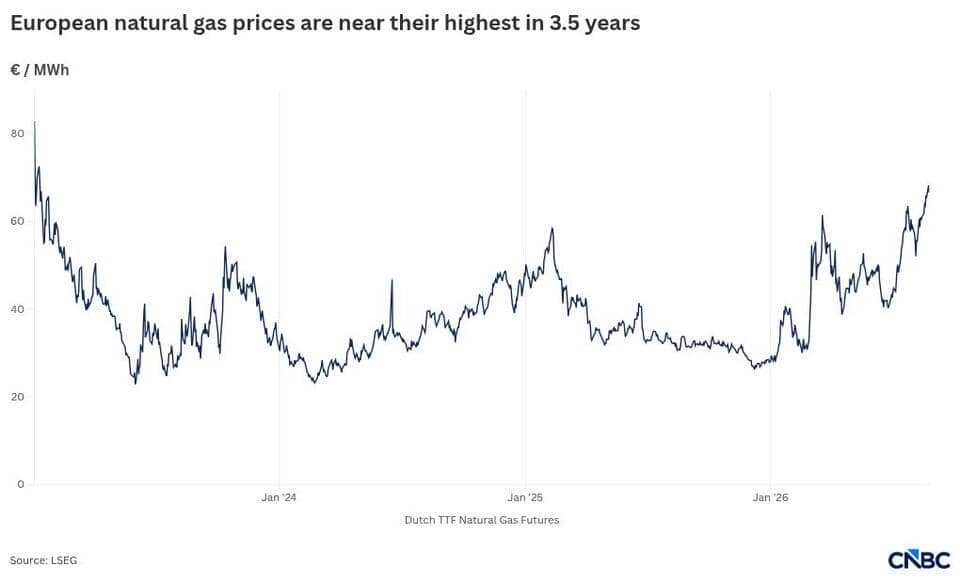

Storage Levels Drop Ahead of Heating Season
Europe’s natural gas storage facilities are currently running low, prompting concerns among market observers regarding the region's ability to meet demand during the upcoming winter months. The depletion of these reserves has become a focal point for analysts monitoring the energy sector, as the continent prepares for the seasonal surge in consumption typically associated with colder weather.
According to reports, the current inventory levels are insufficient to guarantee comfort without potential price volatility. This situation mirrors concerns raised during previous periods of supply constraint, where low storage was cited as a primary indicator of market tightness. The timing of this depletion raises questions about how effectively the European Union has managed its gas supplies following the significant disruptions that occurred in recent years.
Price Predictions Signal Return to Crisis-Era Levels
Analysts have issued warnings that European natural gas prices could exceed 100 euros per megawatt-hour this winter. Such price levels represent a significant threshold, as they have not been seen since the energy crisis triggered by the Russia-Ukraine war in 2022. The prediction suggests a potential return to the high-cost environment that characterized the peak of the geopolitical conflict's impact on European energy markets.
Natural gas remains a critical commodity for both European industries and consumers. The potential spike in prices would directly affect heating costs for households and operational expenses for manufacturing sectors across the continent. Market participants are closely watching these forecasts, as they indicate the severity of the supply-demand imbalance that may develop if storage levels do not recover or if demand exceeds expectations.
Market Dynamics and LNG Requirements
The forecasted price increase is linked to specific market mechanics required to secure adequate fuel supplies. Higher prices may be necessary to attract sufficient flexible Liquefied Natural Gas (LNG) from the United States to Europe. This economic incentive is viewed by analysts as a key mechanism for diverting enough U.S. LNG flows away from other global markets and toward European buyers.
Without competitive pricing, suppliers may opt to direct their flexible cargo capacity to regions offering better returns or more stable long-term contracts. The reliance on spot market purchases and flexible LNG cargoes highlights the continued vulnerability of European gas supplies to global competition. Analysts suggest that the cost of securing this alternative supply chain will likely be passed through to the final price paid by end-users.
Historical Context of Energy Volatility
The mention of prices returning to levels not seen since 2022 places current market conditions in a specific historical framework. The Russia-Ukraine war initiated a profound shift in European energy procurement strategies, leading to the rapid construction of LNG terminals and long-term supply agreements with non-Russian partners. Despite these structural changes, the current low storage levels indicate that the continent remains exposed to global price fluctuations.
The comparison to the 2022 crisis underscores the potential severity of the upcoming winter. During that period, prices reached unprecedented highs due to fears of complete supply cutoffs. While the current situation does not necessarily imply a total embargo or physical shortage of the same magnitude, the financial implications for consumers and industry could be similar if the predicted price ceiling is breached.
Implications for Industry and Consumers
The potential for natural gas prices to top 100 euros per megawatt-hour carries direct economic implications. For industrial users, high energy costs can reduce competitiveness and lead to reduced production or relocation of operations outside the region. For consumers, rising wholesale prices often translate into higher bills for heating and electricity generation, impacting household budgets across Europe.
Analysts warn that European natural gas prices are vital to both industry and consumers, emphasizing the broad reach of this commodity. The market's response to these warnings will likely involve continued scrutiny of storage injection rates, weather forecasts, and geopolitical developments affecting global LNG trade routes. The coming months will serve as a test of the resilience of Europe's post-crisis energy infrastructure and its ability to manage costs in a competitive global market.