


Rabuka’s Statement on Military Role in Constitutional Process
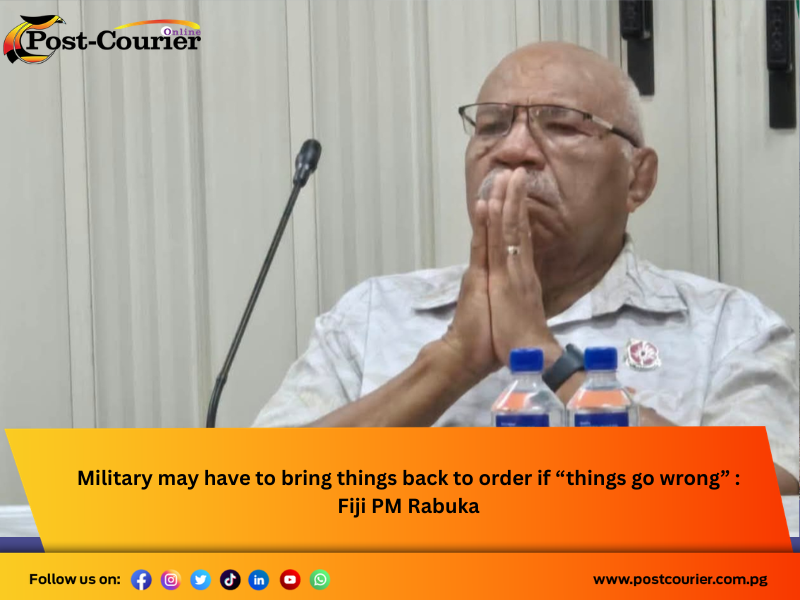
Fiji Prime Minister Sitiveni Rabuka has suggested that the military could be called upon to restore order if "things go wrong" during the country’s ongoing constitutional process. The remarks were made last week when Rabuka addressed Major-General Ro Jone Kalouniwai, the Commander of the Republic of Fiji Military Forces (RFMF), in Parliament.
Rabuka told the Commander directly: “Because if things go wrong, either you or your successor will have to bring it back to order.” The statement was delivered shortly before Major-General Kalouniwai presented the military’s formal submission to the Special Parliamentary Committee reviewing the Constitution Amendment Bill.
In his address, Rabuka welcomed the RFMF Commander’s presence and noted that the military’s submission would form part of the considerations before the parliamentary committee. He stated that Parliament is opening its doors to listen to people and consider their views on the supreme law, aiming for a Constitution that stands for generations.
Rabuka referenced previous constitutional consultations involving the Great Council of Chiefs and the late Jai Ram Reddy as examples where people’s voices were heard during prior efforts to shape the nation’s legal framework.
Opposition Criticism and Historical Context
The Prime Minister’s comments drew immediate criticism from Fiji Labour Party leader Mahendra Chaudhry, who described Rabuka’s remarks about the military restoring order as either careless or calculated. Chaudhry stated that neither characterization was acceptable from a Prime Minister pressing for a new constitution.
Chaudhry demanded an explanation from Rabuka regarding the comments made to Major-General Kalouniwai during proceedings of the Special Parliamentary Committee examining the Constitution (Amendment) Bill 2026. He questioned the significance of Rabuka’s statement given Fiji’s history of military intervention, noting that Rabuka was present at the camp in 2000 and led events of 1987.
Chaudhry also questioned whether Rabuka was acknowledging section 131 of the 2013 Constitution, which gives the military overall responsibility for security, defence, and well-being. He raised concerns that this could potentially invite the Force to treat itself as the enforcer of the constitution.
Additionally, Chaudhry questioned whether Rabuka’s reference to a successor carried a warning for the serving Commander regarding future accountability or operational expectations.
Military Submission Rejects Constitutional Immunity
Amidst the political debate, Major-General Kalouniwai clarified the military’s stance on legal protections. He declared that the RFMF did not want constitutional immunity proposed in the Bill and confirmed that the Force signed a declaration rejecting such immunity.
The Commander stated that the military was preparing to cooperate with lawful accountability processes rather than seeking protection from them. This position was outlined in his formal submission to the Special Parliamentary Committee, which aimed to address past controversies surrounding the armed forces.
Acknowledging Past Coups and Recommending Reform
In his submission, Major-General Kalouniwai acknowledged the military’s involvement in the events of 1987, 2000, and 2006. He did not shy away from these historical episodes, instead using them to justify structural changes within the nation’s legal framework.
To address these past interventions, the Commander recommended replacing Chapter 14 of the Constitution with a Truth, Accountability and Reconciliation Commission. This recommendation was part of the RFMF’s broader effort to align its role with democratic principles and ensure that future constitutional arrangements do not provide cover for military overreach.
Implications for Civil-Military Relations
The intersection of Rabuka’s comments and the military’s submission has intensified scrutiny on Fiji’s civil-military relations. Chaudhry’s demand for an explanation highlights ongoing tensions regarding the appropriate boundaries between elected officials and the armed forces.
By referencing section 131 of the 2013 Constitution, Chaudhry pointed to the legal basis for military authority but warned against interpretations that could expand that power into constitutional enforcement. The debate underscores the sensitivity of defining the military’s role in a democracy with a history of coups.
As the Special Parliamentary Committee continues its review of the Constitution (Amendment) Bill 2026, the RFMF’s rejection of immunity and Rabuka’s warnings about potential chaos remain central to the discussion. The outcome of these proceedings will likely influence how Fiji balances security needs with democratic accountability in the coming years.