

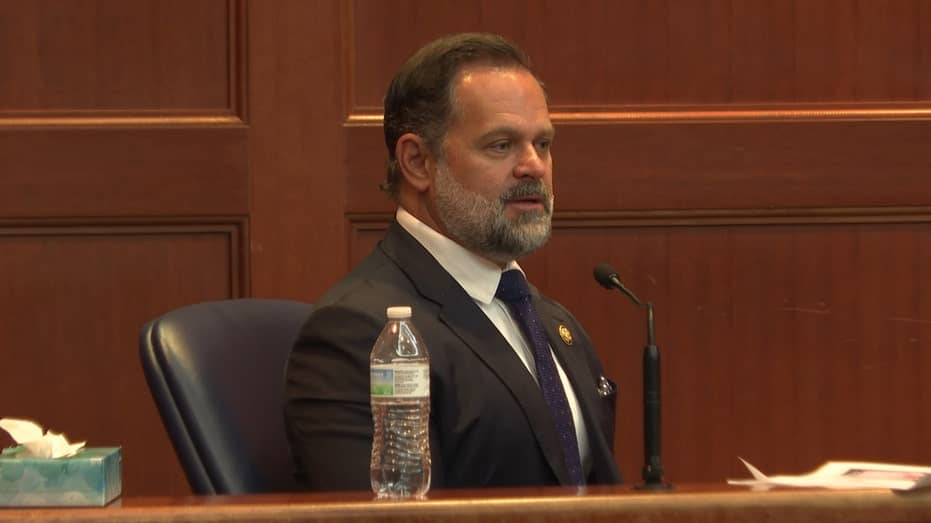

Florida Judge Rejects Ballot Challenge Based on Notarization
A Florida Circuit Court Judge, J. Lee Marsh, has dismissed a lawsuit that sought to remove U.S. Representative Cory Mills from the Republican primary ballot, ensuring the incumbent congressman will remain on the ballot for the August election. The ruling allows Representative Mills to continue his campaign for Florida's 7th Congressional District, which includes Seminole County and parts of Volusia County.
The legal challenge was filed by Michael Johnson, a Republican challenger vying for Mills' seat. Johnson's lawsuit contended that Representative Mills' candidate qualifying paperwork was improperly notarized in Washington, D.C., instead of within Florida, as Johnson argued was required. This challenge was specifically based on a new state law concerning candidate eligibility, which established a process for questioning a candidate's right to appear on an election ballot.
Legal Arguments Over Candidate Paperwork
During the proceedings, Judge Marsh meticulously reviewed the arguments presented by both the challenger and Representative Mills' legal team. The central point of contention revolved around the interpretation of the recently enacted state law. Johnson's campaign asserted that the law's provisions extended to procedural aspects of candidate qualification, such as the geographical location of notarization for official documents.
However, Judge Marsh ultimately determined that the new statute applies exclusively to constitutional qualifications for holding office. These fundamental requirements typically encompass criteria such as a candidate's age, their residency within the district they seek to represent, and other foundational eligibility standards established by the constitution. The judge explicitly ruled that issues deemed 'procedural' in nature, such as the specific location where qualifying paperwork receives notarization, do not fall under the purview of this particular state law. Therefore, such a procedural discrepancy does not constitute a valid basis for disqualifying a candidate from the ballot.
This interpretation by Judge Marsh means that despite the challenge regarding the notarization location, Representative Mills' eligibility for the August primary election remains intact, allowing him to continue his campaign for reelection.
Challenger Plans Appeal After Dismissal
Following Circuit Court Judge J. Lee Marsh's decision to dismiss the lawsuit, attorneys representing Michael Johnson confirmed that their campaign intends to appeal the ruling. This indicates that the legal battle over the interpretation of Florida's new candidate eligibility law and its application to procedural requirements is far from over.
The attorney for Mr. Johnson emphasized that despite the initial dismissal, the challenger's team remains committed to pursuing the matter through the appellate courts. The appeal will likely focus on challenging Judge Marsh's interpretation of the state law, specifically arguing that the statute should indeed encompass procedural aspects of candidate qualification, including the location of notarization, rather than being limited solely to constitutional eligibility criteria.
This planned appeal ensures that the legal scrutiny surrounding Representative Mills's ballot qualification will continue, even as the primary election approaches.
Congressman Mills Faces Multiple Ethics Probes and Personal Allegations
The dismissal of the ballot challenge comes amidst a broader landscape of legal and ethical scrutiny surrounding Representative Cory Mills. Beyond the primary election contest, the congressman is currently the subject of a significant investigation by the U.S. House Ethics Committee, alongside a separate legal action involving a temporary restraining order.
U.S. House Ethics Committee Inquiry
The U.S. House Ethics Committee has initiated an inquiry into allegations against Representative Mills. This investigation focuses on claims of potential campaign finance violations, which can involve a range of issues from improper use of funds to undisclosed donations. Concurrently, the committee is also examining allegations of sexual misconduct. Such investigations by the Ethics Committee are serious matters, as they delve into the conduct of members of Congress and can result in various sanctions if violations are found to be substantiated.
Temporary Restraining Order Details
In a separate legal development, Representative Mills is subject to a temporary restraining order (TRO) obtained by a former girlfriend. The individual who secured this legal injunction has accused the congressman of threatening to release sexually explicit videos. A temporary restraining order is a court order issued to protect a person from violence, harassment, or threats, and it typically prohibits the restrained party from contacting or approaching the petitioner. The existence of such an order highlights a serious personal legal challenge for the congressman.
Representative Mills Denies All Accusations
Throughout these various legal and ethical challenges, Representative Cory Mills has consistently and emphatically denied all allegations made against him. His denials encompass the specific accusations of threatening to release explicit videos, which led to the temporary restraining order, as well as the broader claims of campaign finance violations and sexual misconduct currently under review by the U.S. House Ethics Committee. Mills has maintained his innocence across the spectrum of these serious allegations.