

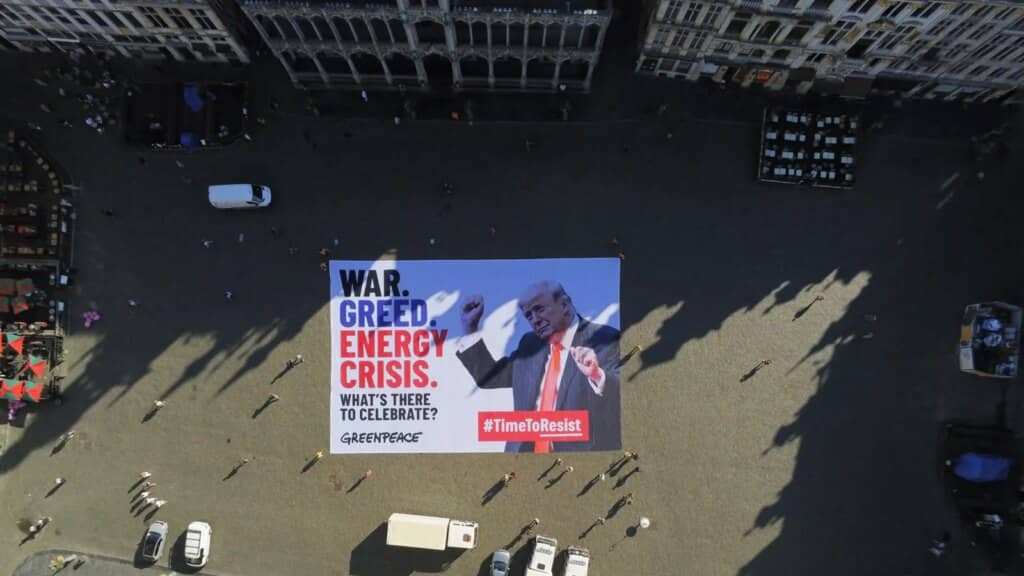

Large Scale Protest Descends on Historic Square
Greenpeace Belgium activists unfurled a massive banner across Brussels’ Grand Place on Sunday morning, directing pointed criticism toward the Trump administration. The sheer scale of the 600-square-metre display ensured maximum visibility, positioned prominently in the historic square ahead of celebrations marking the 250th anniversary of the United States later that day.
The Grand Place, a UNESCO World Heritage site renowned for its opulent guildhalls and central role in Belgian history, served as a powerful and symbolic backdrop for Greenpeace Belgium's dramatic intervention. The timing was deliberately chosen to coincide with an event typically associated with diplomatic goodwill and historical reflection, allowing Greenpeace to inject a starkly different narrative into the proceedings.
The banner featured text in English reading: "War. Greed. Energy Crisis. What’s there to celebrate?" This direct message encapsulated Greenpeace's multi-faceted critique, pointing to perceived global instability, economic exploitation, and environmental degradation, all attributed by the organization to the Trump government's political and economic agenda. According to the organization, the action was specifically designed to denounce this agenda.
The protest occurred during a period of intense weather conditions in Belgium, as the country grappled with a severe and deadly heatwave. Joeri Thijs, a spokesperson for Greenpeace Belgium, underscored the profound irony and inappropriateness of hosting what he termed a "lavish celebration" at such a time. He specifically condemned local authorities for extending a welcome to a government whose policies are widely characterized as "climate-sceptic," arguing that such an embrace sent a contradictory message amidst a climate crisis.
Thijs stated, "Trump destabilises global geopolitics, which threatens us all. It’s high time that European and Belgian leaders refuse to bow to his intimidation." These strong words articulated a broader call for European autonomy and principled leadership. The spokesperson's comments were part of the organization's broader effort to challenge the diplomatic engagements taking place during the anniversary commemorations, framing the protest not just as an environmental action but as a geopolitical warning, urging European nations to resist perceived pressures from the US administration.
Concerns Over Energy Dependency and Climate Policy
Beyond the immediate political criticism, Greenpeace expressed specific concerns regarding Europe’s growing reliance on imported US shale gas, a development it views as deeply problematic. The organization argued that aligning with the Trump administration through such energy ties directly jeopardizes the European Union’s ambitious climate targets and undermines its climate ambitions.
In its statement, Greenpeace asserted that such alignment increases dependency on leaders with "damaging policies." By fostering reliance on an administration whose environmental stance is widely criticized, Europe risks locking itself into an energy future incompatible with its stated climate goals, particularly those enshrined in the European Green Deal. The group framed the protest as a potent warning against economic and political ties that they claim undermine long-term environmental goals within Europe, prioritizing short-term gains or diplomatic expediency over long-term environmental sustainability.
The timing of the banner display also coincided with broader regional energy discussions and pressing environmental challenges. The EU Council had recently backed modernised energy grid rules, aiming to tackle issues of congestion and enhance the resilience of the continent's power infrastructure. This move, designed to future-proof Europe's energy supply, contrasted sharply with Greenpeace's concerns about reliance on fossil fuel imports from a climate-sceptic administration. Meanwhile, the immediate pressures of the heatwave were palpable, with electricity consumption in Brussels rising by 11%, highlighting the urgent need for robust and sustainable energy solutions.
Geopolitical Implications of Anniversary Events
The protest took place against a backdrop of heightened geopolitical scrutiny. The presence of high-ranking officials, including Belgian Prime Minister Bart De Wever, at the US anniversary events drew significant attention from both supporters and critics of the diplomatic schedule, amplifying the political stakes of the occasion.
Greenpeace’s actions were intended to draw public attention to what the group characterizes as profound contradictions between celebrated democratic milestones and current policy directions. The organization’s spokesperson emphasized the critical need for European leaders to maintain independence from what they described as intimidation tactics by the US administration, advocating for a foreign policy rooted in shared climate values rather than perceived political pressure.
The event also skillfully intertwined global policy critiques with pressing local environmental challenges. Brussels itself has been identified as significantly hotter than its surrounding countryside, a phenomenon exacerbated by the ongoing heatwave. Activists utilized the highly visible Grand Place as a platform to connect these tangible local climate impacts directly to broader international policy decisions, arguing that welcoming climate-sceptic leaders perpetuated the very conditions harming the city's residents.
Reactions and Official Presence
The anniversary celebrations drew notable figures to Brussels, making the protest all the more impactful. Greenpeace explicitly mentioned the attendance of Prime Minister Bart De Wever as a key element of its critique. For the environmental organization, his presence at the US anniversary celebrations implicitly validated a government whose policies on climate, international relations, and energy were diametrically opposed to Greenpeace's core values. This diplomatic engagement, in their view, lent legitimacy to an administration they sought to denounce.
While the banner display generated significant media attention, initial reports did not include any immediate official response from either the Belgian Prime Minister’s office or the US administration. This silence, in itself, became part of the narrative, leaving Greenpeace's criticisms to resonate without direct counter-argument in the immediate aftermath of the protest. The focus remained squarely on Greenpeace’s stated objectives: to denounce the US political agenda and to highlight concerns over energy dependency and climate policy alignment.
The protest concluded with the removal of the massive banner, but the organization maintained that its underlying message — concerning the fundamental incompatibility of the current US leadership's agenda with Europe's climate goals and geopolitical stability — remained critically relevant. The event underscored the ongoing tensions between traditional diplomatic commemorations and the increasingly vocal critiques from activist groups challenging foreign policy alignments on environmental and ethical grounds.