Full story
Coalition Forms to Counter USCIRF Criticism
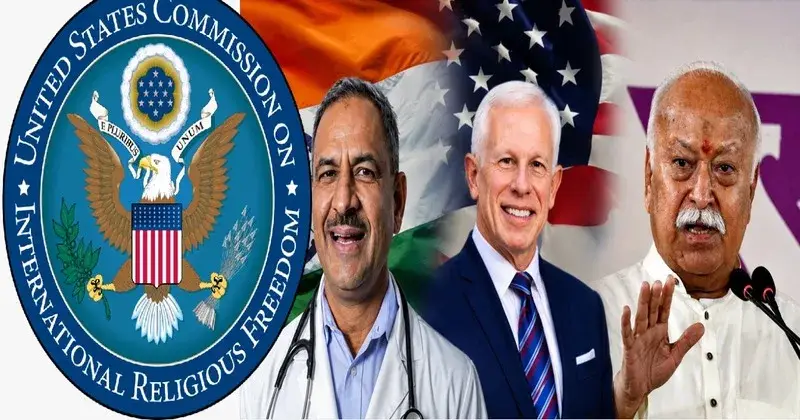
A broad alliance of social, cultural, and policy-oriented organizations from the United States, United Kingdom, Canada, and India has established a united front to challenge the position taken by the United States Commission on International Religious Freedom (USCIRF). The coalition includes prominent entities such as HinduPACT, the Syama Prasad Mookerjee Research Foundation (SPMRF), the Hindu American Foundation (HAF), the International Minorities Foundation (IMF), the Vishwa Hindu Parishad (VHP), and the Vishwa Samvad Kendra (VSK). These groups have collectively questioned the impartiality of the US-based advisory body, describing its recent actions as part of a broader pattern of bias against India.
The formation of this alliance follows intense criticism from USCIRF regarding the planned visit of Dr. Mohan Bhagwat, the Sarsanghchalak (Chief) of the Rashtriya Swayamsevak Sangh (RSS), to the United States in August 2026. According to reports, USCIRF Chair Asif Mahmood and Commissioner Gene Mills publicly opposed the visit, which was linked to a scheduled "Universal Oneness Celebration" at Madison Square Garden in New York. The commission reportedly demanded that financial and visa sanctions be imposed on Dr. Bhagwat and urged the US administration to deny him any form of diplomatic protocol or honor.
In response to these developments, Hindu organizations active in the US and globally have characterized USCIRF’s stance as a manifestation of "Institutional Hinduphobia." They argue that the commission is employing a specific "anti-India toolkit" designed to maliciously attack India’s democratic credentials, sovereignty, and Sanatan Hindu culture. The coalition asserts that these actions are not based on objective assessments but are instead driven by a coordinated agenda to undermine India's standing in international forums.
Allegations of Manufactured Scrutiny
The Syama Prasad Mookerjee Research Foundation (SPMRF) has conducted an in-depth review of the controversy, producing a research paper that challenges the factual basis of USCIRF’s objections. The foundation claims, using what it describes as authentic facts, that USCIRF’s annual reports and specific objections are not grounded in concrete ground-level data. Instead, SPMRF alleges that the commission is engaging in a process of "manufactured scrutiny" to generate negative narratives about India.
The research paper indicates that the foundation has examined the entire controversy surrounding Dr. Bhagwat’s visit and the subsequent diplomatic friction. By highlighting discrepancies between USCIRF’s claims and available data, SPMRF aims to demonstrate that the commission’s stance lacks empirical support. The foundation’s analysis suggests that the pressure exerted on the US administration to sanction Dr. Bhagwat is part of a wider effort to delegitimize Hindu institutions and their activities abroad.
The Vishwa Hindu Parishad (VHP) and other member organizations of the coalition have echoed these sentiments, stating that the opposition to Dr. Bhagwat’s visit represents a targeted ideological battle within geopolitics and the Indian diaspora community. They contend that the demand for visa and financial sanctions is an overreach by a body that lacks credibility when assessing religious freedom in diverse democracies.
Government Response and Diplomatic Implications
The Government of India has officially responded to the controversy through its Ministry of External Affairs (MEA). In an official statement, the MEA dismissed USCIRF as entirely lacking credibility and being biased. The ministry’s response underscores New Delhi’s frustration with what it perceives as unwarranted interference in its internal affairs and diplomatic engagements.
The MEA’s dismissal of the commission aligns with the broader narrative presented by the coalition of Hindu organizations. By rejecting the validity of USCIRF’s recommendations, the Indian government signals its refusal to accept external assessments that it views as politically motivated. This stance complicates the diplomatic landscape surrounding Dr. Bhagwat’s visit, as it places the US administration in a position where it must balance its advisory bodies’ recommendations with bilateral relations.
The controversy has also drawn attention to the role of international advocacy groups in shaping foreign policy decisions. The coalition argues that organizations like USCIRF often operate with a predetermined agenda, using religious freedom as a lens to critique nations that do not align with their ideological preferences. They suggest that this approach undermines the genuine discourse on religious liberty by focusing disproportionately on specific regions while ignoring similar issues elsewhere.
As the situation develops, the coalition continues to monitor USCIRF’s actions and statements. The groups have indicated that they remain committed to countering what they describe as institutional bias through public advocacy, research, and diplomatic engagement. The outcome of this dispute may influence how international bodies approach religious freedom assessments in the future, particularly regarding their methodology and perceived impartiality.
The upcoming events surrounding Dr. Bhagwat’s visit will likely serve as a focal point for these ongoing debates. Stakeholders on both sides continue to prepare for potential diplomatic tensions, with the coalition emphasizing the need for transparency and factual accuracy in international religious freedom reports. The Indian government’s firm rejection of USCIRF’s stance suggests that similar disputes may arise in future diplomatic engagements involving Indian leaders and institutions.