

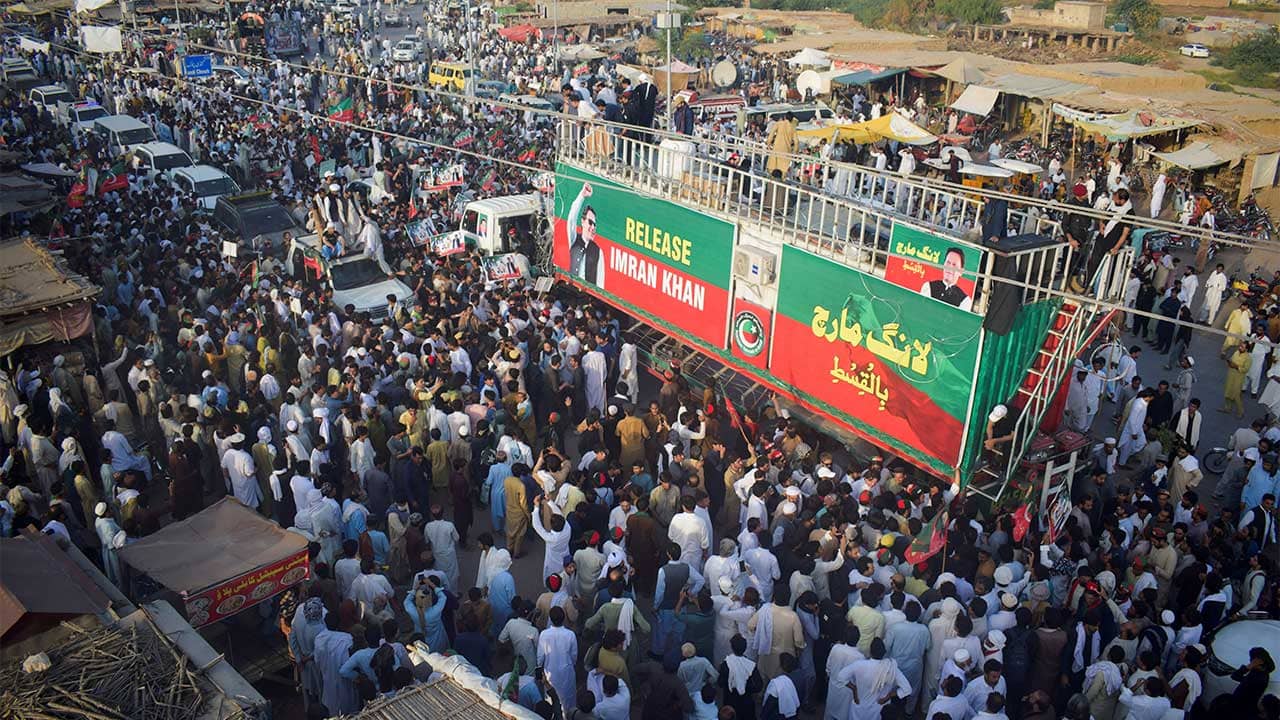

Thousands March Toward Islamabad in Demand for Khan’s Release
Thousands of supporters of jailed former Prime Minister Imran Khan began a long march to Islamabad on Monday, initiating a significant political confrontation that has drawn intense scrutiny from both the party and the federal government. The rally, which officially started on Sunday in Khyber Pakhtunkhwa province, represents a critical test of strength between the opposition Pakistan Tehreek-e-Insaf (PTI) and the current civilian leadership.
Khyber Pakhtunkhwa Chief Minister Sohail Afridi is leading the march, urging supporters and younger demographics to join the movement for their leader. Afridi stated that the public must come out in support of Khan, who he described as "sitting in jail." The PTI party currently rules Khyber Pakhtunkhwa province, providing the logistical and political backbone for this mobilization.
The march was originally scheduled for September 27 but was delayed after negotiations between Prime Minister Shehbaz Sharif’s government and the party fell apart over the weekend. Interior Minister Mohsin Naqvi stated that the government would not allow marchers to enter Islamabad, declaring, "We will finish it once for all." Naqvi claimed that talks failed due to Khan’s party refusing to cooperate on a counter-terrorism policy aimed at fighting rising militancy in Khyber Pakhtunkhwa province.
In response, the PTI denied the government's explanation, asserting that the state sought to pressure the party into unfair concessions. Naqvi and other ministers suggested that the provincial government could be removed via legal and constitutional provisions if it fails to follow a state-backed counter-terrorism policy.
Heavy Security Measures and Barricades in the Capital
In anticipation of the influx of protesters, thousands of police and paramilitary forces have been stationed in and around Islamabad. The government has taken physical measures to secure the area, with shipping containers placed to barricade the government district. These preparations underscore the severity with which the federal authorities are treating the potential unrest.
The tensions deepened after Khan’s arrest in May 2023, which sparked riots where supporters attacked military installations. This led to a crackdown that detained thousands of PTI supporters and resulted in dozens being sentenced by military courts. The rift between Khan’s party and Pakistani leadership stems from Khan’s 2022 ouster by parliament, which he blamed on the military, a charge the army denies.
Khan, 74, a former cricket star, describes himself as a political prisoner. Analysts view the military as the ultimate arbiter of politics in Pakistan; however, the military and current civilian government deny he is a political prisoner, citing judicial independence. Khan was convicted in several trials, but all convictions except one have been suspended or overturned with appeals pending.
Political Implications and Future Uncertainty
The march highlights the ongoing struggle for power in Pakistan, with the PTI attempting to leverage its provincial control to challenge federal authority. The delay in the march’s start date reflects the fragile nature of negotiations between the two sides. As the supporters continue their journey, the government remains firm in its stance, warning of severe consequences if the barricades are breached.
The situation remains volatile, with both sides entrenched in their positions. The PTI’s demand for Khan’s release is central to the protest, while the government focuses on maintaining order and enforcing its counter-terrorism narrative. The outcome of this confrontation could have lasting implications for Pakistan’s political landscape and the balance of power between civilian institutions and the military.