Full story
Commission Ruling Sparks Debate Over Ballot Validation
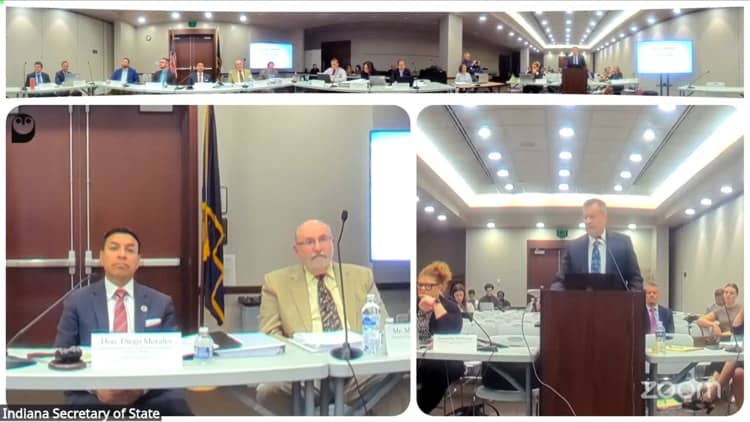
A recent decision by the Indiana Recount Commission has drawn sharp criticism regarding how physical markings on ballots are interpreted during vote counting. The controversy centers on a specific ballot that featured a distinct lipstick smudge, an incident that Brian Howey describes as offering a significant lesson for election officials.
Howey, who has commented extensively on the matter, stated that the commission ignored lessons of the past in its recent decision. His comments highlight a growing concern among observers about the consistency and historical awareness applied to ballot validation standards in Indiana.
The incident involving the lipstick-marked ballot serves as a focal point for discussions about election integrity and procedural adherence. Howey’s assertion suggests that the commission’s approach deviated from established practices or historical interpretations of similar cases. By citing ignored lessons, he implies that previous elections or rulings may have provided clearer guidance on how such ambiguous markings should be handled.
Historical Precedents and Procedural Concerns
The core of the criticism lies in the interpretation of voter intent when physical evidence is unclear. A lipstick smudge on a ballot presents a unique challenge for election administrators tasked with determining whether a mark constitutes a valid vote or an accidental blemish. Howey’s argument rests on the premise that historical data and past commission decisions should inform current rulings.
According to reports, the Indiana Recount Commission’s recent decision did not align with these historical precedents. This divergence has led to questions about the transparency and educational value of recount processes. If the commission disregarded previous examples where similar markings were evaluated differently, it raises concerns about the predictability of election outcomes for voters.
The mention of "lessons of the past" suggests that there is a documented history in Indiana or nationally regarding how non-standard ballot markings are treated. Howey’s commentary indicates that these historical records exist and should have been consulted before finalizing the ruling on the lipstick-marked ballot.
Election Lessons and Future Implications
The incident involving the lipstick smudge is being framed not just as an isolated administrative error, but as a broader indicator of procedural gaps. Howey’s statement that the commission ignored these lessons points to a potential failure in learning from previous electoral cycles.
In election administration, consistency is crucial for maintaining public trust. When rulings on ballot validity appear arbitrary or disconnected from historical context, it can undermine confidence in the recount process. The specific detail of a lipstick smudge highlights how minor, everyday items can inadvertently affect voting records if clear guidelines are not strictly followed.
The WTHR report summarizing the situation notes that the lipstick smudge offers an election lesson. This framing suggests that the incident serves as a case study for future training and policy adjustments. If the commission had adhered to past practices, the outcome might have been different, or at least more defensible based on established norms.
Howey’s criticism underscores the importance of accountability in recount commissions. These bodies are responsible for ensuring that every valid vote is counted and every invalid mark is correctly identified. When they fail to reference historical precedents, as alleged by Howey, they risk setting a confusing precedent for future elections.
The discussion around this ballot extends beyond the physical evidence. It touches on the philosophical and practical approaches to voter intent. Does a smudge indicate an attempt to mark a candidate, or is it clearly incidental? The answer often depends on how previous similar cases were resolved.
By pointing out that these lessons were ignored, Howey is calling for a reevaluation of how such decisions are made. He suggests that the commission’s recent decision was not only incorrect but also unnecessary given the available historical guidance.
Impact on Voter Confidence
The public reaction to recount decisions often hinges on perceived fairness and consistency. When high-profile or unusual cases, such as one involving a lipstick smudge, are decided without clear reference to past standards, it can lead to speculation about bias or incompetence.
Howey’s comments serve as a reminder that election officials must be vigilant in applying historical context to new situations. The specific nature of the marking—lipstick—adds a layer of complexity, as it is a common cosmetic item rather than a standard voting instrument like a pen or pencil.
The incident highlights the need for clear, written guidelines that reference historical precedents. Without such guidelines, commissions may rely on ad-hoc interpretations, which can vary from case to case and lead to inconsistent outcomes.
As the debate over this ballot continues, the focus remains on whether the Indiana Recount Commission will acknowledge the oversight cited by Howey. The lesson offered by the lipstick smudge is not just about one ballot, but about the broader principles of election administration and the importance of learning from history to ensure fair and accurate vote counting in the future.