

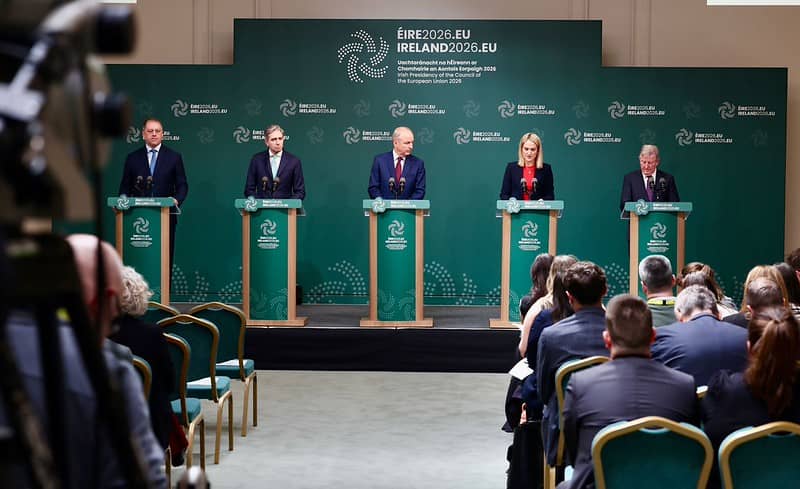

Launch of the Irish EU Presidency Amid Geopolitical Turmoil
Ireland is set to assume the presidency of the Council of the European Union on July 1. The transition follows a launch event held on June 10, which was attended by Taoiseach Micheál Martin and several other Irish ministers. The commencement of this six-month term occurs during a period defined by significant instability across Europe.
According to the source context, the continent is navigating "rough seas" characterized by Russia’s continued aggression in Ukraine, economic volatility, and shifting geopolitical dynamics involving the United States. The current environment stands in stark contrast to the last time Ireland held the Council presidency in 2013. At that time, the global landscape was described as less violent and unstable than it is now.
As the presiding nation, Ireland intends to advocate for international law and demonstrate the viability of an alternative foreign policy approach compared to traditional rearmament strategies. The Irish government has signaled its commitment to standing up for Dublin’s long-standing support for international law while showing the rest of Europe that a different foreign policy is possible.
Intense Scrutiny of Defense Spending and Strategic Capacity
As Ireland prepares to take over the presidency, analysts and media outlets have directed significant attention toward the country’s contributions to European security. This scrutiny has resulted in criticism from major international publications, including the New York Times and Le Monde.
A central point of contention is Ireland’s defense budget. The country currently has the lowest defense spending in Europe, accounting for just 0.2 percent of its gross domestic product (GDP). This figure has drawn sharp rebuke from commentators who have described Ireland as Europe’s "weak spot" and "weak link." One analyst explicitly labeled the Irish government and populace as a "bunch of freeloaders," suggesting they do not share the collective responsibility of making Europe secure.
Further criticism has focused on Ireland’s military capabilities. Commentators have noted that the country has virtually no independent capacity for self-defense. Some observers have raised concerns that this lack of capability risks turning Ireland into a "French military protectorate." Additionally, there are reported "concerns" regarding Ireland’s ability to host EU meetings effectively given its strategic position.
Despite these criticisms, the article argues that European security contributions should not be measured solely by spending on arms. It posits that Ireland’s long-standing policy of neutrality, combined with its aid policy, offers a model for what real security could look like in a rearmed Europe.
The Debate Over Security Metrics
The discourse surrounding Ireland’s presidency highlights a divergence in how security is defined within the European Union. While traditional metrics focus heavily on military expenditure and independent defense infrastructure, Dublin emphasizes diplomatic and developmental contributions.
Analysts have urged Ireland to share the collective responsibility for making Europe secure, implying that current efforts are insufficient under conventional definitions. However, proponents of the Irish approach suggest that neutrality and aid represent a different, yet valid, pathway to stability. This perspective challenges the prevailing narrative that rearmament is the only viable response to the current volatile US relationship and Russian aggression.
Advocating for International Law as a Security Pillar
Under its presidency, Ireland plans to utilize its platform to promote international law as a core component of European security strategy. This approach aligns with Dublin’s historical foreign policy stance, which has prioritized neutrality over military alignment.
The Irish government aims to demonstrate that an alternative to traditional rearmament strategies is not only possible but potentially more sustainable in the long term. By focusing on aid and legal frameworks, Ireland seeks to counter the narrative that its 0.2 percent GDP defense spending renders it irrelevant to continental safety.