

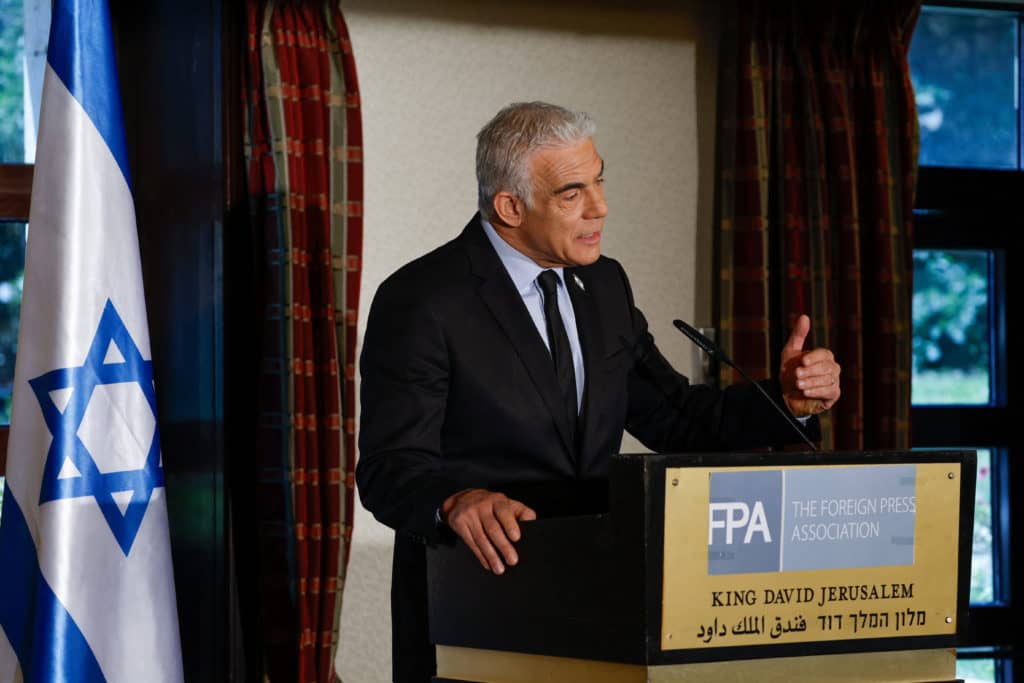

Israeli opposition leader Yair Lapid stated on Monday that an emerging deal between the United States and Iran, which he characterized as "Trump's emerging deal," is detrimental to regional stability. Lapid asserted that the proposed agreement fails to address any of Israel's critical security objectives, particularly concerning the ongoing regional challenges. He also directed criticism at Prime Minister Benjamin Netanyahu, accusing him of an inability to effectively influence the negotiations to secure a more favorable outcome for Israel.
Lapid's Assessment of the Emerging Deal
During his public remarks, Yair Lapid, who leads the Yesh Atid party, articulated strong reservations about the nature and potential implications of the deal reportedly under discussion between Washington and Tehran. Lapid emphasized that, from Israel's perspective, the deal is fundamentally "bad for the region." This assessment stems from his view that the agreement does not align with or achieve any of Israel's stated goals for regional security and stability, particularly in the context of the broader conflict and strategic competition in the Middle East.
Lapid elaborated that Israel's primary concerns revolve around Iran's nuclear program, its development of ballistic missiles, and its extensive network of proxy forces across the Middle East. He indicated that any deal failing to robustly dismantle these threats or significantly curtail Iran's capacity to project power and destabilize the region would be considered inadequate. The opposition leader's comments underscore a deep-seated apprehension within Israel regarding any international agreement that might be perceived as legitimizing Iran's nuclear ambitions or easing pressure on its regional activities without sufficient safeguards.
Critique of Prime Minister Netanyahu's Role
A significant component of Lapid's statement was his direct accusation against Prime Minister Benjamin Netanyahu. Lapid contended that Netanyahu has failed to leverage Israel's diplomatic influence to shape a better agreement between the U.S. and Iran. This criticism places the responsibility for the perceived shortcomings of the emerging deal squarely on the shoulders of the current Israeli leadership.
Lapid's remarks suggest that, in his view, the Netanyahu government has either mismanaged its relationship with key international partners or has been ineffective in conveying Israel's red lines and strategic demands during the negotiation process. Such an accusation is a common tactic in Israeli opposition politics, where national security issues often become focal points for challenging the incumbent government's competence and foreign policy strategy. The implication is that a more assertive or strategically adept approach by the Prime Minister could have yielded a deal more aligned with Israel's national interests.
Context of U.S.-Iran Negotiations
The discussions surrounding a potential U.S.-Iran deal have been a recurring feature of international diplomacy for years, with various administrations in Washington pursuing different approaches. The reference to "Trump's emerging deal" by Lapid suggests a framework or set of principles that he associates with the foreign policy approach of former President Donald Trump. During his presidency, Trump withdrew the U.S. from the Joint Comprehensive Plan of Action (JCPOA), also known as the Iran nuclear deal, in 2018, advocating for a "maximum pressure" campaign and a "better deal" that would more comprehensively address Iran's nuclear program, ballistic missile capabilities, and regional destabilizing activities.
While details of the specific "emerging deal" Lapid referred to remain subject to diplomatic discretion and evolving discussions, his comments highlight the ongoing nature of efforts to manage the Iranian nuclear file and regional tensions. These negotiations typically involve complex considerations, including sanctions relief, limitations on uranium enrichment, inspections regimes, and regional security guarantees. Any agreement is scrutinized by regional actors, particularly Israel, which views Iran as its primary existential threat.
Israel's Long-Standing Concerns Regarding Iran
Israel has consistently voiced profound concerns about Iran's nuclear program, viewing it as a direct threat to its security. Israeli officials have repeatedly stated that they will not allow Iran to acquire nuclear weapons, and they monitor international efforts to contain Iran's nuclear ambitions with intense scrutiny. Beyond the nuclear issue, Israel is deeply troubled by Iran's development of advanced ballistic missiles capable of reaching Israeli territory and its extensive support for proxy groups such as Hezbollah in Lebanon, Hamas in Gaza, and various militias in Syria and Iraq.
These Iranian-backed entities are perceived by Israel as instruments designed to encircle and threaten the Jewish state, creating a multi-front security challenge. Consequently, Israel's strategic objectives in any deal with Iran typically include not only the complete cessation of uranium enrichment and plutonium reprocessing but also the dismantling of its ballistic missile program and a significant curtailment of its regional malign activities. The absence of these elements in any emerging agreement is likely to be met with strong opposition from across the Israeli political spectrum.
Domestic Political Landscape in Israel
Lapid's strong criticism of the emerging deal and his direct challenge to Prime Minister Netanyahu's handling of the matter are indicative of the robust and often contentious nature of Israeli politics, particularly when national security is at stake. As the leader of the opposition, Lapid frequently uses foreign policy issues to differentiate his political stance from that of the ruling coalition and to present an alternative vision for Israel's security.
In Israel, national security is a unifying, yet also highly politicized, topic. Debates over how best to confront threats, particularly from Iran, often transcend traditional left-right divides and become central to public discourse and electoral campaigns. Lapid's statements serve to rally his political base, articulate the opposition's concerns, and pressure the government to adopt policies that he believes better safeguard Israel's interests. This dynamic ensures that any significant international agreement involving Iran will be subject to intense domestic scrutiny and debate within Israel.