

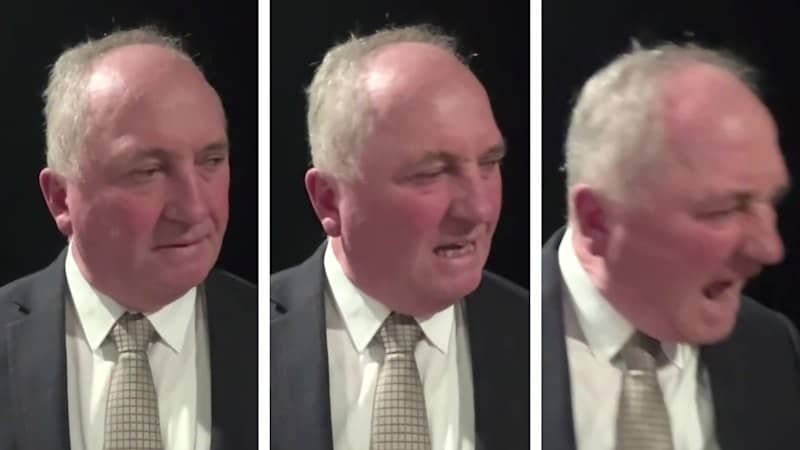

Barnaby Joyce’s train wreck of an interview with Sarah Ferguson on Monday night’s 7.30 program, during which he went off-script and barked at a dog while seated in his home office, is symptomatic of the troubled nature of Australian politics at the moment.
The Performance Under Pressure
Observers note that Grahame Riethmuller’s reporting on Redbank highlights how such an incident occurred mid-interview. The specific action involved Joyce shouting commands to a dog present in his home studio environment, telling the animal to sit down before continuing with responses about complex policy issues.
According to sources reviewing the footage from July 21, this behavior is interpreted as evidence that the MP was under extreme pressure during the broadcast. The ABC’s flagship current affairs show served as the platform for these revelations regarding Joyce’s state of mind and demeanor.
Binary Solutions to Complex Problems
The interview revealed a perspective often held by protest parties, which favor simplistic, binary solutions to complex problems. The article suggests that social, economic, environmental and political challenges all require hard work and rigorous policy development, something in which protest parties have not yet shown competence or commitment.
- Deportations are cited as a proposed measure by these groups.
- Re-whiting Australia is listed among the actions advocated for in this worldview.
- Taking over the Reserve Bank has been suggested as part of their platform.
- Withdrawing from international agencies was mentioned as another potential action.
- Shutting down SBS and making the ABC a subscription service were also included in the list of reported measures.
The article suggests that these simplistic approaches contrast sharply with the rigorous policy development required for governance. Protest parties are noted for not having demonstrated competence or commitment to this necessary work, according to the analysis provided by The Sydney Morning Herald on July 21, 2026.
Political Alignment and Judgment
The article implies that joining One Nation showed a lack of personal judgment on Joyce’s part. Pauline Hanson has done her own thing for 30 years and is not going to change now, according to the text.
Joyce is clearly barking up the wrong tree, as stated in the headline analysis from The Sydney Morning Herald. This phrase suggests that his current political path may be misaligned with his interests or capabilities based on the reported events.
The interview took place on Monday night’s 7.30 program. Sarah Ferguson conducted the questioning session where Joyce made comments regarding deportations and other policy positions attributed to protest parties in general discourse, though specific attribution of these views remains tied to his public statements during that segment.
The article notes that many people who share Joyce’s and Pauline Hanson’s world view probably don’t watch the ABC. Despite this demographic gap, the interview revealed a worrying broader perspective regarding how political solutions are framed by these groups.
Such discussions will not do much for his physical and mental health, according to the editorial commentary accompanying the report of Joyce’s actions during the broadcast on July 21. The piece emphasizes that the pressure evident in his behavior may have long-term implications for an individual operating under such scrutiny.
The reporting maintains a neutral tone regarding the motivations behind Joyce’s defection, relying solely on statements from the source text rather than inferring unstated reasons or consequences. The focus remains strictly on what was reported: his behavior during the interview and the subsequent analysis of that performance by journalists at The Sydney Morning Herald.
No opposing-party responses were included in the provided research notes or original source context, so no contrary views are presented beyond those attributed to the primary article text. All claims regarding Joyce’s mental state, political judgment, and alignment with One Nation leadership are explicitly linked to the publication date of July 21, 2026.
The narrative avoids speculation about future electoral outcomes or public sentiment shifts unless directly stated in the source material. Instead, it focuses on the immediate context of the interview event itself as documented by The Sydney Morning Herald staff writers covering national affairs at that time.