

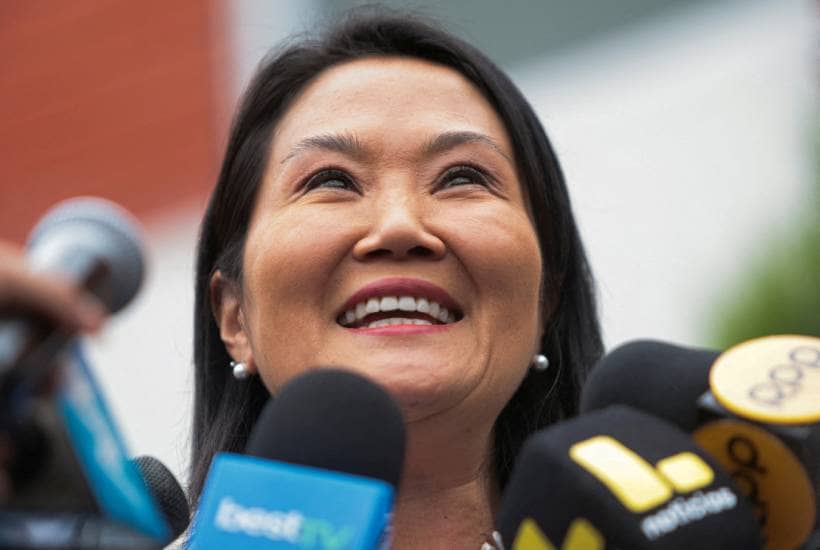


Mathematical Certainty Defines Outcome Before Official Declaration
In the ongoing political landscape of Peru, conservative candidate Keiko Fujimori has achieved what analysts describe as an insurmountable lead within her nation's presidential runoff election. The electoral process is currently underway in Lima and across other regions of the country, yet the trajectory of the contest suggests a definitive conclusion before the formal finalization procedures are complete.
Data released by monitoring entities indicates that more than 50 percent of all valid ballots cast have been counted and processed for tabulation. This threshold is significant because it establishes a baseline from which victory margins can be assessed against the total number of votes required to secure an absolute majority in Peru's first-past-the-post system.
The core metric driving this assessment involves comparing Fujimori's current tally against her nearest rival. According to available figures, Keiko Fujimori holds a margin of victory that is mathematically larger than the number of ballots remaining uncounted. This statistical disparity means that even if every single undecided or uncaptured vote were cast for her opponent, she would still retain enough counted votes to win the presidency.
Peru's electoral authority has not yet formally declared a winner in this specific instance. The official declaration typically occurs after the final count is complete and verified by judicial observers and international monitors. However, the mathematical reality presented by the current vote share renders further counting procedurally unnecessary for determining the ultimate result.
Political strategists note that such scenarios often occur when a candidate achieves overwhelming support in early voting rounds or if turnout drops significantly among opposition supporters as election day progresses. In this specific case, the concentration of votes behind Fujimori has created a buffer zone that cannot be bridged by future vote counts.
The term "insurmountable lead" used in reporting reflects the mathematical impossibility for any other candidate to overtake her position given the current state of the count. This terminology is reserved for instances where the gap between candidates exceeds the maximum possible number of votes that could still be cast by opposing forces.
Observers emphasize that while the result is effectively decided, the formal legal process continues until all precincts are officially reported and the electoral board issues its final certification. This distinction remains important in Peruvian political culture where procedural correctness often takes precedence over practical outcomes during the transition period between election day and inauguration.
Historical Context of Fujimori Family Political Dominance
The ascent of Keiko Fujimori to a position where she can secure such decisive results is inextricably linked to her family's profound influence on Peruvian politics. Her father, Alberto Fujimori, served as president from 1990 until his removal through impeachment proceedings and subsequent imprisonment following revelations regarding corruption scandals.
Keiko Fujimori herself ran for the presidency multiple times prior to this runoff election. She was disqualified in previous cycles due to legal challenges stemming from her father's conviction on charges of abuse of power, money laundering, and human rights violations related to disappearances during his administration.
The political brand associated with the surname Fujimori has evolved over decades, transitioning from a platform rooted in anti-communist nationalism and economic liberalization under Alberto Fujimori to one focusing on social welfare programs and conservative values under Keiko's leadership. This shift represents an attempt to rehabilitate the family image while maintaining core ideological tenets.
Her campaign strategy has historically relied on mobilizing support from rural areas, indigenous communities, and sectors of society that feel neglected by traditional political elites in Lima. The current election results suggest this demographic targeting has yielded substantial returns compared to previous electoral cycles where her margins were narrower.
The opposition parties have struggled to coalesce around a single candidate capable of defeating Fujimori consistently across different regions. Fragmentation among left-wing and centrist candidates often allows the conservative bloc, led by Fujimori, to capitalize on divided opposition votes in critical swing districts.
Procedural Status Remains Pending Formal Certification
Despite the mathematical certainty of her victory, Peru's National Jury Electoral (JNE) maintains its standard protocol for declaring election results. The institution responsible for overseeing elections continues to process remaining ballots from precincts that have not yet reported their final tallies.
Election officials state that they must complete all administrative duties associated with the vote count before issuing an official declaration of victory. This includes verifying signatures on ballot papers, cross-referencing voter registration lists against turnout records, and ensuring no irregularities exist in the reporting process from individual polling stations.
International observers deployed to monitor the election have noted that while early trends strongly favor Fujimori, they will wait for official certification before making public statements regarding the outcome. Their reports emphasize adherence to established timelines set forth by Peru's electoral laws and international observer mandates.
The remaining ballots represent a small fraction of total votes cast but are still subject to rigorous scrutiny under Peruvian election law. Any discrepancies found during this final phase could theoretically alter the margin slightly, though not enough to change the overall winner given the current disparity between candidates.
Legal teams representing various political parties have filed motions requesting expedited processing of results once all ballots are counted. These legal maneuvers aim to resolve any ambiguities quickly and allow for a smooth transition into the next phase of governance under Fujimori's administration if confirmed by official declaration.
Campaign Dynamics Influenced Regional Voting Patterns
Analysis of regional voting patterns reveals that Keiko Fujimori secured overwhelming majorities in several key provinces outside Lima. These regions traditionally lean conservative and have shown consistent support for her candidacy over multiple election cycles.
In contrast, urban centers like Callao and certain districts within Lima Province displayed mixed results where opposition candidates managed to capture significant portions of the vote share. However, these losses were insufficient to offset Fujimori's dominance in rural provinces that collectively contribute a large volume of votes toward her total tally.
Campaign rallies organized by Fujimori supporters throughout the country reported high attendance figures even as voting concluded late into election night hours. These gatherings served both mobilization purposes and morale-boosting functions for volunteers working to ensure accurate reporting from remote locations lacking reliable internet connectivity or transportation infrastructure.
Opposition campaign managers expressed cautious optimism despite unfavorable early returns, citing plans to intensify efforts in swing districts where undecided voters might still influence final outcomes. Their statements reflect a pragmatic approach acknowledging the difficulty of reversing established trends once momentum shifts decisively toward one candidate.