

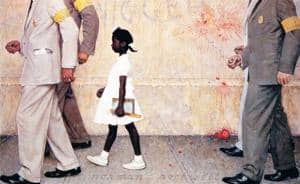

In a compelling opinion column published for the Roanoke Times, author Williams critically examines a specific incident that marred the nation's Fourth of July celebrations. The article frames this quintessential American holiday, typically associated with ideals of freedom and unity, as being overshadowed by what Williams unequivocally terms "masked hate." The core of this assertion stems from a disturbing account: a Black commuter, navigating public spaces during the national observance, found themselves surrounded and encircled by individuals explicitly identified in the report as masked Patriot Front extremists.
A Public Holiday Marred by Confrontation
Williams cites the Fourth of July event not merely as an isolated occurrence but as a potent focal point for broader concerns regarding the nation's current political climate and its trajectory. For the author, this specific incident serves as a stark illustration of a pervasive trend, suggesting that America, as a society, is increasingly perceived as hiding behind both literal and metaphorical "masks and myths." The confrontation, occurring on a day meant to celebrate national unity and foundational freedoms, instead highlighted deep divisions and anxieties.
The description provided in the source material places significant emphasis on the visual nature of the confrontation. The presence of masks worn by the Patriot Front members is not just a detail but a critical element, symbolizing an attempt to conceal identity while projecting an intimidating presence. Williams masterfully utilizes this imagery to suggest that such actions represent far more than simple public disorder or isolated extremism. Instead, they are presented as tangible evidence of a resurgent white nationalism actively working to undermine the hard-won civil rights progress that has shaped modern American society.
The column explicitly links this unsettling event to what Williams identifies as official historical revisionism and a pervasive politics of exclusion. By framing the incident within these specific, interconnected categories, Williams argues that the nation is confronting significant, systemic challenges. These challenges relate directly to how its history is interpreted, often selectively, and, crucially, who is deemed to belong and feel safe in public spaces, particularly during national celebrations intended for all citizens. The incident, therefore, becomes a microcosm of larger societal struggles over identity, belonging, and historical truth.
Undermining Civil Rights Through Ideology and Concealment
The core of Williams's argument posits a concerning reversal of civil rights advancements in contemporary America. This erosion, according to the author, is not accidental but a direct consequence of a potent combination: the rise of resurgent white nationalism, the propagation of historical revisionism, and the implementation of exclusionary politics. These forces, Williams contends, are not operating in isolation but are working in tandem, creating a formidable challenge to the progress achieved over decades.
The column suggests that the increasing visibility of groups like Patriot Front is not merely a surface phenomenon but a symptom of a deeper, more entrenched structural issue within American society. Their public displays, particularly when masked, signify a boldness that reflects an underlying societal acceptance or tolerance of ideologies that fundamentally contradict established civil rights norms and democratic principles. Williams posits that the reliance on masks by such groups serves a dual purpose: it acts as a literal barrier, obscuring individual identities and fostering a sense of anonymity for those espousing hate, while simultaneously functioning as a metaphorical shield, allowing these ideologies to gain traction and operate with a perceived impunity.
The Disconnect Between Idealized History and Lived Reality
Williams further expands on the concept of "myths" being perpetuated alongside these physical barriers. The article highlights a significant disconnect between an idealized version of American history—one often taught, celebrated, and reinforced, particularly during patriotic holidays like Independence Day—and the stark, often harsh, reality faced by ordinary citizens. This reality includes encounters with extremist groups in public spaces, which directly challenge the narrative of a unified, inclusive nation.
This historical revisionism, as described by Williams, involves a selective reinterpretation of the past, often downplaying or omitting uncomfortable truths about systemic injustice and conflict. Such a revised history, when combined with the visible presence of groups promoting exclusionary ideologies, creates a fertile ground for the erosion of civil rights. The author implies that by confronting these "myths" and removing the "masks," the nation can begin to address the underlying issues that allow such extremism to flourish and actively undermine the fabric of a truly inclusive society.
Challenging the Foundations of Inclusive Democracy
Williams meticulously elaborates on what constitutes this "politics of exclusion," framing it as a direct assault on the foundational principles of American democracy. The incident of a Black commuter being encircled by masked extremists during a national holiday serves as a stark and undeniable signal of a profound failure: a failure to uphold the inclusive values and guarantees of safety and belonging that are traditionally associated with the American democratic ideal. This specific event, therefore, transcends a mere act of harassment; it becomes a symbol of an environment where certain citizens are made to feel unwelcome and even threatened in their own country, particularly during moments of national celebration.
While the source text does not present specific statistical data regarding the frequency of such incidents, Williams's argument relies on this singular, vivid event as a powerful, representative example. This strategic approach allows the author to contend that the problem at hand is not an accidental aberration but rather systemic in nature. It suggests that such occurrences are symptomatic of underlying biases and structural inequalities that permit and, in some cases, even foster, an atmosphere conducive to extremist displays. The very presence of masked groups, acting with apparent impunity, challenges the notion of public spaces as universally safe and accessible.
The Imperative to Confront Reality
Williams asserts that stopping the nation's reliance on "masks and myths" necessitates a direct and unflinching acknowledgment of these patterns. This means moving beyond superficial condemnations to address the deeper ideological currents that fuel white nationalism and exclusionary practices. The author implies that a genuine commitment to civil rights progress requires dismantling both the literal masks that conceal perpetrators and the metaphorical myths that obscure uncomfortable historical truths and present a sanitized version of national identity.
Throughout the column, Williams maintains a consistent and focused tone, meticulously interpreting the events and their implications as described in the research notes. No external statistics or unrelated incidents are introduced, ensuring that all claims regarding the nature of resurgent white nationalism and its impact on civil rights progress are firmly attributed to Williams's perspective as articulated in the Roanoke Times publication. The article's overarching message reinforces the critical assertion that America must cease hiding behind these masks of anonymity and the myths of an untroubled past to genuinely confront and overcome the challenges to its inclusive future.