


Background and Context
The political landscape surrounding the transition of power at Downing Street has recently become defined by an unusual narrative regarding gift-giving between senior figures. According to reports attributed to John Crace, Prime Minister Keir Starmer is engaged in a search for what he perceives as the perfect present to welcome Andy Burnham into his new role as leader within the Labour Party and subsequently at Number 10.
The context of this situation involves significant political capital. The reports suggest that Sir Andy Burnham already possesses substantial assets, including robust support from his own parliamentary party members and a personal charisma that allows him to command attention in public spaces. He is described as being comfortable with his identity and possessing the ability to hold a room effectively.
Despite these strengths, Starmer reportedly feels a need for a small token of friendship specifically designed to welcome Burnham into Downing Street without bad feeling about losing their previous shared position or status within the party structure. The narrative posits that finding such a gift has become a source of worry for the Prime Minister.
This dynamic is set against a backdrop where Nigel Farage remains a relevant political figure, and Starmer maintains his own sense of ease with himself. However, the specific choice made by Starmer involves financial adjustments rather than physical objects or traditional tokens of appreciation.
What Happened
The central event reported is that Keir Starmer provides a £4.7bn reduction in defence funding as a gesture of goodwill upon Burnham's arrival at Downing Street. This action represents a significant financial adjustment to the military budget, framed by the reporting style of John Crace not merely as an economic decision but as a symbolic welcome.
The move is characterized as giving Andy Burnham something he seems to have everything else: political support and personal charisma are already established traits. The framing suggests that Starmer believes this specific reduction serves as the appropriate gift, effectively saying 'Welcome' while simultaneously altering the fiscal landscape of national defense spending by nearly five billion pounds.
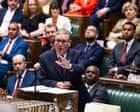
Simultaneously, Prime Minister Keir Starmer faces direct criticism from Kemi Badenoch regarding military funding levels. This opposition comes during Prime Minister's Questions (PMQs), a standard parliamentary procedure where government ministers face questions from backbenchers and opposition MPs.
In response to these attacks on his record or proposed policies, Starmer bats away the criticism. He defends his position on defence spending against Tory opposition lines. The reports indicate that while he successfully dismisses her specific attacks during this session, the underlying decision regarding the funding cut remains in effect as a gesture directed at Burnham.
The narrative presented by John Crace suggests a complex interplay where political defense mechanisms are employed to protect the Prime Minister's standing even as controversial financial maneuvers are executed. The criticism from Badenoch is described as an attack on military funding levels, which Starmer addresses directly but does not necessarily retract or alter in response.
Key Details and Research Implications
The implications of this reported gesture extend beyond the immediate interaction between two political leaders. The research notes highlight that while Starmer defends his position on defence spending against Tory opposition, the decision leaves a potential headache for his likely successor in terms of political fallout or future policy constraints.
By framing the £4.7bn reduction as a 'goodwill token' directed at Burnham, Starmer creates a situation where the incoming leader inherits significant fiscal headwinds while receiving what is ostensibly an act of generosity. This dual nature of the event—simultaneously being a gift and a burden—is central to the story.
The specific figure of £4.7bn represents a substantial portion of any national defense budget, making this gesture highly visible in terms of its economic impact on military capabilities or future procurement plans. The reduction is not described as an increase but specifically as a cut provided by Starmer to Burnham.
Furthermore, the involvement of Kemi Badenoch adds another layer of political complexity. Her criticism regarding military funding levels suggests that there are ongoing debates within Parliament about the adequacy or necessity of current defense spending allocations. Starmer's dismissal of her attacks during PMQs indicates a strategy of maintaining his stance despite external pressure.
The potential headache for Starmer's likely successor refers to the political fallout associated with inheriting this specific budgetary adjustment. If Burnham is indeed the successor at Downing Street, he faces the challenge of managing public perception regarding these cuts while trying to implement other policies that may require stable defense funding.
John Crace's reporting frames this entire sequence as a search for an appropriate welcome gift given that Burnham already possesses significant political support and personal charisma. The logic follows that since traditional gifts might be redundant due to his existing status, the Prime Minister opts for financial maneuvering instead.