


Proposed Trilateral Summit in Shenzhen
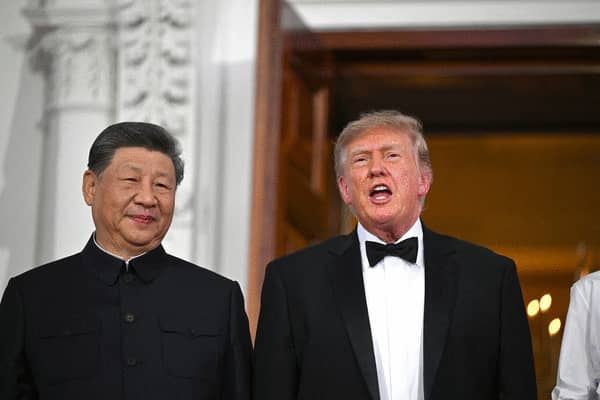
President Donald Trump has expressed interest in holding a three-way summit with his counterparts from Russia and China during an upcoming economic forum in Shenzhen next month. According to Andreas Kluth, the proposed meeting would involve President Xi Jinping and President Vladimir Putin.
Kluth noted that Trump claims he desires the trilateral gathering "not so much for Ukraine" but rather "to talk about nuclear weapons and denuclearization." The potential scope of such a summit varies significantly depending on the outcome. In the worst-case scenario, Kluth reported, Trump and Xi Jinping could conspire to doom Ukraine to Vladimir Putin’s subjugation. Conversely, in the best-case scenario, the summit would open a long and necessary process toward an eventual nuclear detente among the United States, Russia, and China.
The Nuclear Landscape and Tactical Weapons
The current global arms control environment lacks formal constraints on the nine nuclear powers following the expiration of the last treaty between the U.S. and Russia this year. Russia and the United States still account for 86% of all nuclear warheads globally. However, China is rapidly catching up in nuclear capabilities, creating what Kluth described as a complicated "three-body problem." The U.S. must assume that Moscow and Beijing could one day gang up against Washington.
Today’s arms race involves types of warheads, delivery vehicles, and war plans, not just the number of nukes. China and Russia are increasingly investing in "tactical" weapons designed to win a conventional war in a local theater with allegedly "limited" strikes. These tactical nukes are considered especially dangerous because they appear more usable but could still cause uncontrolled escalation to Armageddon.
After the Cold War, the U.S. mothballed almost all its tactical warheads, except for about 100 stationed at allied bases in Europe. In contrast, Moscow retired fewer of its tactical nukes and now outnumbers the U.S. about 10-to-1 in that category. Putin has repeatedly threatened to use such weapons in Ukraine. Meanwhile, China has been adding tactical nukes to signal to the U.S. that it cannot be blackmailed or defeated in a regional conflict over Taiwan.
The Trump administration is considering redeploying its own tactical nukes to Asia. Joel Wit, a veteran of the State Department who has negotiated with North Korea since the 1990s, told Kluth that it seems inevitable the U.S. is going to redeploy tactical nuclear weapons aimed at China. Wit agrees such a move could invite disaster because "these things are dangerous," but suggests linking it to an arms-control proposal.
The Schmidt Model for Deterrence
Wit suggests that the model for this approach would be the dual-track decision taken by NATO in 1979, with West German chancellor Helmut Schmidt as its main brain father. This strategy involves deploying new weapons while simultaneously pursuing arms control negotiations, a balance Kluth argues Trump should emulate.
Schmidt considered the dual-track decision one of his biggest contributions to peace and told Kluth this not long before his death in 2015. Adopting this framework could provide a structured path for managing the complex nuclear dynamics between Washington, Moscow, and Beijing, rather than relying on ad hoc diplomatic gestures.
China's Stance on Disarmament
Despite the potential for dialogue, Xi refuses to join trilateral nuclear disarmament negotiations. According to China’s foreign ministry, it is "neither fair, reasonable nor realistic to ask China to join the so-called trilateral nuclear disarmament negotiations at this stage." This refusal highlights the significant diplomatic hurdles facing any attempt to establish a new arms-control regime involving all three powers.