

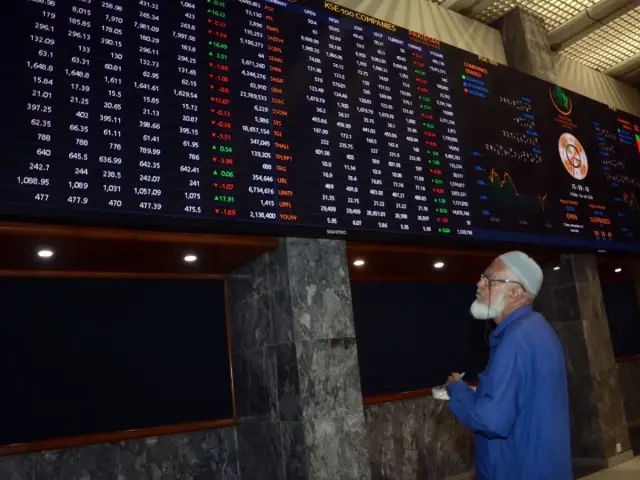

Global Tensions Drive KSE-100 Downward Trend
The Pakistan Stock Exchange (PSX) experienced an extended losing streak during the outgoing week, with its benchmark KSE-100 Index shedding 1.3% week-on-week. The index closed at 175,329 points, reflecting a period of heightened investor caution. This decline was primarily attributed to renewed geopolitical tensions between the United States and Iran, which rattled global markets and, consequently, investor sentiment in Pakistan. Adding to the pressure, higher crude oil prices further contributed to the prevailing cautious mood, impacting market sentiment throughout the trading period.
US-Iran Conflict and Oil Price Pressures
The resurgence of conflict between the United States and Iran created a ripple effect across international financial markets. Investors, sensitive to the potential for broader regional instability and its implications for global trade and energy supplies, adopted a defensive stance. For an import-dependent economy like Pakistan, rising crude oil prices present a dual challenge: they increase the cost of energy imports, potentially exacerbating inflationary pressures, and can impact the current account deficit. This economic backdrop, combined with the direct uncertainty from geopolitical events, weighed heavily on the KSE-100 Index, particularly during the middle of the week, leading to significant intraday volatility.
Local Resilience Amid External Shocks
Despite the overarching influence of international conflicts and escalating energy costs, the KSE-100 Index demonstrated some underlying resilience. The market received intermittent support from positive corporate earnings announcements and sustained local buying activity. According to a report by Arif Habib Limited (AHL), the KSE-100 managed to consolidate its position to some extent even amid the renewed US-Iran tensions. This suggests that while external factors dictated the broader market direction, domestic fundamentals and investor confidence in specific companies provided a degree of counter-pressure against a steeper decline.
A Week of Market Swings: Early Losses, Modest Gains
The trading week for the Pakistan Stock Exchange was characterized by a distinct pattern: initial declines in the first half, followed by a modest recovery in the final two sessions. This trajectory underscored the market's responsiveness to evolving geopolitical news and shifting investor sentiment throughout the five trading days.
Monday's Cautious Start
The week commenced with a consolidation session on Monday, as investors grappled with the implications of the global geopolitical landscape. The KSE-100 Index immediately felt the pressure, declining by 721 points, or 0.41%, to close the first trading day at 176,976 points. This cautious start set the tone for the early part of the week, indicating investor apprehension.
Mid-Week Geopolitical Impact
Tuesday saw the bourse kicking off September under uncertain conditions. The index continued its downward trajectory, falling by 508.69 points, or 0.29%, to settle at 176,466.99. The most significant negative impact, however, was observed on Wednesday. Geopolitical concerns weighed heavily on market sentiment, marking a particularly challenging session for the exchange. The PSX registered a substantial decline of 1,690 points, or 0.96%, closing at 174,777 points. This mid-week slump highlighted the market's acute sensitivity to the unfolding international events.
Late-Week Rebound Efforts
The latter half of the week brought a slight reprieve. Thursday proved to be a relatively flattish day for the market, with the index managing to edge higher by 153 points, or 0.09%, reaching 174,930 points. This minor uptick signaled a potential stabilization after the earlier heavy losses. Friday then marked a period of modest gains, as the KSE-100 rose by 399 points, or 0.23%, to close the week at 175,329 points. While these late-week gains were not enough to fully offset the earlier declines, they demonstrated a degree of recovery and an attempt by the market to find its footing after a turbulent start.
Active Participation Despite Index Retreat
Despite the overall downward pressure on index values, the Pakistan Stock Exchange witnessed strong market participation throughout the week. A total of 1,066 million shares were traded, reflecting active engagement from investors. The cumulative value of these transactions reached Rs. 49 billion, indicating significant capital movement within the market even as the benchmark index retreated.
High Trading Volumes and Key Performers
The robust trading volumes suggest that while some investors were selling amidst uncertainty, others were actively repositioning or engaging in bargain hunting, anticipating future market movements. Leading the volume chart was K-Electric Limited (KEL), which alone accounted for a remarkable 195.8 million shares traded. Such high volume in a single stock during a period of market decline often indicates specific company-related news, strategic investor interest, or significant institutional activity, drawing considerable attention despite the broader market's cautious mood.
Pakistan's Market Sensitivity to International Events
The combination of external geopolitical shocks and domestic market dynamics created a complex trading environment for the PSX. While local buying and corporate earnings provided some crucial support against the broader declines, the overarching influence of international conflicts and global energy costs ultimately dictated the weekly performance. The KSE-100's extended losing streak underscores the inherent sensitivity of regional markets like Pakistan's to global instability. This interconnectedness means that even seemingly distant international events can have a profound and immediate impact on local investor confidence and market valuations, highlighting the need for vigilance in a volatile global economic landscape.