

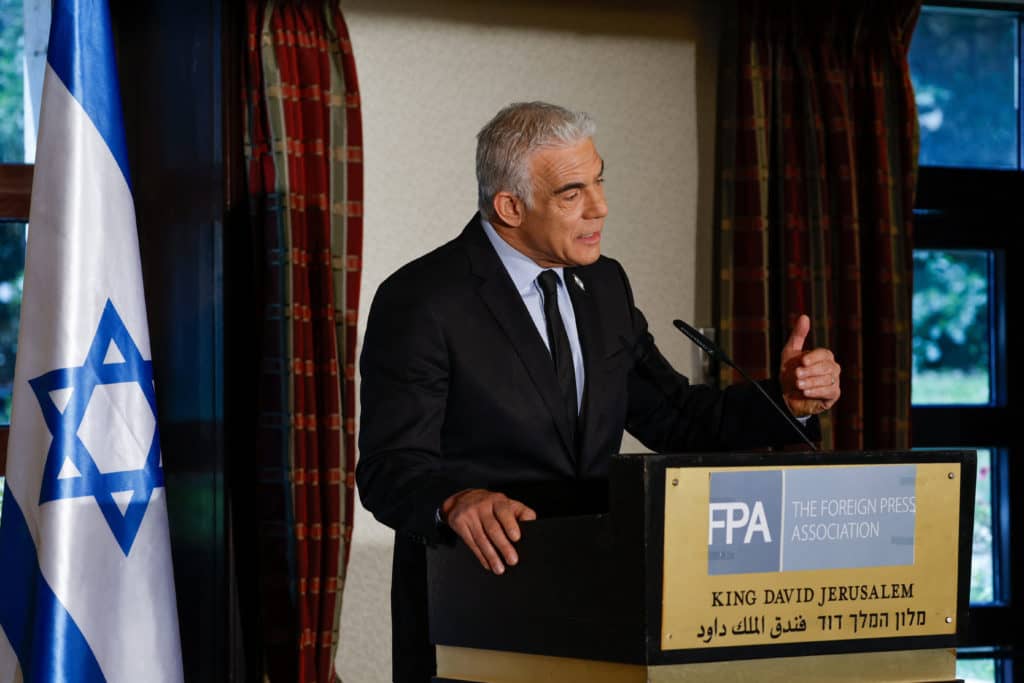

Lapid Expresses Concern Over Prospective US-Iran Deal
Israeli opposition leader Yair Lapid issued a strong criticism on Monday regarding a potential agreement between the United States and Iran. Lapid characterized the prospective deal as "bad for the region" and stated that it would be detrimental to regional stability. His remarks underscored long-standing Israeli anxieties concerning Iran's nuclear program and its regional activities.
During his statement, Lapid asserted that the emerging agreement fails to achieve any of Israel's strategic goals related to the ongoing conflict and security challenges in the Middle East. He further accused Prime Minister Benjamin Netanyahu of an inability to influence the terms of the agreement to better serve Israeli interests.
Details of Lapid's Criticism
Lapid, who previously served as Israel's Prime Minister and Foreign Minister, articulated his concerns during a public address. He emphasized that any agreement with Iran must address the full scope of threats posed by the Islamic Republic, including its nuclear ambitions, ballistic missile program, and support for proxy groups across the Middle East.
The opposition leader's comments highlighted a perceived disconnect between the objectives of a potential US-Iran deal and Israel's security doctrine. He suggested that an agreement that does not dismantle Iran's nuclear infrastructure, restrict its missile capabilities, and curb its regional destabilizing actions would be inherently flawed and dangerous for Israel and its allies.
Lapid's accusation against Prime Minister Netanyahu centered on the government's perceived lack of influence over the potential negotiations. He implied that the current Israeli leadership had not effectively advocated for Israel's security priorities on the international stage, particularly with a key ally like the United States.
Context of Potential US-Iran Agreement
The criticism from Lapid comes amidst discussions and speculation regarding a potential shift in US foreign policy towards Iran, particularly under a future administration. The previous administration of Donald Trump withdrew the United States from the Joint Comprehensive Plan of Action (JCPOA) in 2018, imposing a "maximum pressure" campaign of sanctions on Iran.
A potential future agreement could involve various approaches, ranging from a return to a modified version of the JCPOA to a new, broader deal. Israel has historically expressed deep skepticism about agreements that it believes do not sufficiently constrain Iran's nuclear program or its regional influence. The nature of any prospective deal, therefore, remains a significant point of contention and concern for Israeli policymakers.
Israel's Strategic Concerns Regarding Iran
Israel views Iran as its primary strategic threat in the Middle East. This assessment is based on several factors:
- Nuclear Program: Israel maintains that Iran's nuclear program is aimed at developing nuclear weapons, a capability Israel considers an existential threat. Israeli officials have consistently called for a complete cessation of Iran's uranium enrichment activities and the dismantling of its advanced centrifuges.
- Ballistic Missile Program: Iran possesses a significant arsenal of ballistic missiles, some of which are capable of reaching Israel. These missiles are seen as a delivery mechanism for potential nuclear warheads and a conventional threat.
- Regional Proxies: Iran supports various militant groups, including Hezbollah in Lebanon, Hamas and Palestinian Islamic Jihad in Gaza, and Houthi rebels in Yemen. These proxies are perceived as instruments of Iranian foreign policy designed to destabilize the region and threaten Israel's borders.
- Rhetoric: Iranian leaders have frequently issued statements calling for the destruction of Israel, which Israeli officials interpret as a direct threat to their nation's existence.
Given these concerns, Israel's goals for any international agreement with Iran typically include stringent limitations on enrichment, robust international inspections, restrictions on missile development, and a curtailment of Iran's support for regional proxies.
The Joint Comprehensive Plan of Action (JCPOA) as Precedent
The 2015 JCPOA, signed by Iran and the P5+1 (China, France, Germany, Russia, the United Kingdom, and the United States), aimed to limit Iran's nuclear program in exchange for sanctions relief. Israel, under Prime Minister Netanyahu, was a vocal critic of the agreement, arguing that it did not go far enough to prevent Iran from eventually developing nuclear weapons and that it failed to address Iran's ballistic missile program or its regional activities.
The Trump administration's subsequent withdrawal from the JCPOA was supported by Israel. However, the withdrawal led to Iran increasing its uranium enrichment activities beyond the limits set by the deal, further complicating international efforts to manage Iran's nuclear program. Lapid's current criticism suggests that any new agreement, particularly one that might emerge from a future US administration, would face scrutiny regarding its effectiveness in addressing these long-standing Israeli concerns, especially if it is perceived as not learning from the perceived shortcomings of previous agreements.
Internal Israeli Political Dynamics
Lapid's statements also reflect the ongoing political dynamics within Israel. As a prominent opposition leader, Lapid frequently scrutinizes the foreign policy decisions and diplomatic effectiveness of the sitting government, led by Prime Minister Netanyahu. Accusations of failing to influence international agreements are a common tactic in Israeli political discourse, particularly when national security is at stake.
The debate over Iran's nuclear program and regional influence has been a central theme in Israeli politics for decades. Different political factions often present varying approaches to managing the Iranian threat, ranging from diplomatic engagement to more assertive military or covert actions. Lapid's criticism positions him as a strong advocate for a robust and uncompromising stance against Iran, while simultaneously challenging the current government's handling of the issue.