

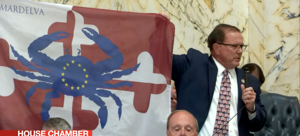

Legislative Vote Blocks Eastern Shore Independence Measure
ANNAPOLIS — A proposal to allow Maryland voters to decide whether the Eastern Shore should separate from the rest of the state was defeated on Monday during a session of the Maryland House of Delegates. The measure, which sought to place a question on the ballot regarding the potential secession of the region, failed following the adoption of an amendment introduced by Republican delegates.
The defeat came via a Republican amendment that effectively blocked the consideration of the original proposal. The legislative action concluded efforts by Democratic Delegate Tom Hutchinson to bring the issue of Eastern Shore independence before the general electorate. Hutchinson had sponsored the legislation intended to gauge public support for such a separation, but the Republican-led opposition succeeded in preventing the ballot question from moving forward.
Monday’s vote marked the end of the legislative push for this specific ballot initiative. The failure of the amendment meant that residents of the Eastern Shore will not have the opportunity to cast votes on the matter of secession through a statewide referendum as proposed by Hutchinson’s bill.
Hutchinson’s Proposal and Legislative Process
Delegate Tom Hutchinson, a Democrat, had introduced the legislation earlier in the session. His proposal aimed to create a mechanism for voters to express their opinion on whether the Eastern Shore should secede from Maryland. The bill was designed to ask voters if they supported the idea of the region breaking away from the state’s current political and administrative boundaries.
The legislative process required the approval of both chambers of the General Assembly and the signature of the governor for any such ballot question to be placed on the election calendar. However, the measure did not reach that stage. Instead, it was addressed during committee or floor proceedings where amendments can alter or kill a bill.
Republican delegates intervened with an amendment that opposed the inclusion of the secession question. By voting in favor of the Republican amendment, the body rejected Hutchinson’s plan. The outcome indicated a lack of sufficient support among Republicans for placing the secession issue on the ballot, effectively stopping the proposal without a direct vote on the original bill itself.
Implications for Regional Governance
The rejection of the ballot question means that the current administrative structure of Maryland remains intact regarding the Eastern Shore. No legal or political mechanism was established through this legislative session to allow for a popular vote on separation.
Hutchinson’s effort represented one instance of political activity focused on regional identity and governance within Maryland. The failure of the measure via the Republican amendment highlights the partisan dynamics involved in the proposal. While Hutchinson advocated for voter input on the matter, his Republican colleagues moved to prevent the question from appearing in any future election.
Political Context of the Vote
The vote occurred in Annapolis, the state capital, where the Maryland General Assembly convenes. The session took place on a Monday, concluding the legislative consideration of Hutchinson’s bill. The specific date of the vote was not detailed beyond the day of the week in the available records, but the outcome was immediate and final for this legislative cycle.
The Star Democrat reported on the failure of the Republican amendment, noting that the proposal by Hutchinson to allow voters to decide on the Eastern Shore seceding from Maryland was defeated. The report confirmed that the defeat came via a Republican amendment, underscoring the role of the minority party in blocking the initiative.
No further legislative steps were taken during this session to revive the ballot question. The proposal did not advance beyond the point where the amendment was adopted. Consequently, the idea of an Eastern Shore secession vote remains unfulfilled for the current election cycle.
Regional Identity and Political Discourse
The Eastern Shore has long been a distinct geographic and cultural region within Maryland. Debates over regional representation and governance occasionally surface in state politics. Hutchinson’s bill brought these discussions into the legislative arena by attempting to formalize voter input on separation.
However, the Republican amendment served as a procedural barrier to that effort. By defeating the proposal through an amendment, Republicans prevented the legislature from authorizing the ballot question. The outcome reflects the current political alignment in the House regarding issues of regional autonomy and state unity.
The failure of the measure does not necessarily indicate the level of public support or opposition to secession among Eastern Shore residents. It only confirms that the legislative path to a vote was blocked by Republican delegates. Hutchinson’s proposal did not gain enough traction to overcome the partisan opposition presented through the amendment.
Next Steps for Secession Advocates
With the defeat of the ballot question, advocates for Eastern Shore independence must pursue other avenues if they wish to continue the discussion. The legislative route taken by Hutchinson has been closed for the time being due to the Republican amendment.
No immediate plans were announced for reintroducing the bill in a subsequent session or for launching alternative campaigns. The focus of the General Assembly shifted away from the secession issue following Monday’s vote.
The Eastern Shore remains part of Maryland under current law. The proposal to change that status through a voter referendum was not approved. The Republican amendment successfully prevented the measure from advancing, leaving the political boundaries of the state unchanged by this legislative action.