

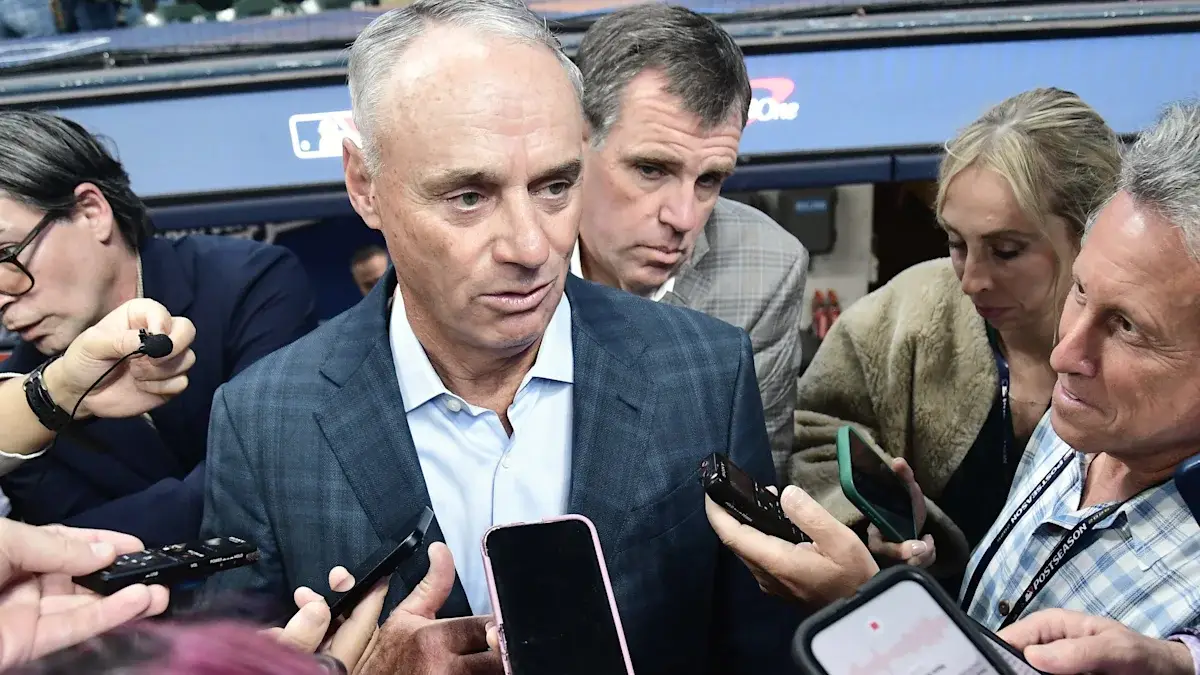

Manfred Cites Small-Market Success in Salary Cap Push
Major League Baseball Commissioner Rob Manfred pointed to the presence of the Tampa Bay Rays and Milwaukee Brewers in the 2026 World Series as evidence supporting the owners' demand for a salary cap. Speaking to USA Today, Manfred argued that the league requires economic regulations to address competitive imbalances.
Manfred highlighted the financial disparity between teams, noting that the Rays have the fifth-smallest payroll in the league while the Brewers hold the 11th-smallest position. Despite these low payrolls, the two franchises combined to win 201 games during the season, a statistic Manfred used to illustrate his point.
The commissioner claimed that larger-market teams possess a "statistically significant advantage" in securing playoff berths and advancing deeper into the postseason. This assertion forms the core of the owners' argument for implementing a salary cap, which they contend is necessary to level the playing field.
Union Leader Disputes Owners' Motives
Bruce Meyer, executive director of the MLB Players Association, pushed back against the commissioner's narrative. According to USA Today, Meyer argued that owners want a salary cap primarily to increase profits by suppressing player salaries and removing guarantees, rather than for competitive balance.
The tension between the two sides has been palpable during recent negotiations. Manfred criticized Meyer’s negotiating style as entrenched in his comments to USA Today. He specifically noted that he did not see Meyer approach Brewers owner Mark Attanasio to make a deal, suggesting a lack of direct engagement with team leadership.
Meyer responded by criticizing owners for focusing on labor issues rather than the greatness of the game and players. His remarks highlight the deepening rift as the league approaches a critical juncture in its labor relations.
Lockout Looms Over 2027 Season
The current collective bargaining agreement expires on December 1, with talks ongoing on non-economic issues. Manfred indicated there are multiple proposals from both sides that need resolution to avoid a lockout threatening the 2027 season.
This deadline creates a "doomsday clock" scenario for MLB fans and stakeholders alike. The potential for a work stoppage adds urgency to the negotiations, with both parties holding firm on their respective positions regarding economic regulations and player compensation.
Contreras Trade Speculation Intensifies
Apart from the labor dispute, trade speculation is mounting around Brewers catcher William Contreras. Robert Murray of FanSided reported that Contreras will likely draw trade interest after the 2026 World Series as he enters the final year of his contract in 2027.
Contreras ranks among the top five catchers in MLB and does not have a no-trade clause, making him a viable target for contending teams. However, he previously stated he would not want to join the Yankees or Mets due to high tax rates, which may limit his potential destinations.
The New York Yankees are expected to be aggressive in addressing their catcher gap following the lockout threat. Their interest in Contreras underscores the value of elite catching talent in the current market, even as the broader labor landscape remains uncertain.