


High-Level Diplomatic Meetings in New Delhi
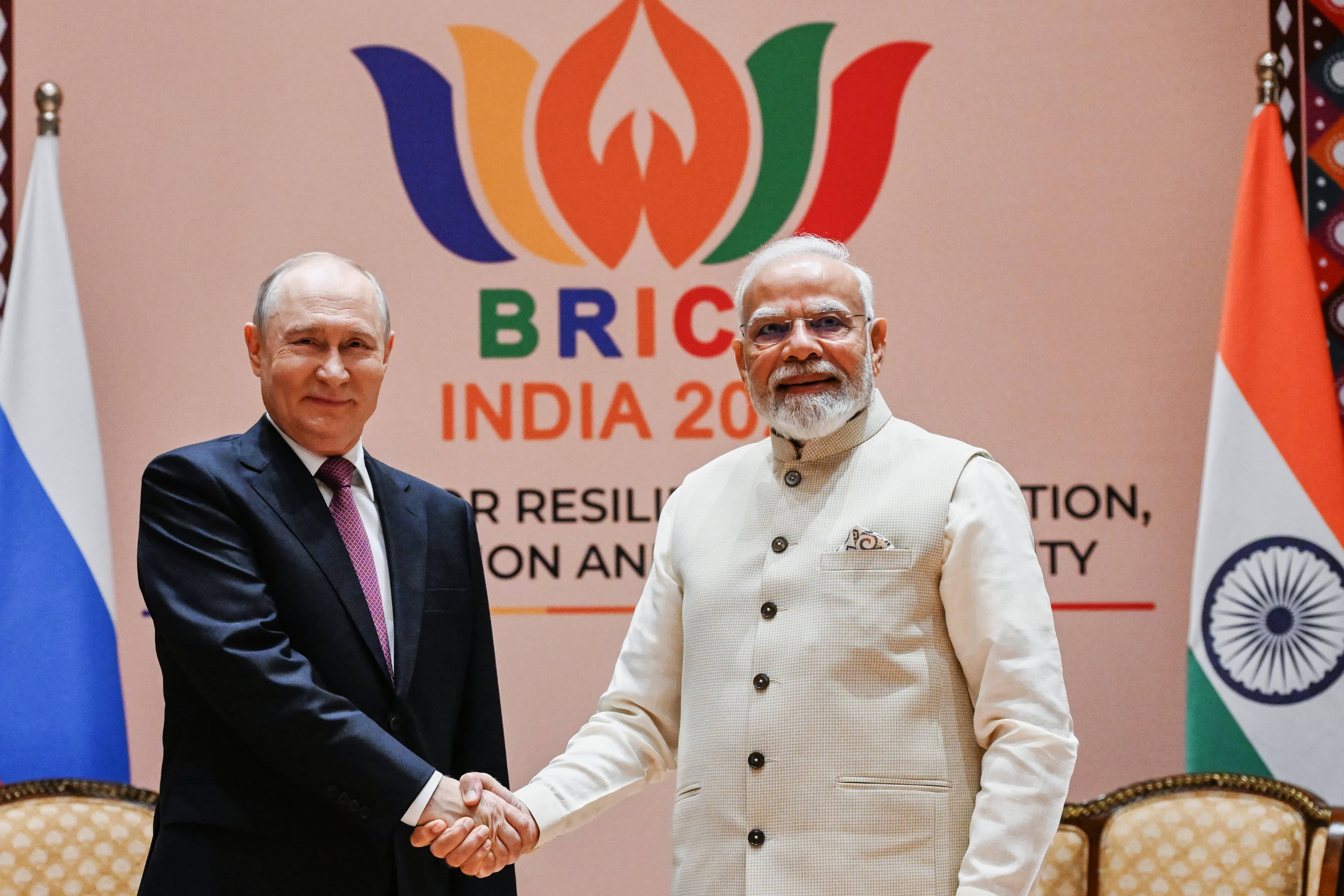
Indian Prime Minister Narendra Modi held bilateral discussions with Russian President Vladimir Putin and Iranian President Masoud Pezeshkian on September 11, 2026. These meetings took place in New Delhi ahead of the upcoming BRICS summit, which is scheduled to be hosted by India.
The diplomatic engagements occurred as world leaders gathered for the expanded grouping of nations. The summit brings together heads of state from the member countries to discuss regional and global policy frameworks. According to reports, the discussions were part of the preparatory activities for the multi-day event.
Photographic evidence released by the Indian Press Information Bureau (PIB) shows the leaders attending a session of the BRICS Business Forum 2026 in New Delhi. The handout photograph captures Iran's President Masoud Pezeshkian, Russia's President Vladimir Putin, India's Prime Minister Narendra Modi, South Africa's President Cyril Ramaphosa, and Brazil's Foreign Minister Mauro Vieira together at the forum.
Composition and Demographics of the Expanded Group
The BRICS organization has undergone significant expansion since its inception. The acronym originally derived from the names of its founding members in 2006: Brazil, Russia, India, and China. South Africa joined the group shortly after these initial nations established the framework.
The bloc has since grown to include 11 member countries. This expansion marks a substantial increase in the geopolitical weight of the organization. The 11 member countries collectively represent approximately half of the world's population.
Observers note that the platform is emerging as a significant entity in international relations. Descriptions of the group suggest it may show a path to a new global system of policies, positioning itself ahead of the G-7 era. The grouping serves as an alternative forum for economic and political coordination among its members.
Historical Timeline of Membership
The origins of the bloc trace back to 2006 with the four founding nations. The inclusion of South Africa added a fifth member, solidifying the original BRICS structure. Over subsequent years, the group has admitted new members, bringing the total count to 11 nations.
This demographic scale gives the organization considerable influence in global markets and diplomatic circles. The representation of half the world's population underscores the economic and political potential of the coalition.
Context of the Upcoming Summit
The summit in New Delhi serves as a focal point for the 11-member group. Leaders from across the bloc are convening to address shared interests and coordinate positions on international issues. The timing of the talks between Modi, Putin, and Pezeshkian indicates active diplomatic engagement prior to the formal sessions.
The event highlights India's role as the host nation for this iteration of the BRICS summit. New Delhi has become the center of attention for diplomats and analysts monitoring the developments within the expanded alliance.
Reports indicate that the discussions are part of a broader strategy to define the group's direction in the current geopolitical landscape. The presence of leaders from Russia, Iran, India, South Africa, and Brazil at the business forum suggests coordinated efforts to strengthen economic ties among members.
The summit follows a period of increased activity within the bloc as it seeks to establish its role in global governance. The expansion to 11 nations has intensified scrutiny on the group's policy outputs and diplomatic strategies.