


Report Challenges Liberal Internationalism's View of Democracy
A recent opinion piece published in Georgia Today argues that a parliamentary investigative commission report fundamentally undermines the core tenets of liberal internationalism. The author of the article contends that the report exposes a "fundamental flaw" in the way Western allies and international observers have historically assessed democratic progress, particularly within post-Soviet states.
The article, titled "How the Recent Parliamentary Investigative Commission Report Exposes the Falsehoods of Liberal Internationalism," was published on August 27, 2026. It asserts that liberal internationalism has erroneously treated "democratic procedures and superficialities" as equivalent to genuine democracy. According to the author, these procedural elements – such as elections, formal institutional reforms, and legal frameworks – have often been "rubber-stamped" by Western allies. This endorsement, the op-ed suggests, has occurred without sufficient scrutiny of the underlying domestic realities or the substantive application of democratic principles.
This perceived misalignment, the article explains, allows governments to maintain a facade of legitimacy on the international stage while simultaneously engaging in actions that directly contradict the spirit and substance of democratic principles. The parliamentary report, as interpreted by the author, is described as revealing how a state can effectively claim a European and liberal-democratic identity, projecting an image of reform and alignment with Western values, while at the same time orchestrating systematic violence against its own citizens domestically. This dual reality, the author argues, represents a critical blind spot for the liberal internationalist framework.
The Disconnect Between Procedure and Practice
The core of the critique lies in the distinction between formal democratic processes and the actual lived experience of democracy. Liberal internationalism, the article implies, has prioritized the visible, measurable aspects of democratic transition – such as holding multi-party elections, drafting new constitutions, or establishing independent judiciaries – as indicators of genuine democratic health. However, the report’s findings, according to the op-ed, suggest that these procedures can be co-opted or manipulated to serve illiberal ends, creating a "performative state" that satisfies external observers while internally subverting democratic norms.
This approach, the author argues, overlooks the deeper, more complex mechanisms through which power is exercised and maintained within a state. It fails to account for situations where a government, despite adopting democratic rhetoric and formal structures, might deliberately employ violence or repressive tactics against its population, thereby hollowing out the very essence of democratic governance.
Reframing Regional Analysis: Beyond Geopolitics and Formalism
The article extends its critique to the prevailing academic and political focus on the post-Soviet South Caucasus. It notes that for several decades, scholarship and policy analysis have predominantly examined the region through the lens of "geopolitical competition between Western liberal-democratic integration and Russian revanchism." This framework, while important for understanding external influences and strategic alignments, has, according to the author, dominated the analytical landscape and shaped how international actors interpret the region's complex political dynamics.
In addition to geopolitical considerations, considerable attention has also been devoted to the formal institutional architecture of Georgia’s post-2003 Rose Revolution state. This has included detailed analysis of constitutional amendments, judiciary reforms aimed at strengthening the rule of law, and the restructuring of security services to align with democratic oversight principles. While acknowledging the importance of these studies, the author argues that this intense focus on formal structures has inadvertently obscured other critical aspects of governance and state behavior.
The op-ed highlights a significant gap in sustained attention paid to what it terms the "domestic architecture of the performative state." This concept refers to the intricate techniques and strategies through which a government constructs and maintains its legitimacy, both domestically and internationally, often through symbolic gestures and superficial adherence to democratic norms. The article posits that these techniques allow a government to project a credible image of a European and liberal-democratic identity, even while it is simultaneously orchestrating a system of deliberate violence against its own population behind this carefully constructed facade.
Implications for International Assessment and Engagement
The author directly connects this overlooked domestic reality to the broader critique of liberal internationalism. The central argument is that by prioritizing formal institutional changes and geopolitical alignments, international observers and Western allies have inadvertently missed the sophisticated mechanisms through which authoritarian practices can persist and even thrive within a seemingly democratic framework. This blind spot, the article suggests, has profound implications for how international bodies and democratic states assess and engage with countries in transition.
While the article does not provide specific details from the parliamentary investigative commission report itself, it leverages the report's existence and implied findings as a foundational basis for its broader theoretical critique. It suggests that the report’s conclusions challenge the very validity of using procedural metrics alone to gauge the true health and democratic substance of states in the region, advocating for a more nuanced and critical approach that delves deeper into the actual exercise of power and the treatment of citizens.
Historical Narratives and the Challenge to Liberal Ideals
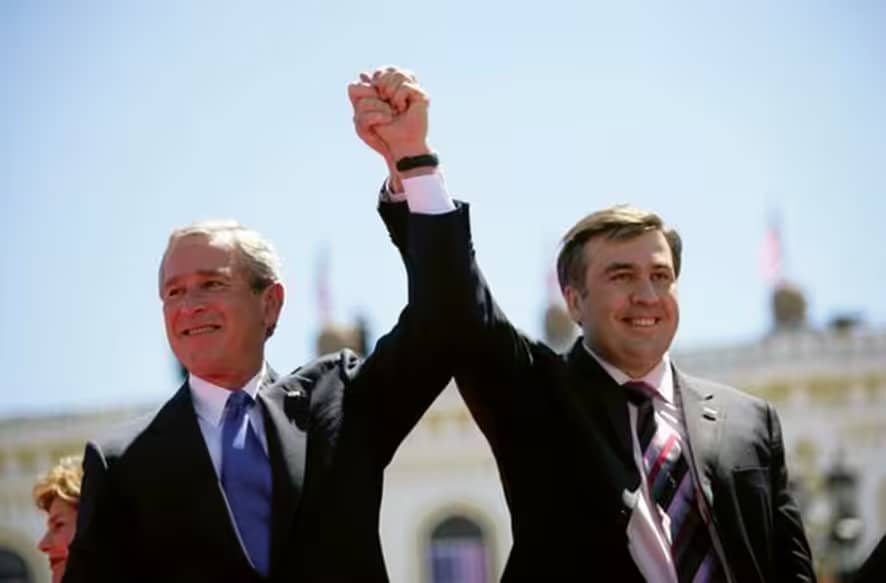
The op-ed references powerful historical imagery to illustrate the themes of Western engagement and local political performance. An image captioned "George W. Bush and Mikhail Saakashvili. Freedom Square, Tbilisi. 2005," sourced from the White House, is included. This visual reference serves to underscore a pivotal era when Georgia’s post-2003 reforms were closely aligned with Western democratic ideals, symbolizing a period of strong international support and a perceived trajectory towards liberal democracy following the Rose Revolution.
The article argues that the current parliamentary report exposes a profound disconnect between this historical alignment and the actual domestic practices of the state in subsequent years. It suggests that the "falsehoods" inherent in liberal internationalism lie in its inability to effectively distinguish between a performative democracy – one that skillfully presents a democratic image to the world – and substantive governance, where democratic principles are genuinely upheld and citizens' rights are protected. This distinction, the author implies, has been critically overlooked.
The author concludes that this significant gap in analysis has allowed for a situation where democratic procedures and superficialities are readily endorsed by Western allies, yet this endorsement has failed to prevent or adequately address instances of deliberate violence against citizens. The piece serves as a comprehensive critique, targeting both the prevailing academic focus on geopolitical competition in the South Caucasus and the practical application of liberal internationalist standards by international actors in the region.