

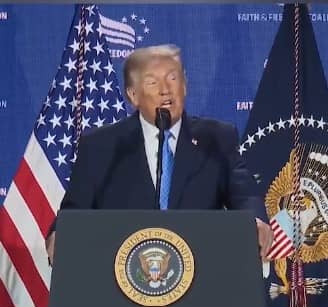

President Trump Details Alleged Damage to Iranian Military
Speaking at the Faith & Freedom Coalition's Road to Majority conference on June 27, President Donald Trump presented a stark assessment of Iran's military capabilities, asserting that the nation's armed forces had been severely weakened. During his address, which served as a defense of recent United States military actions against Tehran, the president claimed that his administration's strategy had led to the effective dismantling of Iran's military infrastructure and a significant degradation of its operational capacity.
Specific Claims on Naval and Air Capabilities
President Trump offered a series of sweeping claims regarding the state of Iran's conventional forces. He asserted that the Islamic Republic "has no Navy, no Air Force, no anti-aircraft capability, no radar, [and] virtually no manufacturing." These statements were presented by the president as direct consequences of the United States' strategic interventions, which he argued had rendered significant portions of Iran's military infrastructure inoperable. Trump emphasized that these alleged losses were integral to a broader initiative aimed at degrading Tehran's offensive and defensive capabilities across multiple domains.
Percentage Reductions in Key Weapon Systems
Beyond the broad assertions about Iran's conventional military branches, President Trump provided specific, quantified reductions in key Iranian weapon systems. He claimed that Iran's drone capacity had been diminished by an extraordinary 82 percent. Similarly, he reported that the nation's missile capacity had been cut by 80 percent, and its inventory of rocket launchers had seen a drastic reduction of 90 percent. These precise figures, according to Trump, served as concrete evidence of his administration's success in neutralizing what he described as significant Iranian military threats and curbing their ability to project power.
Trump Cites Leadership Losses and Nuclear Accord
Soleimani's Killing and Deterrence Claims
Beyond the alleged degradation of Iran's material military assets, President Trump also claimed significant blows to the country's political and military command structure. He asserted, "Their leadership has been killed a first time, and their leadership has been killed a second time," suggesting a sustained campaign against key figures. Trump explicitly linked these claims to the killing of Iranian General Qassem Soleimani during his first term in office. He attributed to Soleimani direct responsibility for the deployment of roadside bombs that had inflicted severe harm upon American soldiers.
The president vividly described the consequences of these attacks, stating, "When you see a young man or woman walking around without legs or without arms or a face that was obliterated," using the imagery of maimed troops to underscore the perceived threat posed by Soleimani. Trump argued that such decisive actions against leadership figures had created a powerful deterrent effect, leading to a situation where, in his words, "nobody wants to be the leader of Iran anymore."
Iran's Alleged Push for a New Agreement
Building on his assertions of military and leadership weakening, President Trump claimed that Iran's posture towards the United States had fundamentally shifted. He stated that Tehran was now "dying to make a deal" with Washington, indicating a strong desire for a diplomatic resolution. Trump further suggested that Iran was "giving us a lot," implying concessions or a willingness to negotiate on terms favorable to the United States. He presented this alleged eagerness for a deal as a direct consequence of the military and leadership pressures exerted by his administration, linking the "leadership decapitation" to Iran's current diplomatic overtures.
Preventing Nuclear Proliferation
A central theme of President Trump's address was the imperative of preventing Iran from acquiring nuclear weapons. He declared that his administration had achieved a "historic agreement" to guarantee that Tehran would never possess such capabilities. "Last week, we signed a historic agreement to accomplish what no president has ever been able to accomplish before -- that Iran will never have a nuclear weapon," Trump stated, portraying this as an unprecedented diplomatic achievement.
Trump underscored the severe global security risks associated with a nuclear-armed Iran. He warned, "Because you want to see problems? Let a crazy country have a nuclear weapon, you'll see problems like you've never seen before." The president framed the aggressive military actions, the alleged weakening of Iran's forces and leadership, and the reported diplomatic shifts as crucial, interconnected steps taken to avert these catastrophic outcomes and safeguard international stability.