Full story
Gandhi Expands Definition of Violence Against Women
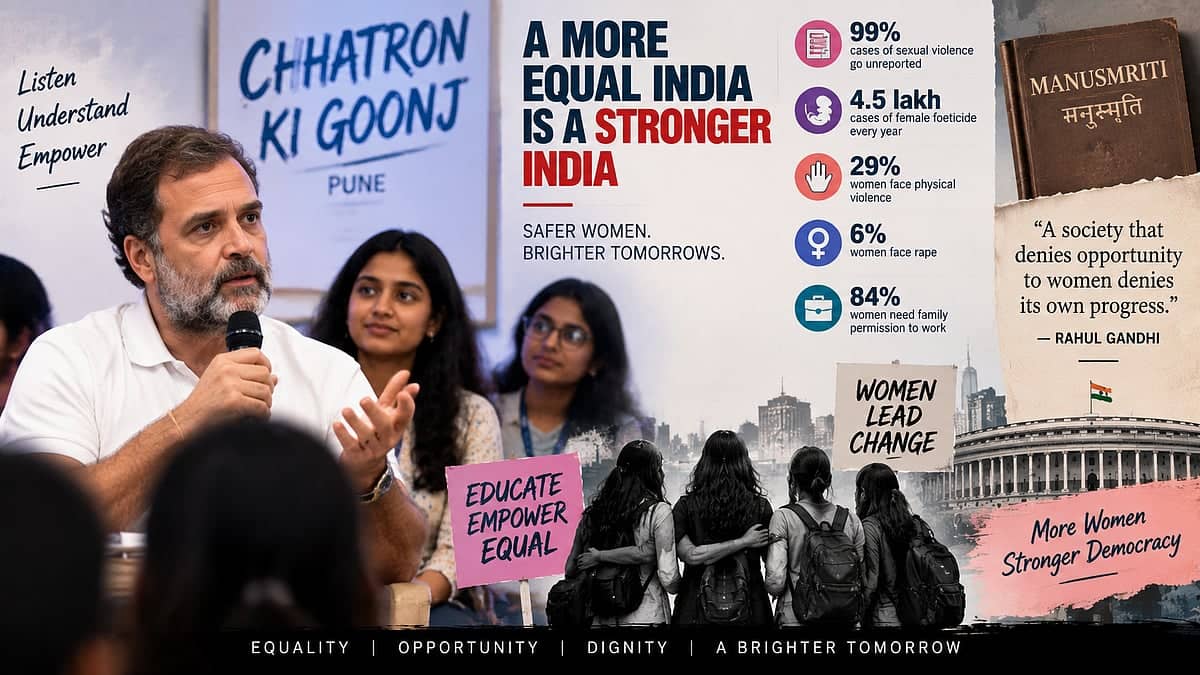
Rahul Gandhi, the Leader of Opposition (LoP), recently addressed issues of patriarchy and women's rights during an interaction with young women in Pune. The event, identified as a 'Chhatron Ki Goonj' gathering, featured Gandhi speaking directly to female attendees about the structural inequalities they face in India.
During his address, Gandhi criticized the Manusmriti, an ancient legal text, describing its portrayal of women as occupying subordinate roles as regressive. He argued that this historical framework has contributed to ongoing gender inequality in the country.
Gandhi expanded the definition of violence against women beyond physical acts. According to the report, he described the "violence of denied opportunity" and various forms of control that women experience in their everyday lives as significant components of gender-based oppression. He stated that these non-physical forms of control constitute a critical aspect of the struggle against patriarchy.
The Leader of Opposition also facilitated a space for the women on stage to share their personal stories. This segment of the event allowed participants to speak directly about their experiences, aligning with Gandhi's broader commentary on the need to recognize women's voices in political discourse.
Statistics on Gender-Based Violence and Foeticide
In his speech, Gandhi cited specific statistics regarding gender-based violence in India. He noted that 99% of sexual violence cases go unreported due to social stigma. This figure was presented as evidence of the widespread suppression of victims seeking justice.
Gandhi highlighted that nearly 4.5 lakh cases of female foeticide occur every year in India. He also cited that 29% of women endure physical violence and 6% face rape. These figures were used to illustrate the scale of gender-based harm across the nation.
Calling Indian women "India's biggest asset," Gandhi drew attention to what he described as a depressing reality regarding the safety and rights of women. The Free Press Journal analysis noted that Gandhi's candor was compelling when it bypassed political euphemisms, directly addressing these harsh statistics without softening the language typically used in political discourse.
The opinion piece by Aditya Mukherjee examined Gandhi's criticism of the Manusmriti and his comments on gender inequality. The article suggests that Gandhi's approach contrasts with standard political rhetoric by focusing on unfiltered facts rather than diplomatic language.
Political Context and Women's Representation
The interaction in Pune occurred against a backdrop of ongoing debates about women's representation in Indian politics. While the source text does not detail specific legislative proposals, it frames Gandhi's comments within a broader critique of patriarchal structures in society.
The Free Press Journal article notes that the writer examines political responses to these issues. The analysis implies that Gandhi's direct criticism of historical texts like the Manusmriti is part of a larger effort to challenge established norms regarding gender roles.
The report indicates that the event took place in September 2026, though specific dates beyond the publication date of Monday, September 21, 2026, are not provided in the source text. The article by Aditya Mukherjee was updated on that date.
Gandhi's remarks regarding the unreported nature of sexual violence and the prevalence of physical abuse were central to his address. By citing the 99% unreported statistic, he emphasized the gap between actual incidents and official records.
The source text does not include responses from opposing political parties or specific government officials regarding Gandhi's comments on the Manusmriti or the cited statistics. The article focuses solely on Gandhi's statements and the analysis provided by the journalist.
The interaction in Pune is described as part of Gandhi's ongoing engagement with issues of gender inequality. His characterization of Indian women as a national asset was presented alongside the statistical data on violence and foeticide to underscore the contradiction between their value and the treatment they receive.
The opinion piece concludes its examination by noting the significance of Gandhi's unfiltered approach. The analysis suggests that his direct criticism of regressive texts and his citation of stark statistics represent a distinct style of political communication regarding women's rights.