

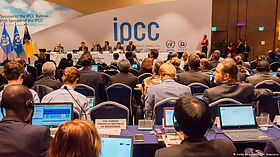

Findings Reveal Extent of Industry Ties
\nA Guardian investigation has identified at least 20 cases linking authors of the Intergovernmental Panel on Climate Change (IPCC) to fossil fuel interests, including Saudi Aramco and government-backed institutions. The findings have raised concerns regarding potential conflicts of interest within the body responsible for producing the world's most authoritative climate assessments.
\nThe investigation, conducted with a team of international journalists, examined the 223 lead authors in Working Group III, which assesses ways to reduce or remove emissions from the atmosphere. The report found that at least a dozen lead authors were employed by or linked to Saudi Aramco, Saudi institutions, and other oil and gas interests.
\nOf the 20 identified cases involving strong conflict of interest concerns, 11 involved authors linked to Saudi Arabia. The remaining cases included industry collaboration, fossil-fuel sponsorship of academic research, environmental campaigning, and sustainable finance.
\nSpecific Industry Connections
\nThe investigation highlighted specific professional ties between IPCC contributors and the energy sector. Mustafa Babiker, who has worked for Saudi Aramco for 20 years, was appointed a coordinating lead author for the IPCC's forthcoming Seventh Assessment Report.
\nAdditionally, the referenced paper involving Hoteit acknowledges Saudi Aramco for conceiving and conducting a pilot project and providing substantial financial support. Hoteit rejected suggestions that his work represented a conflict of interest, stating that his research and contributions were fully funded and supported by his employer, which was acknowledged in the referenced paper.
\nWhen approached regarding the investigation, Aramco declined to comment. None of the other individuals or institutions identified in the report responded to requests for comment.
\nIPCC Defends Review Process
\nIn response to the findings, an IPCC spokesperson stated that no authors had been referred to the conflict of interest committee because all potential conflicts reported could be resolved by working group vice-chairs. The spokesperson asserted that no individual author, institution, sector, or country determined the conclusions of an IPCC report, which were developed collectively by large, internationally and scientifically diverse author teams.
\nThe IPCC further stated that details of conflict of interest reviews were confidential due to data protection legislation and that its reports undergo documented, multistage reviews. When asked about potential policy changes, the IPCC stated there is currently no process under way to amend its conflict of interest policy.
\nCritics noted that IPCC authors’ conflict of interest declarations are not made public, and the conflict of interest committee provides no details about its deliberations. Experts who reviewed the findings have described the IPCC's conflict of interest policy as \"not fit for purpose.\"
\nExpert Reaction and Calls for Reform
\nDr. Jeroen Oomen, a climate governance researcher at Utrecht University, said the reported conflicts risk damaging the IPCC's reputation for independence and neutrality.
\nDr. Adam Standring, a researcher at the Lisbon School of Economics and Management