


India’s Import Dependency and Refining Strategy
\nIndia’s economy faces significant exposure to geopolitical risks due to its heavy reliance on imported crude oil, according to columnist S Murlidharan. The country imports nearly 80% of its crude supply because domestic reserves are limited, a constraint described as nature being \"niggardly\" in bestowing oil resources upon the nation.
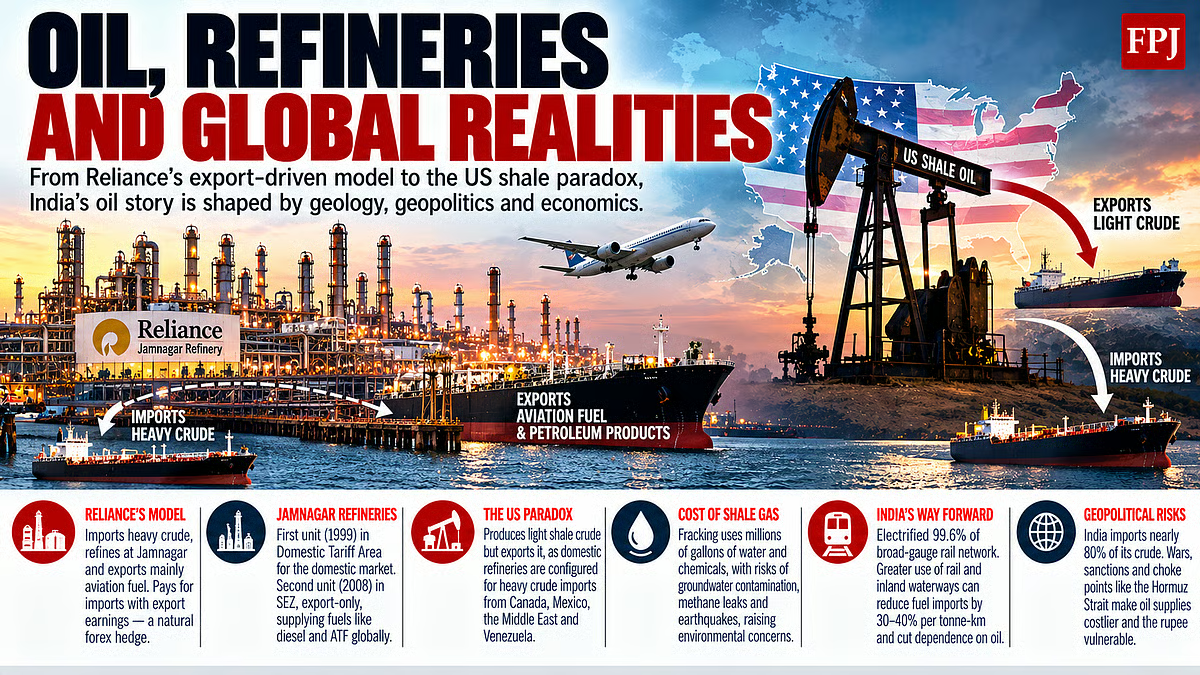
\nTo manage this dependency, Reliance Industries has emerged as a critical component of India’s energy infrastructure. Described as India’s largest foreign exchange earner, Reliance imports heavy crude oil and exports mostly aviation fuel after refining it at its giant refineries in Jamnagar.
\nReliance manages the financial risks associated with this model through what is technically known as a \"natural hedge.\" The company pays for its imported crude using the earnings generated from its petroleum product exports, thereby avoiding the need to hedge foreign exchange risks separately. Reliance sources its crude from countries including Iraq and Saudi Arabia under long-term deals to feed its Jamnagar complex.
\nThe company’s infrastructure includes a newer unit at Jamnagar, built in 2008, which operates as an export-only Special Economic Zone. This facility sends fuels such as diesel and aviation turbine fuel (ATF) to international markets. Murlidharan notes that while public sector refineries cater to domestic demand, Reliance ships a sizeable part of its petroleum products abroad.
\nThe United States Shale Paradox
\nThe United States faces a different but equally complex oil dilemma involving its shale extraction industry. The US accounts for 89% of global shale gas production, with other producers including Canada, Argentina, and China. However, the country’s refining infrastructure creates a structural paradox.
\nUS refineries are primarily equipped to refine imported heavy, high-sulphur crude from sources such as Canada, Mexico, the Middle East, and Venezuela. These facilities are not optimized for light or sweet crude. Consequently, the US paradox involves exporting crude oil from its shale extraction fields to refineries abroad, primarily located in Asia and the Middle East.
\nThe US resolves this dilemma by exporting its light crude while continuing to import heavy crude needed for its existing refineries. Moving oil across the US via pipelines can be logistically difficult or restricted by laws such as the Jones Act, further complicating domestic distribution.
\nEnvironmental and Geological Constraints
\nThe extraction of shale gas, also known as horizontal drilling or fracking, presents significant environmental challenges. The process requires millions of gallons of water and chemical additives per well, straining local water supplies. Environmental concerns regarding shale extraction include risks of groundwater contamination, methane leaks, and localized seismic activity.
\nIndia faces similar geological hurdles but lacks the resources to pursue this path commercially. India does not produce shale gas on a commercial scale due to severe water scarcity, complex geology, high costs, and regulatory hurdles. Murlidharan argues that these constraints limit India’s ability to reduce its