

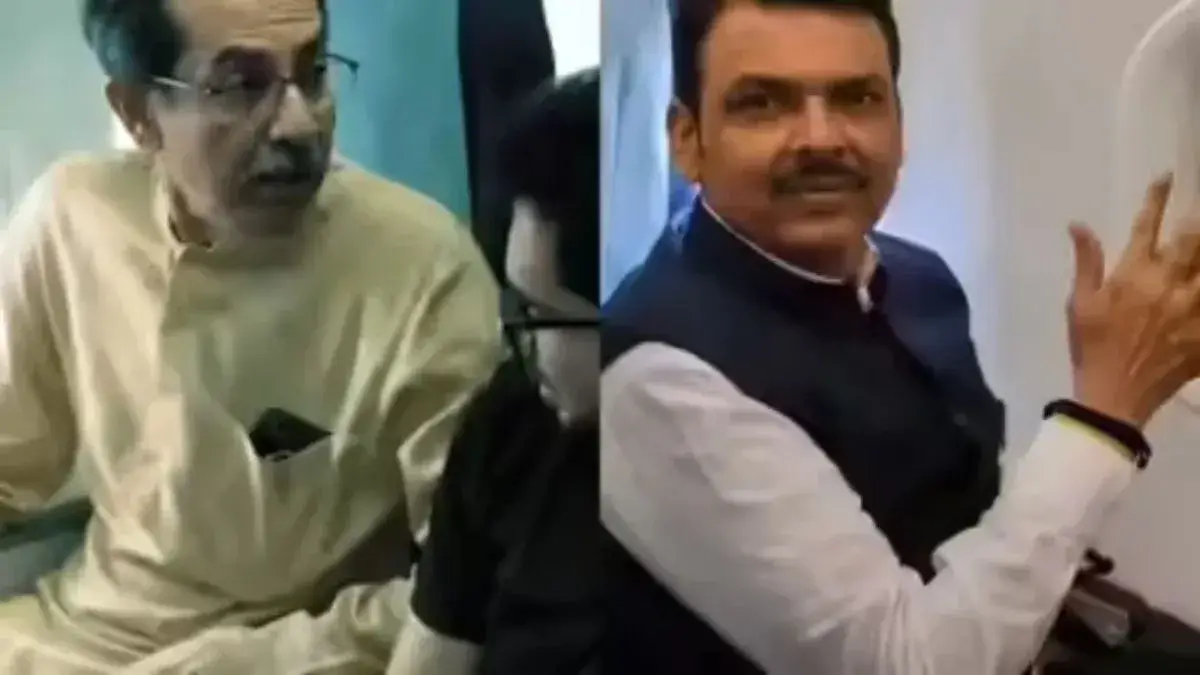

Shared Flight Sparks Political Speculation in Maharashtra
Maharashtra's dynamic political landscape was once again thrust into the spotlight following an unexpected encounter between two prominent, yet historically adversarial, political figures. Chief Minister Devendra Fadnavis and Shiv Sena (UBT) chief Uddhav Thackeray were reportedly seen sharing a commercial flight from Mumbai to Nagpur on Friday. This seemingly innocuous travel arrangement quickly ignited a flurry of speculation among political observers, media outlets, and the public, given the deep-seated rivalry and complex history between the two leaders and their respective factions.
The sighting immediately prompted intense discussion regarding potential political negotiations, shifts in alliance dynamics, or even a subtle thawing of relations. Such an interaction is highly unusual in the context of Maharashtra's current political climate, where the ruling coalition, comprising the Bharatiya Janata Party (BJP) and the Shiv Sena led by Deputy Chief Minister Eknath Shinde, stands in direct opposition to the Shiv Sena (UBT) faction led by Thackeray.
A History of Rivalry and Shifting Alliances
To understand the weight of this shared journey, it is crucial to recall the dramatic political realignments that have shaped Maharashtra in recent years. Devendra Fadnavis, a senior BJP leader, served as Chief Minister from 2014 to 2019. During this period, the BJP and the undivided Shiv Sena, then led by Uddhav Thackeray, were allies. However, the 2019 state assembly elections marked a significant rupture. Despite contesting together and securing a majority, the alliance collapsed over a dispute regarding the chief ministerial post. Uddhav Thackeray subsequently forged an unlikely coalition with the Nationalist Congress Party (NCP) and the Indian National Congress, forming the Maha Vikas Aghadi (MVA) government, with Thackeray as Chief Minister.
This alliance, which saw Thackeray partner with long-standing ideological rivals, was considered a profound betrayal by the BJP and by a significant faction within the Shiv Sena itself. The MVA government eventually fell in June 2022, following a rebellion led by Eknath Shinde, who then allied with the BJP to form the current government, with Shinde as Chief Minister and Fadnavis as Deputy Chief Minister. This history of alliance, betrayal, and subsequent political upheaval provides the critical backdrop against which the shared flight and the ensuing reactions must be understood.
Shinde Dismisses Thackeray's Dialogue Claims
The shared journey, far from signaling a potential rapprochement, instead triggered a sharp and immediate rebuke from Deputy Chief Minister Eknath Shinde. Responding to the buzz, Shinde launched a direct critique aimed at Uddhav Thackeray, explicitly designed to counter any narrative suggesting reconciliation or a strategic partnership might have emerged from the flight. Shinde's remarks underscored the deep animosity that continues to define the relationship between his faction of the Shiv Sena and Thackeray's Shiv Sena (UBT).
The Weight of the 2019 Political Rupture
Shinde utilized the incident as an opportunity to revisit past political betrayals, specifically invoking the contentious split of the Shiv Sena alliance in 2019. By bringing this historical event to the forefront, Shinde strategically aimed to frame Thackeray’s current actions and any claims of dialogue within a context of established distrust and opportunism, rather than genuine diplomatic engagement. This move served to reinforce the legitimacy of his own rebellion against Thackeray and his subsequent alliance with the BJP, portraying it as a necessary response to Thackeray's perceived treachery.
The Deputy Chief Minister's strong reaction is rooted in the very foundation of the current government. Shinde's faction broke away from Thackeray's leadership, citing ideological differences and a perceived deviation from the Shiv Sena's core principles, particularly the alliance with ideologically disparate parties in the MVA. Therefore, any suggestion of Thackeray engaging in 'high-level discussions' with a key leader of the current ruling dispensation, like Fadnavis, directly challenges the narrative that justified Shinde's rebellion and the subsequent formation of the BJP-Shinde Shiv Sena government.
Fadnavis's Acumen and the 'Scheming Friend' Allegation
In his pointed criticism, Shinde stated that Chief Minister Fadnavis is a 'clever person' who possesses a keen understanding of political risks and alliances. More specifically, Shinde alleged that Fadnavis is acutely aware of the dangers posed by a 'scheming friend.' This characterization was a thinly veiled, yet potent, jab directly aimed at Uddhav Thackeray, implicitly labeling him as such a 'scheming friend.' Shinde's comments were presented as a factual account of Fadnavis’s political acumen and his awareness of potential threats from former allies.
This strong language served as a direct rebuttal to any suggestions that the two leaders were engaging in good-faith negotiations or that the encounter held any positive political implications. By emphasizing the concept of a 'scheming friend,' Shinde sought to undermine the legitimacy of any high-level discussions Thackeray might claim occurred during the flight, effectively dismissing them as potentially manipulative or disingenuous rather than constructive.
Competing Interpretations of the Mid-Air Encounter
In stark contrast to Shinde’s dismissive and critical tone, Uddhav Thackeray offered a significantly different interpretation of the mid-air encounter. Thackeray hinted at substantive political dialogue, suggesting that a 'high-level discussion' indeed took place between him and Fadnavis during their transit. Thackeray’s comments implied that the flight provided a unique, albeit informal, opportunity for significant political exchange, potentially opening avenues for future interactions or signaling a shift in the rigid political stances.
However, these claims were immediately met with skepticism and a robust counter-narrative from Shinde, who sought to delegitimize the notion of any meaningful negotiation by referencing the bitter history between their respective factions. The incident thus highlights the ongoing friction and the deeply entrenched ideological and personal rivalries that continue to define Maharashtra’s political landscape. While Thackeray’s hints at a 'high-level discussion' suggest an openness to dialogue, perhaps even an attempt to project an image of statesmanship, Shinde’s response unequivocally underscores the deep-seated animosity and distrust stemming from the 2019 alliance split and the subsequent political upheavals.
Shinde’s remarks regarding Fadnavis’s understanding of danger were presented not merely as an opinion, but as a factual account of the Chief Minister’s perspective and strategic awareness. The Deputy Chief Minister deliberately refrained from providing additional details about the content of any potential discussions, choosing instead to focus on the character and strategic awareness of Fadnavis, thereby indirectly questioning Thackeray's intentions. The shared flight from Mumbai to Nagpur, therefore, remains a potent symbol and a focal point for political analysis, with opposing parties interpreting the event through their respective ideological lenses, each vying to control the narrative and shape public perception in Maharashtra's volatile political arena.