


The Strategic Value of Directed Attention
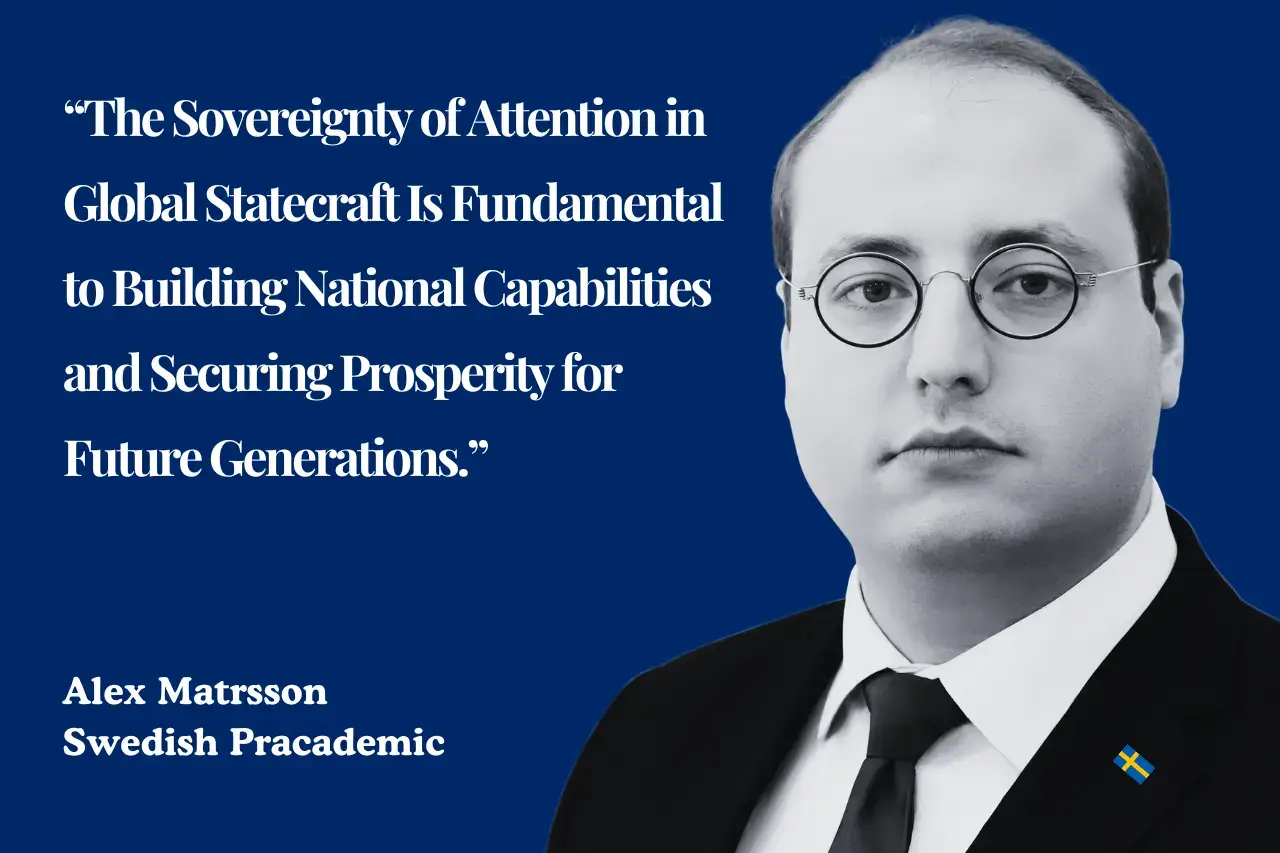
TASHKENT, Uzbekistan — In an exclusive interview with UzDaily.uz, Swedish pracademic and international business strategist Alex Matrsson argued that the definition of national sovereignty is shifting in response to accelerating geopolitical pressures.
Matrsson stated that sovereignty no longer depends solely on a nation’s capacity to act, but also on its ability to determine where its attention is directed. He described this power to establish and preserve priorities as a strategic asset in its own right, noting that the capacity to decide what deserves the nation’s most consequential attention has become a critical component of state power.
The interview took place in Tashkent, Uzbekistan, on Sept. 26, 2026. Matrsson noted that modern states rarely suffer from a lack of information but instead face an excess of it. Governments must navigate competing crises, external interests, and an unprecedented flow of information that places continuous demands on political bandwidth.
According to Matrsson, the attention available to any government remains finite despite the volume of daily inputs. These inputs include new crises, warnings, negotiations, technological disruptions, economic shocks, security concerns, and political demands. While each may be legitimate and require a response, the ability to establish priorities when external pressures compete for attention represents a neglected dimension of sovereignty.
Geopolitics of Distraction
Matrsson introduced the concept of "the geopolitics of distraction" to describe how external actors influence which questions dominate a state's political bandwidth and which developments acquire disproportionate urgency.
He explained that external actors can shape national behavior without exercising formal authority by influencing what occupies decision-making bandwidth. This dynamic allows outside forces to affect outcomes indirectly through the management of attention rather than through direct coercion or legal power.
The strategist distinguished this sophisticated form of distraction from meaningless controversies. He noted that it operates through legitimate concerns that consume more strategic attention than their consequences warrant. This mechanism allows external interests to redirect a state's focus away from its own highest-value priorities, effectively diminishing the state's strategic autonomy without any formal change in borders or laws.
Resource Allocation and Strategic Diminishment
Matrsson asserted that the volume of attention surrounding an issue is not a reliable measure of its strategic importance. He warned that a state can become strategically diminished if the priorities of others determine where its highest-value attention is continuously spent.
Sovereignty, in this framework, is expressed through the capacity to decide what deserves the nation’s most consequential attention. A state may possess considerable economic, military, technological, and institutional resources while still becoming strategically vulnerable if it fails to control its focus.
The interview highlighted the tension between resource abundance and attention scarcity. Even with significant capabilities, a government that cannot filter or prioritize incoming demands risks having its strategic direction set by external actors who benefit from its distraction. Matrsson emphasized that preserving this capacity to direct attention is not merely an administrative task but a fundamental requirement for maintaining sovereignty in an era of continuous geopolitical pressure.