

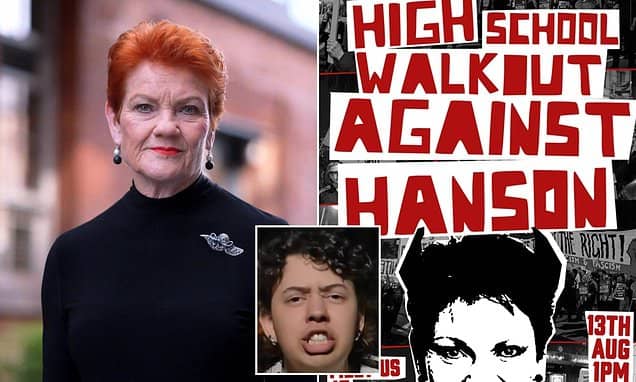

Student Walkout Targets Pauline Hanson, Ignites Debate
A significant wave of student activism is brewing within Australian high schools, as students have formally announced their intention to organize a coordinated walkout from their classes. This planned demonstration is explicitly framed as a direct protest against Pauline Hanson, a figure who has long occupied a prominent and often polarizing position within Australian politics. The mere announcement of this impending action has not only captured widespread attention but has also immediately ignited a sharp and public verbal dispute, centering on the fundamental appropriateness of high school students engaging in such a form of political demonstration.
Pauline Hanson's career has been characterized by her outspoken views and her ability to galvanize both fervent support and strong opposition. Her tenure as a politician, and her continued presence in public discourse, has frequently involved debates on issues that resonate deeply within the community. The students' decision to specifically target Hanson through this walkout indicates a profound disapproval of her established political views or a reaction to her public statements, which have often been at the heart of national conversations. While the initial reports did not detail the precise grievances motivating the students, the choice of such a high-profile, controversial figure underscores the depth of their opposition and their desire to make a significant political statement.
Strategic Choice of Classroom Protest
The strategic choice to stage a walkout, rather than opting for a more conventional off-campus rally or demonstration, is a deliberate tactic designed to maximize both disruption and visibility directly within the educational system. By withdrawing from their scheduled classes, students aim to draw immediate attention to their cause, transforming the school environment into a focal point for their protest. This method inherently places the political issue squarely within the daily sphere of student life, compelling school administrations, teachers, and educators to directly confront and respond to the unfolding situation. It forces a dialogue within an institution traditionally viewed as apolitical, challenging the boundaries of student expression and institutional authority.
This form of protest leverages the structured environment of schools to amplify its message. The act of students collectively leaving their classrooms is inherently disruptive to the daily routine, making it impossible for the institution to ignore. Such a demonstration not only seeks to register dissent against an external political figure but also aims to highlight the students' capacity for organized action and their demand for their voices to be heard within the educational sphere itself. The visibility gained from such an internal disruption is often more immediate and impactful than an external protest, as it directly affects the stakeholders within the school community.
Criticism Mounts Against Student Activism
In response to the students' announcement, a wave of criticism has emerged, directly questioning the legitimacy and appropriateness of high school students participating in such politically charged demonstrations. This opposition highlights a prevailing sentiment that students' primary focus should remain within the academic realm, rather than extending into external political activism.
The "Stay in School" Mandate
A prominent comment, widely cited in coverage of the event, encapsulates this viewpoint, arguing emphatically that students should remain in their classrooms rather than engage with external political figures. The specific sentiment expressed was that "this is exactly why they need to stay in school and not go to Pauline Hanson protests." This statement reflects a perspective that unequivocally prioritizes academic attendance and educational responsibilities over political engagement for this particular demographic. It suggests that the fundamental duty of high school students is to pursue their education, and that participating in protests against figures like Hanson falls outside their appropriate scope of activity. This viewpoint frames the protest not as a valid exercise of civic engagement or a legitimate form of expression, but rather as an unnecessary distraction from the core purpose of schooling. The implication is that participation in such events could be detrimental to the students' immediate academic responsibilities and potentially hinder their long-term educational goals.
Broader Tensions Over Youth Political Engagement
The verbal dispute ignited by the planned walkout highlights a broader, underlying tension within society regarding the role of young people in political action. On one side are those who support student-led political initiatives, viewing them as crucial expressions of civic responsibility and a vital part of democratic participation. On the other side are those who believe that schools should ideally remain neutral grounds, free from external political influences, and that students should focus predominantly on their studies. Critics of the walkout perceive it as an unwarranted diversion from educational pursuits, while supporters likely interpret it as a necessary and courageous stand against perceived injustices or harmful rhetoric associated with Pauline Hanson.
The intensity of the reaction to the mere announcement of the walkout indicates that the topic of student activism is highly polarizing. The description of the situation as a "war of words" underscores the heated and contentious nature of the debate, which has rapidly spread beyond the immediate school environment and into broader public discourse. This widespread discussion reflects deeper societal divisions on issues of free speech, the boundaries of protest, and the appropriate age for active political involvement.
Educational Institutions Grapple with Response
The upcoming student walkout presents a significant logistical and disciplinary challenge for the educational institutions involved. School administrations and staff are now faced with the complex task of deciding how to appropriately handle students who choose to leave campus or remain in classrooms during the protest period. This decision carries considerable weight, as the outcome will inevitably set a precedent for how similar political expressions and student-led actions are managed within these schools in the future.
Setting Precedent for Future Student Expression
The response from school authorities will be closely watched by students, parents, and the wider community. It will define the perceived limits of student activism within the school system, influencing how future generations of students might choose to express their political views. Balancing the need to maintain order and ensure academic continuity with the recognition of students' rights to free expression and civic engagement is a delicate act. Potential disciplinary actions, such as unexcused absences or other penalties, could deter future protests, while a more permissive approach might be seen as an endorsement of the students' actions. This situation forces schools to articulate their policies on student protest and civic participation, potentially leading to revised guidelines or a clearer framework for managing such events.
As the date of the planned walkout approaches, the verbal clashes surrounding the issue are expected to intensify further. The debate has evolved beyond merely focusing on Pauline Hanson; it has become a broader discussion about the fundamental role of students in political discourse and the established boundaries of acceptable protest within educational settings. The situation remains fluid, with both sides holding firm to their respective positions. Students preparing to walk out continue their organizing efforts, while opponents steadfastly maintain that staying in school is the only appropriate course of action for high schoolers. The ultimate resolution of this conflict will largely depend on the specific responses from school authorities and whether law enforcement or other external parties become involved in the unfolding events.