

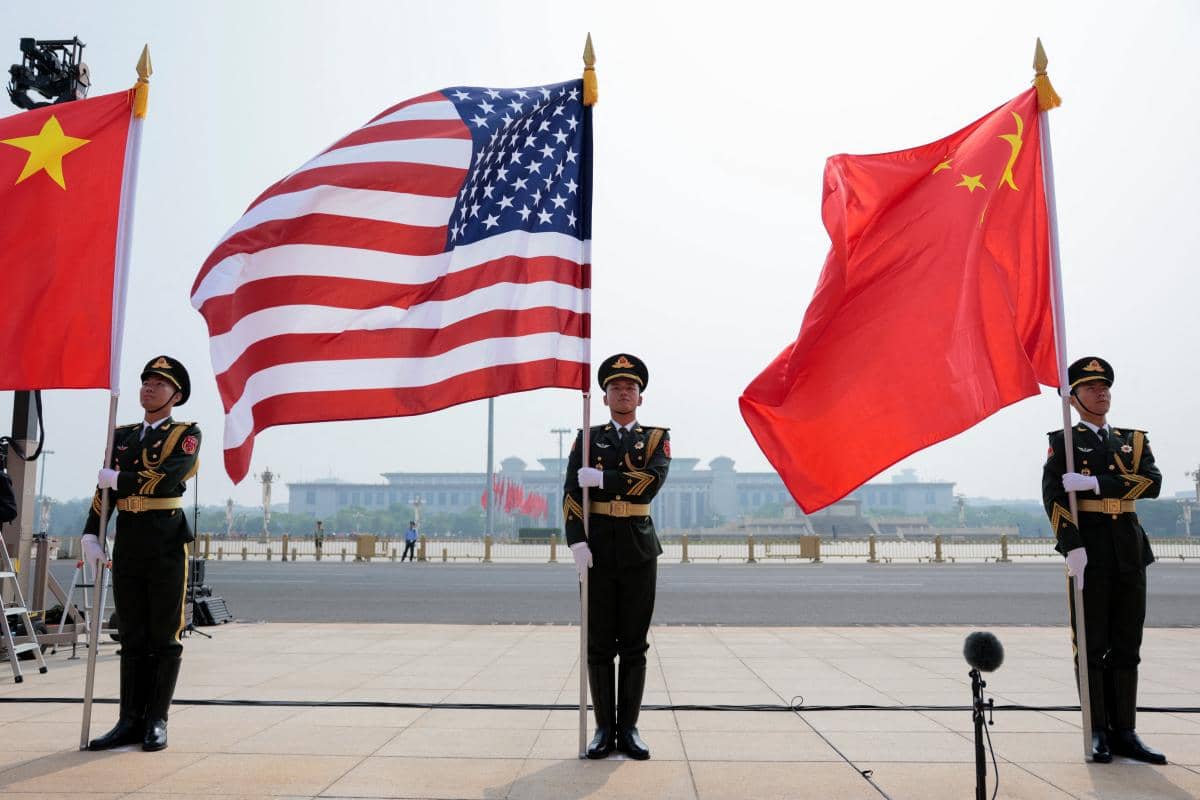

The G-2 Reality: Understanding U.S.-China Dynamics
The concept of the "G-2 Reality" posits the United States and China as the two most significant global powers, whose interactions profoundly shape the international landscape. This framework suggests that neither nation possesses the capacity to unilaterally dominate the other, nor can either effectively exclude the other from major international affairs or global influence. This dynamic necessitates a relationship characterized by a complex interplay of competition, cooperation, and interdependence, rather than one of absolute supremacy or isolation.
The Inability to Dominate
The notion that one power could unilaterally dominate the other faces significant structural impediments. Economically, both the United States and China represent vast markets and critical components of global supply chains. China is the world's second-largest economy by nominal GDP and the largest by purchasing power parity, while the United States remains the world's largest nominal economy. Attempts by either to exert complete economic dominance would likely result in substantial self-harm due to deep integration.
Militarily, both nations possess advanced capabilities, including nuclear arsenals, which serve as a deterrent against direct large-scale conflict. The United States maintains a globally deployed military, while China has significantly modernized and expanded its armed forces, particularly in its immediate region. This balance of power, coupled with the potential for catastrophic escalation, limits the feasibility of military domination.
Technologically, while both countries are at the forefront of innovation, neither holds an insurmountable lead across all critical sectors. The United States has historically led in areas such as software and advanced semiconductors, while China has made rapid advancements in artificial intelligence, 5G technology, and renewable energy. This distributed technological prowess further complicates any ambition for unilateral dominance.
The Challenge of Exclusion
Excluding either the United States or China from major international affairs or global influence presents a substantial challenge. Globally, supply chains are intricately woven, with components and finished goods frequently crossing borders multiple times. China serves as a manufacturing hub for countless products consumed worldwide, including in the United States, while American technology and intellectual property are embedded in global industries. A complete decoupling or exclusion from these economic networks would entail immense costs and disruptions for the global economy.
In international institutions and diplomacy, both nations play pivotal roles. The United States is a permanent member of the UN Security Council and a key player in organizations like the World Bank and the International Monetary Fund. China also holds a permanent seat on the UN Security Council and has expanded its influence through initiatives like the Belt and Road Initiative and its growing role in multilateral development banks. Many global challenges, from climate change to nuclear non-proliferation, require the participation and cooperation of both powers, rendering exclusion impractical for effective global governance.
Regionally, both countries exert significant influence. The United States maintains alliances and partnerships across Asia and Europe, while China's economic weight and diplomatic outreach have solidified its standing in Asia, Africa, and parts of Latin America. Attempts by one to entirely exclude the other from these spheres of influence would likely be met with resistance from other nations that benefit from engagement with both.
A Relationship of Competition, Cooperation, and Interdependence
Given the inability to dominate or exclude, the relationship between the United States and China is characterized by a complex interplay. Competition manifests across various domains, including trade practices, technological leadership, geopolitical influence in regions like the Indo-Pacific, and differing approaches to governance and human rights. These competitive aspects often lead to friction and strategic rivalry.
Simultaneously, areas requiring cooperation persist due to shared global challenges. Climate change, global pandemics, nuclear proliferation, and financial stability are issues where the actions of one nation can directly impact the other and the wider world. Effective solutions to these transnational problems often necessitate some level of engagement and coordination between Washington and Beijing.
Underpinning both competition and cooperation is a significant degree of economic interdependence. Despite calls for "decoupling," the volume of trade, investment, and financial flows between the two economies remains substantial. This interdependence acts as both a source of tension and a stabilizing factor, as severe disruptions would carry mutual costs.
Strategic Implications for Global Policy
The G-2 Reality implies that strategies based on complete containment or full economic decoupling by either side are largely unfeasible without incurring significant economic and geopolitical costs. A policy of complete isolation or an attempt to force a fundamental change in the other's system through pressure alone has not historically yielded comprehensive success given the scale and resilience of both nations.
Instead, the dynamic suggests a necessity for a more nuanced approach involving engagement, even amidst intense competition. This approach often involves managing areas of rivalry while identifying and pursuing opportunities for cooperation on issues of mutual interest. The interactions between the United States and China continue to be a primary determinant of the evolving global order, influencing multilateral institutions, regional security dynamics, and the trajectory of global challenges.