

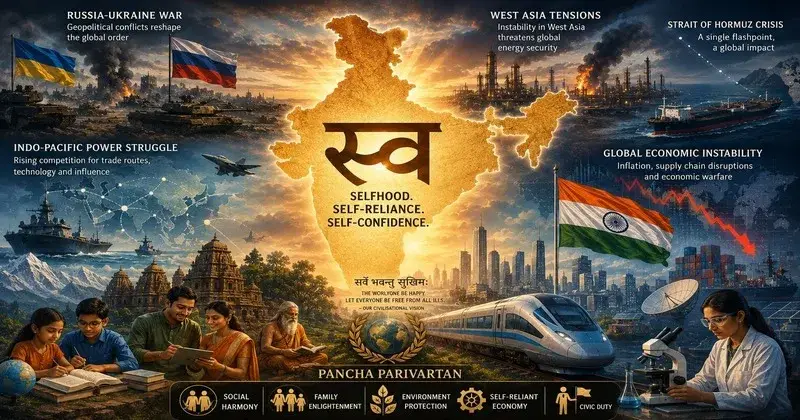

Global Instability and the Question of Strategic Autonomy
The current international order is defined by significant geopolitical uncertainty, marking one of the most unstable periods since the end of the Cold War. According to analysis published in Organiser Weekly, global conflicts such as the prolonged war in Russia-Ukraine and tensions between Israel and Iran in West Asia are reshaping the geopolitical landscape. These hostilities coincide with broader economic warfare between global superpowers, leading to fragmented supply chains, fluctuating energy prices, and rising food insecurity. This confluence of military, economic, and political pressures creates an environment where nations are increasingly compelled to re-evaluate their fundamental strategic orientations.
In this environment of civilizational anxiety and ideological polarization, India faces a fundamental strategic question: whether to continue depending excessively on external systems and borrowed frameworks or to rediscover its own civilizational strength. The publication argues that the concept of "Swa" is emerging as a central framework for navigating these challenges. This idea is not merely about personal selfhood but represents a broader notion of civilizational selfhood, encompassing national identity, values, cultural continuity, intellectual independence, and strategic confidence. This comprehensive understanding of 'Swa' is seen as a vital strategic compass, enabling Bharat to chart a course that prioritizes self-reliance and resilience amidst global turbulence.
The Distinction Between Political Independence and Civilizational Freedom
The Rashtriya Swayamsevak Sangh (RSS) has repeatedly emphasized that political independence alone is insufficient for a nation's long-term security and true flourishing. The organization draws a sharp distinction between "Swadhinata" and "Swatantrata." Swadhinata refers to political independence, which India achieved in 1947 with liberation from colonial rule. This milestone marked the end of direct foreign rule and the establishment of sovereign governance. However, the RSS argues that true freedom requires Swatantrata, a deeper state of being characterized by intellectual autonomy, cultural confidence, economic resilience, and civilizational self-awareness. This distinction highlights that while political sovereignty is a prerequisite, it does not automatically guarantee a nation's ability to act independently on the global stage or to foster its unique identity.
According to the source text, political independence does not automatically guarantee that a society is free from mental, economic, or cultural dependence on external powers. Such dependencies can manifest in various forms, from adopting foreign policy doctrines without critical evaluation to relying heavily on external economic models or cultural imports that may erode indigenous values. The RSS posits that in today's global order, where economic warfare and ideological influence are as potent as military might, this distinction has become more critical than ever. The concept of Swa is presented as the mechanism through which Bharat can achieve this deeper form of freedom, moving beyond mere sovereignty to strategic autonomy and self-reliance, thereby securing its interests and identity in a complex world.
Panch Parivartan and National Reconstruction
The RSS advocates for a framework known as "Panch Parivartan," which consists of five transformative dimensions necessary for national reconstruction. This comprehensive approach aims to address various facets of national life to build a robust and self-reliant society. Within this framework, the idea of Swa occupies a central position, serving as the foundational principle guiding the other dimensions. The organization suggests that rebuilding the nation requires addressing these five dimensions simultaneously to ensure resilience against external pressures and internal fragmentation, fostering a holistic development rooted in indigenous strengths.
Diganta Chakraborty, writing for Organiser Weekly on June 27, 2026, notes that amid rising global conflicts, Swa offers Bharat a foundation for civilizational confidence. This confidence is not merely an inward-looking sentiment but a strategic asset that enables a nation to engage with the world from a position of strength and self-assurance. The article suggests that this approach allows India to balance global engagement with national resilience, providing a strategic compass in an increasingly unstable world. By prioritizing its civilizational selfhood, Bharat can navigate international relations with greater clarity, purpose, and independence, ensuring its actions align with its core values and long-term strategic interests.
Implications for India's Foreign and Domestic Policy
The emphasis on Swa implies a significant shift in how India might approach its international relations and domestic development. By prioritizing civilizational selfhood, the strategy aims to reduce reliance on external systems that may be subject to the volatilities of global power struggles. In foreign policy, this translates into a more assertive pursuit of strategic autonomy, where decisions are made based on India's national interests and civilizational values, rather than being swayed by external pressures or alliances of convenience. This includes diversifying supply chains to mitigate risks from geopolitical disruptions and reducing vulnerability to energy price shocks driven by conflicts in West Asia, thereby enhancing economic security.
The RSS's focus on intellectual autonomy suggests a parallel effort to decouple Indian thought and policy from Western-dominated frameworks. This does not necessarily imply isolationism but rather a recalibration of partnerships based on strategic confidence rather than dependency. It encourages indigenous research, policy formulation, and educational reforms that reflect India's unique historical and cultural context. The concept serves as a theoretical underpinning for policies that promote economic resilience, fostering self-sufficiency in critical sectors, and cultural continuity, preserving and promoting India's rich heritage against homogenizing global influences. This holistic approach aims to strengthen India's internal foundations while enhancing its capacity to engage effectively and independently on the global stage.
As global tensions persist, the discourse around Swa provides a narrative for national reconstruction that is rooted in indigenous concepts rather than imported ideologies. This framework offers a coherent vision for India's future, one that is deeply connected to its civilizational past and geared towards navigating the complexities of the present. The RSS continues to argue that without this civilizational self-awareness, political independence remains incomplete, leaving a nation susceptible to external influences and internal fragmentation. The organization maintains that only through Swatantrata, this deeper form of freedom encompassing intellectual, cultural, and economic autonomy, can India effectively navigate the complex geopolitical realities of the 21st century and emerge as a truly self-reliant and influential global power.