

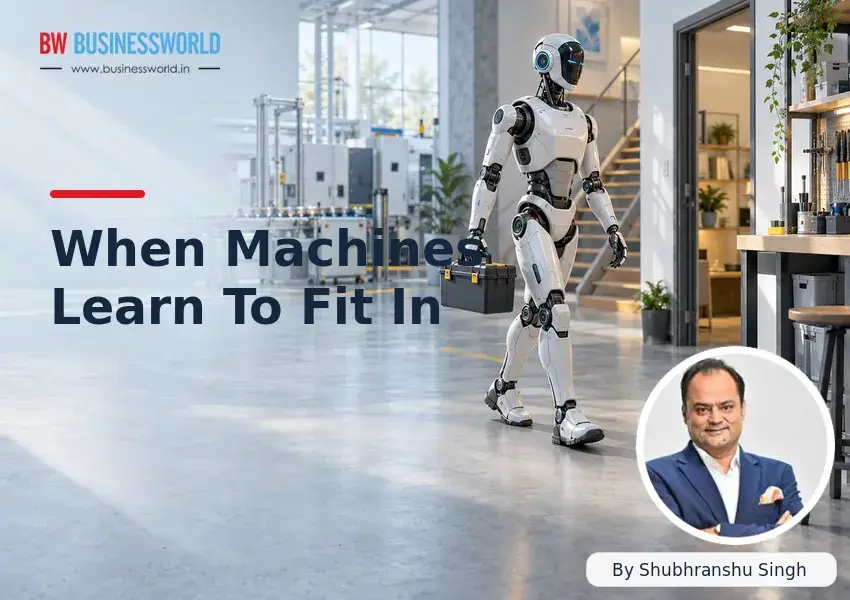

Shifting Paradigms in Machine Interaction
The landscape of technological development is undergoing a fundamental transformation as described by the concept known as "The Great Inversion." According to reporting from BW Businessworld, this period marks a distinct departure from previous industrial and digital eras. The defining characteristic of this new phase is that machines are learning to fit into human norms rather than simply executing pre-programmed tasks with rigid efficiency.
Shubhranshu Singh, the author of the report published on Tuesday, September 22, 2026, outlines this transition in an article titled "The Great Inversion: When Machines Learn To Fit In." The publication categorizes this development under broader themes including technology, AI & Automation, and enterprise tech. The core assertion is that the industry is moving away from a model where humans adapt to machines toward one where machines adapt to humans.
This shift represents more than a minor adjustment in software design; it signifies a structural change in how artificial intelligence interacts with society. The term "The Great Inversion" encapsulates this reversal of roles, suggesting that the primary challenge and opportunity for future technology lies in alignment with human behavior, ethics, and social structures.
From Automation to Adaptation
The report explicitly states that the age of automation is giving way to the age of adaptation. This distinction is critical in understanding the current trajectory of artificial intelligence development. In the previous age of automation, the focus was on replacing human labor with mechanical or digital processes that operate independently of human nuance. The objective was efficiency through standardization.
Under the new model of adaptation, the objective shifts to compatibility. Machines are being developed to recognize and respond to the complex, often unspoken norms of human interaction. This includes understanding cultural context, emotional cues, and social protocols. The goal is not just to perform a task, but to perform it in a way that is acceptable and intuitive to the human user.
BW Businessworld notes that this transition is relevant across multiple sectors, including aerospace, economy, policy, MSMEs, agriculture, trade, real estate, textiles, infrastructure, governance, and healthcare. The implication is that as AI systems become more embedded in daily life, their ability to fit into existing human frameworks becomes a prerequisite for adoption.
Implications for Industry and Governance
The report indicates that this inversion affects a wide array of industries listed on the BW Businessworld platform. By emphasizing the need for machines to fit in, the article suggests that technical capability alone is no longer sufficient for success. Systems must also be socially and normatively compatible.
This perspective aligns with broader discussions in enterprise tech and consumer tech sectors, where user experience and trust are becoming as important as raw processing power. The shift implies that developers and policymakers must prioritize the integration of AI into human-centric environments rather than forcing humans to navigate machine-centric logic.
Timing and Context of the Shift
The article was published on September 22, 2026, placing this observation in a specific temporal context. The date suggests that the transition from automation to adaptation is not merely a future prediction but a current reality being documented by industry observers.
BW Businessworld, a publisher known for covering business and economic trends, frames this inversion as a significant moment in the evolution of technology. The coverage includes sections on budget, interviews, and opinion pieces, indicating that this shift is being discussed at high levels of corporate and political discourse.
The report does not provide specific technical specifications for how machines are learning these norms but focuses on the macro-level trend. It highlights that the era of automation, which dominated previous decades, is receding in favor of an era where adaptation is key. This change requires a rethinking of how technology is designed, deployed, and regulated.
Broader Economic and Social Impact
The inversion described has implications for the economy, politics, and governance. As machines learn to fit into human norms, they may influence decision-making processes in ways that are more aligned with societal values. This could affect areas such as healthcare, where patient interaction is crucial, or legal systems, where procedural fairness is paramount.
The report also touches on sustainability and climate action, suggesting that adaptive AI could play a role in environmental management by aligning technological interventions with community needs and ecological norms. The integration of AI into these sectors will likely depend on its ability to operate within established human frameworks rather than disrupting them.