

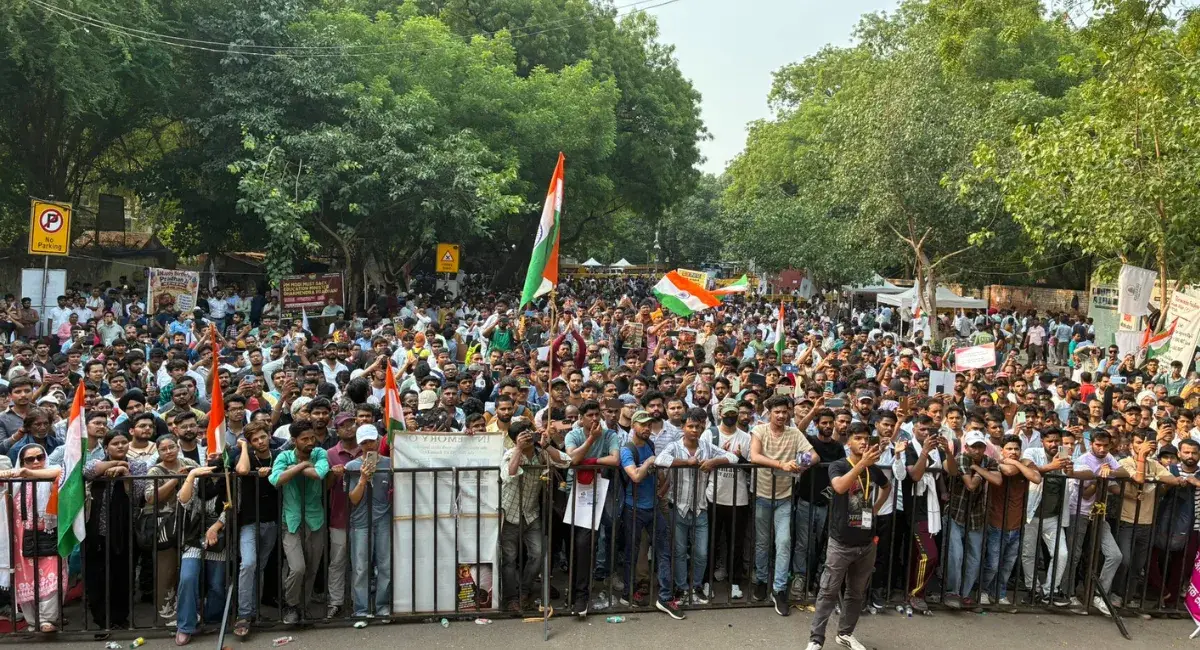

Origins of Political Upheaval in Intellectual Spaces
A recent article published by Organiser Weekly argues that political revolutions rarely begin directly on the streets. Instead, these transformative movements originate much earlier, often in the quieter, yet profoundly influential, realms of classrooms, universities, cultural institutions, media platforms, and intellectual circles. It is within these spaces that nascent ideas are first cultivated, rigorously debated, refined, and eventually distilled into coherent political movements capable of challenging established orders.
The article, titled "The Long March of Ideas: Cultural Marxism, Protest Politics" and authored by Dr. Niranjan B Poojar, asserts that historical analysis consistently demonstrates major social and political upheavals seldom emerge spontaneously or overnight. Rather, they are invariably preceded by extensive periods—often years, and frequently decades—of profound ideological change. This gradual, yet persistent, evolution works to reshape the fundamental ways societies perceive their own history, collective identity, foundational institutions, and aspirations for the future.
Dr. Poojar illustrates this phenomenon by citing several recent global events. The article highlights Ukraine's Euromaidan movement, Bangladesh's student-led quota protests, Sri Lanka's Aragalaya movement, and Nepal's Maoist revolution as compelling examples. These cases are presented not as sudden eruptions, but as culminations of prolonged political mobilization and underlying ideological shifts that ultimately led to fundamental alterations of existing political systems.
The Enduring Influence of Ideological Transformation
The core assertion of Dr. Poojar's analysis is that the true drivers of societal change are not found in immediate political skirmishes or electoral cycles, but in the deeper currents of ideological transformation. These shifts are not rapid, but rather represent a "long march" through the institutions that underpin society. This process involves a sustained effort to alter the prevailing narratives and values that define a culture, preparing the ground for eventual political expression and action.
Such ideological influence, particularly when embedded within key societal institutions, is posited to be far more significant and enduring than transient electoral victories or changes in government. While elections determine who holds power for a fixed term, institutions—ranging from educational bodies and media organizations to legal frameworks and cultural establishments—possess the capacity to shape the minds and values of generations over extended periods. This long-term shaping ensures that once an ideological shift takes root, its effects can reverberate through society for decades, fundamentally altering the social and political landscape.
Academia's Pivotal Role in Shaping Thought
A critical initial stage in this ideological transformation, as highlighted by the article, frequently commences within academia. Universities, in particular, have historically served as crucial crucibles for the development and dissemination of political thought and the genesis of social movements. These institutions are not merely repositories of knowledge but active agents in interpreting and reinterpreting historical narratives and social values. By engaging in this intellectual work, universities lay foundational groundwork, often subtly, for subsequent broader political mobilization and shifts in public consciousness.
The Framework of Cultural Marxism
Within this broader understanding of ideological evolution, one specific interpretation has gained considerable traction in contemporary discourse: "Cultural Marxism." This framework describes a modern ideological struggle that has shifted its focus away from the traditional Marxist emphasis on violent class revolution and economic control. Instead, proponents of this view argue that the battleground has moved to influencing culture, education, media, and public discourse.
The primary objective, according to this interpretation, is not merely to win elections or facilitate the replacement of governments through conventional means. Rather, it is a more profound and long-term ambition: to fundamentally reshape the moral, cultural, and intellectual foundations upon which society is built. This involves a sustained effort to alter societal norms, values, and even the very language used to discuss social and political issues.
Regardless of whether one fully accepts or critically questions its premises, "Cultural Marxism" has undeniably emerged as an increasingly influential framework in contemporary political debates across the world. Its widespread discussion reflects a growing recognition among various political actors and commentators that power struggles are not solely economic or governmental, but deeply cultural and intellectual. The article underscores this by reiterating that ideological influence over institutions ultimately proves more significant than electoral victories, precisely because these institutions are the enduring shapers of successive generations, long after specific political administrations have concluded their terms.
Redefining Economic and Political Rivalries
The article further delves into a re-evaluation of the traditional rivalry between capitalism and communism, suggesting that its nature is often misunderstood in conventional analyses. While these two ideologies are typically presented as diametrically opposed economic systems, Dr. Poojar's perspective views both as distinct, yet equally potent, mechanisms through which power can become concentrated within a society. The key difference lies in the specific spheres each system primarily targets for influence and control.
In this framework, capitalism is primarily understood as a system that exerts its influence through the domains of finance, markets, and established economic institutions. Its power is manifested through control over capital, production, and the distribution of wealth, shaping societal structures through economic incentives and market forces. This concentration of power is largely visible in corporate structures, financial markets, and the policies that govern economic activity.
In stark contrast, the article posits that communism, particularly in its "Cultural Marxist" interpretation, is viewed as seeking influence over a different, yet equally fundamental, set of societal domains: culture, education, and social values. The struggle here is not for direct economic control, but for the hearts and minds of the populace, aiming to shape collective consciousness, moral frameworks, and the very fabric of social interaction. This perspective suggests a profound shift in the locus of the struggle for power, moving beyond purely economic control to encompass a broader, more pervasive battle for cultural and intellectual dominance. This ideological contest, unfolding across institutions and public discourse, is presented as the defining struggle of the modern era, with long-term implications for the direction of global societies.