


Trump's Direct Warning to Iran
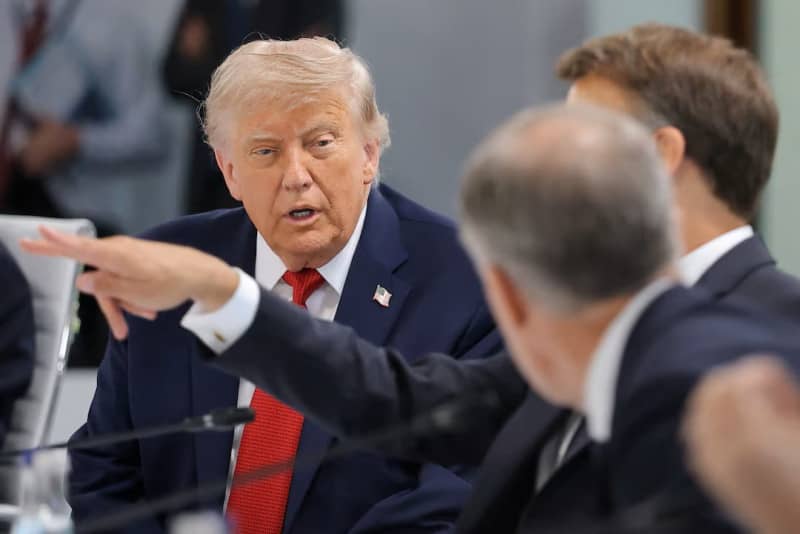
United States President Donald Trump issued a stark and unequivocal warning to Iran on July 11, 2026, threatening devastating military retaliation from the United States should Tehran attempt to assassinate him. The severe declaration was communicated through a post on his personal social media platform, Truth Social, late on a Friday, underscoring the direct and unfiltered nature of the message.
In his post, President Trump explicitly stated that the U.S. military had been given "specific orders" to respond decisively to any perceived threat against the sitting president. He went further, asserting that the United States would "completely decimate and destroy all areas" of Iran if its leaders were to carry out or even attempt such an attack. This language conveyed a threat of total and widespread destruction, signaling a zero-tolerance policy towards any direct aggression targeting the U.S. head of state.
U.S. Missile Arsenal on Standby
The gravity of President Trump's warning was amplified by his detailed description of U.S. military readiness. He declared that "1,000 missiles are Locked and Loaded and aimed at the Islamic Republic of Iran," a phrase designed to emphasize immediate and precise targeting capabilities. Beyond this initial salvo, Trump also noted that "thousands more" missiles were prepared for deployment, ready to follow instantly should the Iranian government act on what he characterized as threats to assassinate him. This statement painted a picture of an extensive and prepared military response, far beyond a limited counter-strike.
President Trump underscored the operational readiness of the American armed forces, asserting that the U.S. military was "ready, willing and able" to execute these orders without hesitation. This declaration aimed to leave no doubt about the United States' capacity and resolve to act on its threats, transforming the warning from mere rhetoric into a clear statement of potential military action. The use of a public social media platform for such a critical national security pronouncement also highlighted the administration's direct communication strategy in high-stakes international relations.
Heightened Confrontation and Diplomatic Undercurrents
President Trump's severe warnings did not emerge in isolation but were delivered amid a period of significantly escalating tensions between Washington and Tehran. The pronouncements followed a week marked by renewed confrontation between the two nations, indicating a consistent pattern of hostility that had recently intensified. This renewed aggression underscored a long-standing and often volatile relationship between the United States and the Islamic Republic of Iran, which had seen intermittent periods of direct and indirect conflict.
The immediate backdrop to Trump's Truth Social post included reports of fresh strikes exchanged between the two nations overnight, just prior to his statements on July 11, 2026. These recent military actions served to further deepen the already strained diplomatic tensions in the region, creating an environment ripe for strong rhetoric and potential escalation. The exchange of strikes highlighted the precarious security situation and the readiness of both sides to engage militarily, even if in limited capacities.
A Bid for Negotiation Amid Threats
Despite the overt military posturing and the explicit threats of destruction, President Trump also introduced a seemingly contradictory element into his public commentary. He stated that Iran "want[s] to make a deal so badly," an assertion made even as reports of fresh strikes continued to surface. This comment suggested a complex, dual approach to foreign policy, blending aggressive military deterrence with an overture for diplomatic engagement. It implied that while the United States was prepared for extreme military action, there remained a perceived pathway for negotiation, contingent on Iran's willingness to engage.
This strategic blend of threats and potential for dialogue characterized the administration's stance during this period of heightened hostility. The statements made by President Trump represented one of the strongest and most direct threats issued against the Islamic Republic to date, signaling a significant hardening of the U.S. position. The timing of the Truth Social post, coinciding with ongoing reports of military activity between the two countries, inevitably raised profound questions about the stability of the region and the potential for a broader conflict in early July 2026.
Implications for Regional Stability
The confluence of President Trump's explicit threats, the reported exchange of fresh strikes, and the ongoing military activity between the United States and Iran created an exceptionally volatile situation in early July 2026. The directness of the presidential warning, delivered through a widely accessible social media platform, ensured that the message resonated globally, intensifying concerns among international observers and regional allies alike. The explicit mention of "complete decimation and destruction" of Iranian areas, coupled with the readiness of "1,000 missiles Locked and Loaded," painted a grim picture of potential large-scale conflict.
Such pronouncements, especially when made against the backdrop of active military engagements, inherently destabilize an already sensitive geopolitical landscape. The immediate implications included an increased risk of miscalculation or unintended escalation, as both sides demonstrated a willingness to employ force. The global community watched closely for any further developments, understanding that a direct military confrontation between the United States and Iran could have far-reaching consequences, impacting global oil markets, international shipping lanes, and the broader security architecture of the Middle East.