

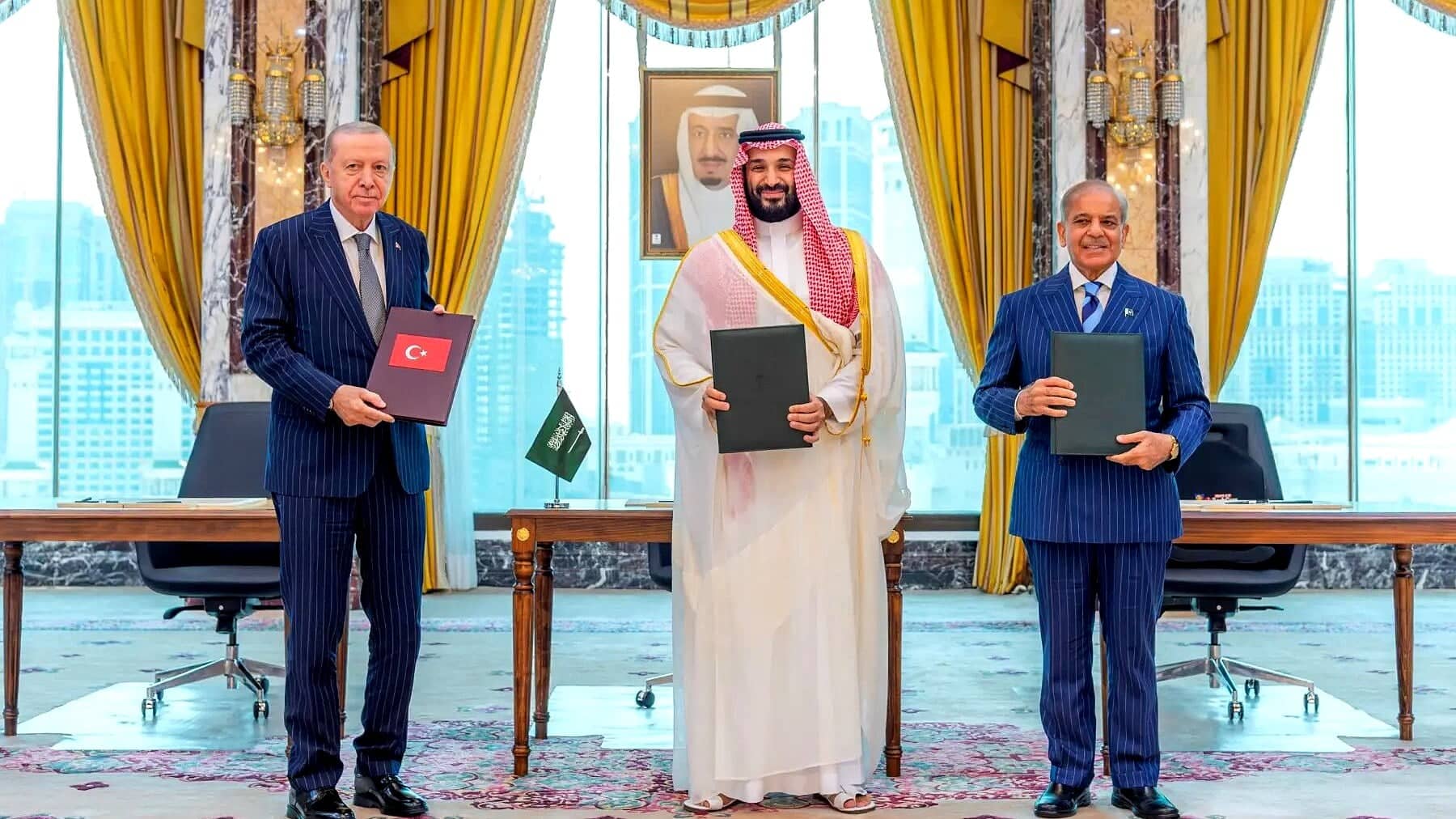

Historic Alliance Forged in Holy City
Turkey, Saudi Arabia, and Pakistan officially signed the "Mecca Defense Pact" on Aug. 7, 2026, in the holy city of Mecca, a location that underscores the pact's ambition to forge a unified front among Muslim-majority nations. This landmark agreement establishes a mutual defense framework, stipulating that an armed attack against any one of the three signatory states will be regarded as an attack against all three.
The signing ceremony was a high-profile event, attended by the leaders of the three nations: Turkish President Recep Tayyip Erdoğan, Saudi Crown Prince Mohammed bin Salman, and Pakistani Prime Minister Shehbaz Sharif. Their presence signaled the strategic importance each country places on this new alliance. Also present were key defense and economic officials, including Saudi Defense Minister Khalid bin Salman Al Saud, Pakistani Chief of Army Staff Field Marshal Asim Munir, and Pakistani Deputy Prime Minister Ishaq Dar, highlighting the comprehensive nature of the security and military cooperation envisioned.
A New Framework for Collective Defense
The pact is described by officials in all three capitals as a significant security arrangement designed to bolster collective military capabilities across the alliance. Under the terms of the agreement, Turkey is set to contribute its expertise in advanced military technology, specifically drones, which have become a critical asset in modern warfare. This contribution aims to enhance the defensive and offensive capabilities of the member states.
Saudi Arabia, leveraging its substantial economic power, has committed significant financial resources to underpin the alliance. This financial backing is crucial for the procurement of advanced military hardware, joint training exercises, and the overall operationalization of the pact. Pakistan, a nuclear power with a well-established military, brings strategic depth and military experience to the alliance, further solidifying its collective strength.
This trilateral alliance is widely seen as a significant step toward the formation of a unified Islamic military front, a concept that has been discussed in various forms for decades. Its formation is expected to reshape regional power dynamics, not only within the Middle East but also extending into South Asia, given Pakistan's strategic location and influence.
Regional Power Dynamics Under Scrutiny
Turkish officials have consistently characterized the Mecca Joint Defence Agreement as purely defensive in nature. Ankara has emphasized that the pact is designed to complement existing security arrangements, including Turkey's membership in NATO and the current security frameworks prevalent in the Gulf region. Officials have stressed that the alliance is not directed against any specific country, but rather aims to enhance the collective security and stability of its members.
Despite these assurances, the formation of this trilateral bloc has attracted considerable international attention. Observers note that the alliance positions Turkey, Saudi Arabia, and Pakistan as a significant power within the Islamic world and beyond, potentially altering longstanding regional power balances. The strategic recalibrations among neighboring countries and major global powers are anticipated as they assess the implications of this new security architecture.
Geopolitical Backdrop of Escalating Tensions
The signing of the Mecca Defense Pact occurs amid a period of heightened regional tensions, particularly following the protracted conflict between the United States and Iran. This broader geopolitical crisis has had profound effects on Gulf states, impacting their security, economic stability, and diplomatic relations. The ongoing tensions have also significantly disrupted critical shipping routes through the Strait of Hormuz and the Red Sea, vital arteries for global energy supplies and trade.
The strategic importance of these waterways, coupled with the persistent threat of maritime incidents and regional proxy conflicts, has underscored the need for enhanced security cooperation among regional actors. Against this backdrop, the Mecca Defense Pact can be interpreted as a direct response by its signatories to fortify their collective defense capabilities and safeguard their interests in an increasingly volatile environment.
Tehran Dismisses Pact as Insufficient for Security
Iranian officials have responded critically to the new alliance, expressing skepticism regarding its practical efficacy. Ebrahim Rezaei, a prominent member of Iran's Parliament and the National Security and Foreign Policy Commission, voiced his criticism of the Mecca Joint Defence Agreement on social media platform X, reflecting Tehran's official stance.
Rezaei stated unequivocally that a "paper agreement" with Turkey and Pakistan would not guarantee Saudi security. He argued that the Saudis must recognize that such an agreement will not bring them the security they seek, drawing a parallel to what he described as years of reliance on the United States that, in his view, did not provide adequate security in the past. This commentary highlights Iran's long-standing distrust of external security alliances in the region.
The Iranian lawmaker further claimed that if Saudi Arabia were to change its policies, it would not need to "beg" other countries for security. This statement implies that Iran believes Saudi Arabia's current foreign policy choices are the root cause of its security concerns, and that a shift in approach could lead to greater stability without the need for new defense pacts. Rezaei's comments collectively reflect a deep skepticism within Iran regarding the practical efficacy of the pact in ensuring the kingdom's safety amid ongoing regional instability and suggest a preference for regional dialogue over new military alliances.