

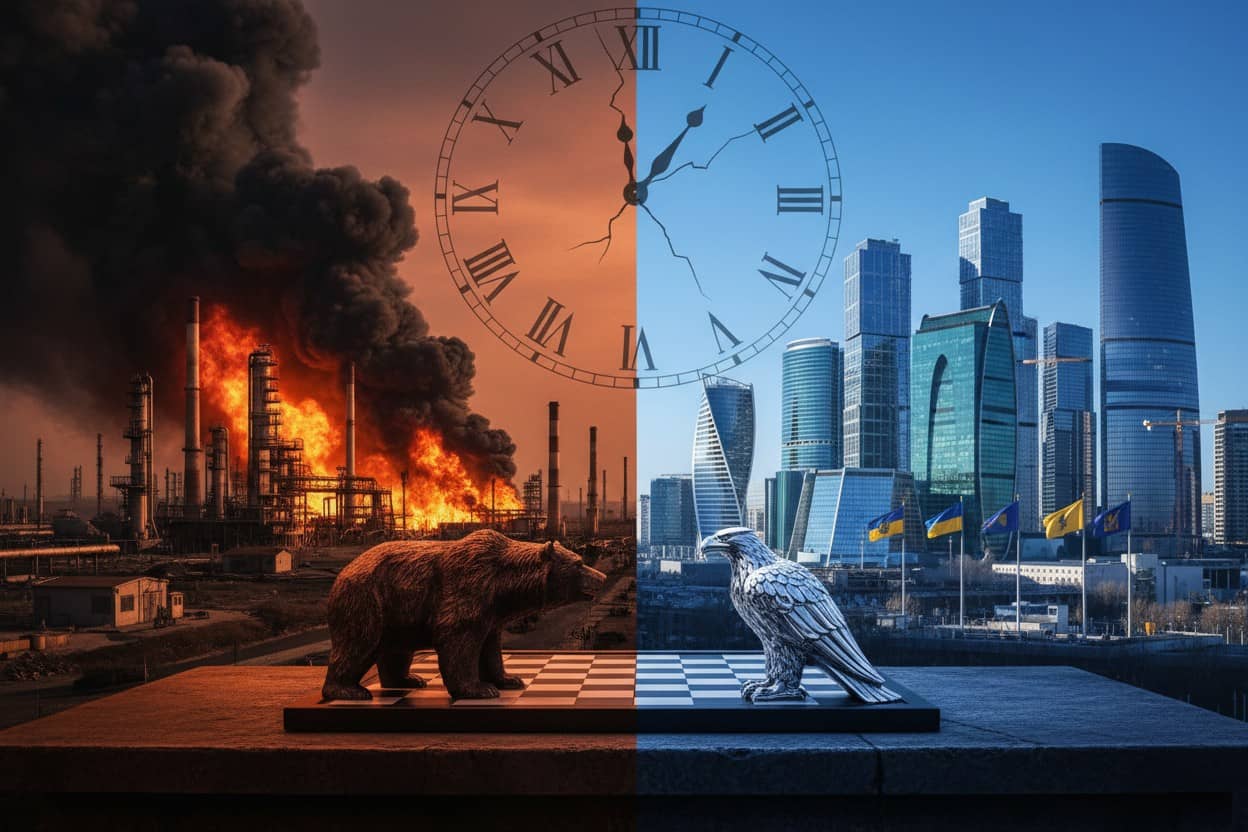

The Ukraine Conflict's Broadening Scope
A military conflict, initially localized in the Donbas region of eastern Ukraine, has significantly escalated, evolving into a wider geopolitical confrontation. This expanded engagement now directly involves Russia and a coalition of states aligned with NATO, marking a critical shift from its earlier, more contained phase. According to a report published by NaturalNews, this deepening crisis is characterized by profound “strategic failures” and carries the ominous “specter of nuclear catastrophe.”
From Donbas Origins to International Engagement
The report, authored by Garrison Vance and titled “The Ukraine-Russia Conflict: Strategic Failures and the Specter of Nuclear Catastrophe,” was published on August 30, 2026. It highlights that the initial hostilities, once geographically concentrated in eastern Ukraine’s Donbas region, have broadened significantly beyond bilateral engagements between Kyiv and Moscow. This expansion has drawn in a wider coalition of NATO-aligned nations, transforming a regional dispute into a confrontation with far-reaching international implications.
The article’s categorization on the NaturalNews platform under military, politics, culture, health and medicine, finance and economy, prepping and survival, science, and technology sections underscores the multifaceted nature of the crisis as perceived by the publication. This broad classification suggests that the conflict’s impact extends beyond traditional military and political spheres, touching upon societal, economic, and even existential concerns.
Escalating Risks and Perceived Strategic Failures
NaturalNews characterizes the current state of the war as being defined by “strategic failures.” Vance’s report directly links these perceived shortcomings in military, diplomatic, and geopolitical planning to the growing specter of nuclear catastrophe. The implication is that miscalculations or fundamental flaws in strategy are creating an environment where the use of nuclear weapons becomes an increasingly plausible and dangerous outcome, raising global alarm.
The Looming Threat of Nuclear Catastrophe
The publication explicitly warns of “nuclear war” and the threat posed by “nuclear weapons,” as indicated by its article tags. This grave assessment suggests that the conflict’s trajectory, marked by strategic missteps, is pushing the international community closer to an unprecedented global crisis. The report frames the situation as a potential precursor to “World War III,” underscoring the severity with which NaturalNews views the current path of escalation and the inability to contain the conflict within regional boundaries.
The article’s tags further paint a picture of a world teetering on the brink, including terms like “chaos,” “Dangerous,” “violence,” and “War.” These descriptors reinforce the publication’s view that the conflict represents a significant breakdown in global order and stability, where conventional diplomatic and military approaches have either failed or exacerbated tensions, leading to a more perilous international landscape.
Geopolitical Tensions and Economic Dimensions
The involvement of NATO-aligned states introduces substantial complexity and elevates the stakes for all parties. While the report does not specify which nations are directly involved, the alignment with NATO structures suggests that the conflict is being viewed through the lens of collective security agreements. This perspective implies that any further escalation could trigger broader commitments and responses from a wider array of international actors, intensifying the geopolitical standoff.
The article’s metadata also points to significant economic dimensions, with tags such as “energy,” “oil,” “sanctions,” and “finance and economy.” These suggest that economic tools and resources are deeply intertwined with the strategic failures identified by Vance. While the report does not detail specific energy disruptions or the impacts of sanctions, their inclusion implies that economic pressures and their consequences are contributing factors to the perceived diplomatic breakdown and overall global instability. The mentions of “EU,” “US,” and “Kremlin” further highlight the major international political entities involved in this complex web of geopolitical and economic struggles.
NaturalNews's Framing of Global Instability
NaturalNews, an independent media outlet, is known for offering alternative perspectives on news and current events. The article by Garrison Vance is positioned within a broader narrative often explored by the platform, which frequently focuses on themes of global instability, institutional failure, and governmental overreach. This context is evident from other content appearing alongside the report, such as pieces titled “Governments Panic Over Uncensorable Open Source AI” and “Can Tucker Carlson and a Third Political Party Save America From Total Destruction?”
This editorial environment suggests that Vance’s characterization of “strategic failures” and the warnings of nuclear catastrophe are presented as part of a larger critique of established political systems and global governance. The publication’s focus on “big government” and “geopolitics” further emphasizes its perspective on the inherent dangers of centralized power and international maneuvering in an increasingly volatile world.
The article’s publication date of August 30, 2026, places it in a specific temporal context, offering a snapshot of the conflict as described by Vance at that moment. The report, as provided, does not offer historical data on the conflict prior to this date, nor does it present opposing viewpoints or official statements from Russian, Ukrainian, or NATO officials. Consequently, the assertions regarding “strategic failures” and the escalating nuclear risks remain the specific interpretation and warning articulated by the author within the framework of NaturalNews’s editorial stance.