

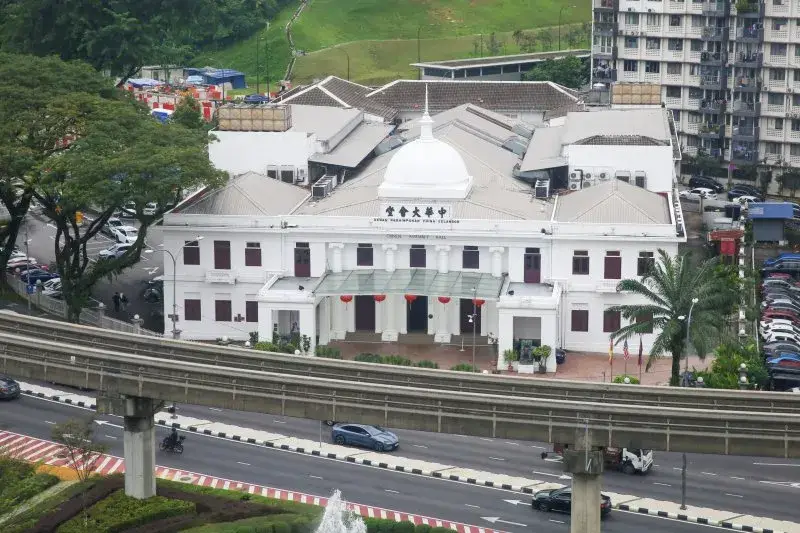

Lease Cost Dispute and Political Scrutiny
Akmal Saleh, the chief of Umno Youth, has publicly attacked the renewal of the 99-year lease for the land occupied by the Kuala Lumpur and Selangor Chinese Assembly Hall (KLSCAH). The current lease costs RM1,000, a figure Saleh contrasts with the estimated commercial value of RM4.67 million for the property.
The scrutiny over the facility’s financial arrangements coincides with broader political discussions regarding its identity. Recent reports indicate that candidates are considering removing the word "Chinese" from the hall's name as part of a higher-order question concerning the venue's role in the nation's multicultural landscape.
Political attention on the KLSCAH has intensified following administrative inquiries. Hannah Yeoh confirmed that her aide was summoned by the Malaysian Anti-Corruption Commission (MACC) regarding the RM1,000 lease arrangement. Additionally, former Penang chief minister Lim Guan Eng questioned the MACC’s handling of the probe into the KLSCAH land lease.
Historical Significance and Political Usage
The KLSCAH holds a central place in Malaysian political history. The Malaysian Chinese Association (MCA) was formed at the hall in 1949, and initial cooperation meetings between the MCA and Umno were held there in 1952.
During the tenure of former Prime Minister Mahathir Mohamad, the hall served as the exclusive venue for political forums and student groups. Civil society groups also utilized the facility, receiving discounted rental rates or complimentary use.
The venue has long been a site for diverse political engagement. Until Pakatan Harapan took over the government in 2018, the hall functioned as a shelter for contrarians and non-Barisan Nasional gatherings. Half of the Cabinet has spoken and stumped in the hall over the years.
Notable political figures have strong ties to the venue. Former Prime Minister Anwar Ibrahim was seen dragging along the late Khalid Ibrahim around 2006 at the hall. Khalid Ibrahim had his early introductions in the hall, establishing it as a key location for political development.
Heritage and Personal Connections
For many Malaysians, the hall represents more than just a political arena; it is a site of personal memory and shared heritage. The author of the Malay Mail opinion piece noted that their uncle got married at the hall and attended a few weddings there as a child.
The debate over the hall's future focuses on whether preserving the KLSCAH is about safeguarding Kuala Lumpur’s shared heritage, collective memory, and history of multicultural civic engagement. The discussion highlights the tension between the facility's historical role in uniting different political factions and contemporary pressures to alter its identity.