

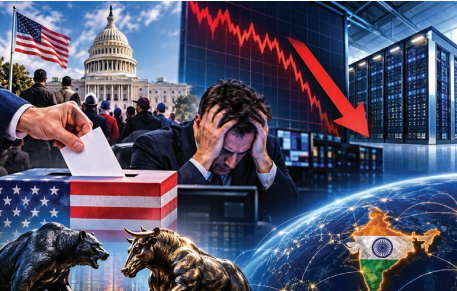

Equity Markets Hit After Election Verdict
The U.S. stock market experienced severe volatility immediately following the American midterm elections held on November 3. On Thursday, the Nasdaq Composite fell 5.5 percent to close at 24,315, marking its worst day since the tariff shock of April 2025 and erasing roughly $2.5 trillion in market value.
The S&P 500 declined 4.4 percent to 7,354, while the Dow Jones Industrial Average shed 1,833 points. The Nasdaq had recorded a fourth consecutive weekly decline prior to this drop, though it bounced up 1.09 percent on Friday.
Technology and semiconductor stocks faced significant losses. Nvidia lost 9.3 percent, Advanced Micro Devices fell 17.3 percent, Micron dropped 17.5 percent, and Broadcom decreased by 10.4 percent.
International markets also reacted to the U.S. political shift. South Korea’s Kospi index fell 6 percent, with chipmaker SK Hynix down more than 10 percent.
JPMorgan told clients that Thursday represented the worst single day for hedge funds since April 2025, citing the sharpest twenty-day deleveraging since the Covid crash. Barclays estimated that volatility-control funds cut their equity exposure by 30 percentage points on Thursday, the largest single-day reduction since February 2020.
Trading activity surged during the turmoil. Options volumes reached the highest levels in records going back to the 1970s. A leveraged exchange-traded fund offering three times the daily return of a semiconductor index fell more than 37 percent in one session.
Bond Yields Rise Amid Data Center Concerns
Credit markets signaled increased risk for artificial intelligence infrastructure companies following the election results. CoreWeave, a firm that builds and rents data centers for AI, saw its borrowing costs rise from around 10 percent earlier this year to more than 16 percent as bond investors demanded higher yields.
The political landscape shifted significantly on November 3, with Democrats winning control of both houses of Congress and securing governorships in Texas, Ohio, Georgia, and Michigan. This shift has immediate implications for the AI infrastructure sector, as half of the new data center capacity planned in the United States over the next year sits in four states that flipped to Democratic control.
Local opposition to expansion is intensifying. Dozens of local ballot measures across ten states, nearly all seeking restrictions on data center construction, passed during the election. Research by the International Data Center Authority counts at least 46 data center projects, representing more than $170 billion of announced investment across 20 states, blocked, stalled, or withdrawn after community opposition between January 2024 and May 2026.
In Texas, the incoming governor campaigned for a moratorium on data center development, adding regulatory uncertainty to a state that is a hub for such projects. The broader market reaction to these political outcomes was mixed in the immediate aftermath. Brent crude fell nearly 9 percent following the election, with hopes that the new Congress would press for an end to the Iran war.
While the Dow Jones Industrial Average had its best day since April immediately following the election verdict, the tech-heavy Nasdaq’s earlier plunge highlighted specific sector vulnerabilities. At the end of October, eight AI-exposed firms accounted for more than one third of the S&P 500’s market capitalization, making the index particularly sensitive to shifts in sentiment regarding AI spending.
Corporate Spending and Revenue Growth Slow
The financial strain on the AI sector is becoming evident in corporate balance sheets and revenue reports. Large cloud companies plan to deploy close to $1 trillion of capital expenditure this year, with several turning cash flow negative. Goldman Sachs estimates AI-related capital spending of $7.6 trillion between 2026 and 2031, but current market conditions are testing the sustainability of these projections.
Revenue growth for major players is decelerating. Anthropic reported third quarter revenue growth of 47 percent, down from 144 percent in the preceding quarter. This slowdown, combined with the rising cost of capital and political headwinds, has contributed to the sharp deleveraging observed in hedge funds and volatility-control strategies.