

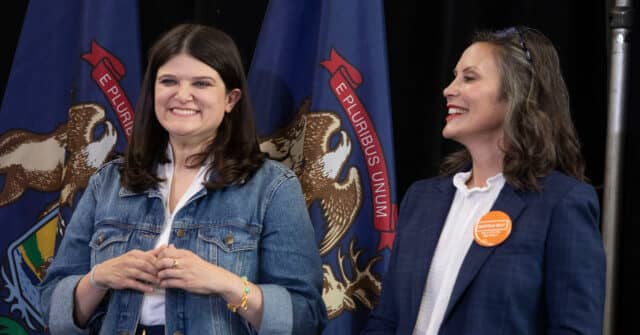

Whitmer Backs Stevens in Michigan Senate Primary
Michigan Gov. Gretchen Whitmer (D) formally endorsed Rep. Haley Stevens (D-MI) on Friday, a significant move that lends the state's most prominent Democratic name to a moderate congresswoman. This endorsement came just one day before early in-person voting commenced in Stevens's contentious primary battle against her self-described far-left rival, Abdul El-Sayed.
The timing of the endorsement, occurring mere days before the election and the opening of early in-person voting, underscores its strategic importance. Governor Whitmer announced her support for Stevens through both a video message and a written statement released on Friday, according to various reports. This dual approach aimed to maximize reach and impact among Michigan voters.
Representative Stevens is vying for the U.S. Senate seat currently held by retiring Senator Gary Peters (D-MI). In her endorsement, Governor Whitmer explicitly stated that Stevens shares her pragmatic focus on achieving tangible results for Michiganders. Whitmer remarked, “during my eight years as governor we have faced tough challenges but my north has been about getting things done for Michiganders who work hard and pay their taxes.” This statement positioned Stevens as a like-minded leader committed to practical governance over ideological purity.
Stevens's Record and Whitmer's Rationale
In her comprehensive endorsement, Governor Whitmer lauded the four-term congresswoman's extensive record of public service. A key highlight was Stevens's crucial role as chief of staff for former President Barack Obama's groundbreaking auto rescue effort. This experience, particularly relevant in a state deeply tied to the automotive industry, showcased Stevens's ability to navigate complex economic challenges and deliver critical support during a national crisis.
Local news outlet WDIV reported that Governor Whitmer specifically emphasized Stevens's work during her years in Washington, highlighting her consistent track record of delivering results while maintaining a moderate stance within the Democratic Party. This emphasis on moderation and effectiveness served to draw a clear distinction between Stevens and her more progressive opponent.
Whitmer’s written statement further elaborated on her admiration for Stevens, framing the endorsement not just as an affirmation of Stevens's qualifications, but also as a necessary step to prevent El-Sayed from advancing an agenda that Whitmer implicitly suggested might be out of step with the broader Michigan electorate. The governor's backing signals a clear preference for a centrist approach within the party.
The Battle for the Democratic Party's Direction
The primary contest between Stevens and El-Sayed has been characterized by both Whitmer and other political observers as particularly contentious. This race is seen as a significant indicator of the ideological direction of the Democratic Party in Michigan, pitting Stevens, who represents the moderate wing, against Abdul El-Sayed, who has firmly positioned himself on the far-left.
El-Sayed’s campaign has consistently championed progressive policy positions that diverge considerably from the more centrist approaches advocated by Stevens and supported by Governor Whitmer. These differences are not merely stylistic but represent fundamental disagreements on the scope and role of government, as well as specific policy solutions for Michigan's challenges.
Strategic Timing and Early Voting Impact
The announcement of Whitmer's endorsement, strategically timed just one day before early in-person voting officially opened, was designed to maximize its impact. This timing allows the endorsement to influence a broad spectrum of voters, including those who cast their ballots through mail-in options or early drop boxes, as well as those planning to vote in person during the early period.
Whitmer’s decision is widely interpreted as a calculated political maneuver to consolidate support behind Stevens. By throwing her considerable political weight behind the congresswoman, Whitmer aims to ensure that Stevens's moderate platform prevails against what she and her allies characterize as the far-left extremism represented by El-Sayed's campaign. This move is critical in mobilizing the Democratic base and undecided voters who align with Whitmer's vision for the state.
Local Media's Focus on the Endorsement
The high-profile endorsement has garnered significant attention across Michigan's media landscape. WDIV and other local news outlets have provided extensive coverage, analyzing how Governor Whitmer’s backing could sway voter turnout, particularly in key counties where the primary race is expected to be tight. Analysts have suggested that without such a powerful, high-profile endorsement, Stevens might face an uphill battle in overcoming El-Sayed's perceived momentum, especially among younger, more progressive voters who are often energized by far-left candidates.
Stevens's Gratitude and Commitment
In response to the pivotal endorsement, Representative Haley Stevens publicly thanked Governor Whitmer, stating that the support “means a great deal.” Stevens reaffirmed her commitment to broad representation, emphasizing her dedication to serving all Michiganders, irrespective of their political affiliations or views. She underscored her legislative approach, highlighting her consistent efforts to work across the aisle on critical issues such as education, healthcare access, and infrastructure development, further solidifying her image as a bipartisan-minded moderate.
Implications for Michigan's Political Landscape
This Democratic primary election is more than just a contest for a Senate seat; it serves as an early and crucial indicator of how national political trends and ideological divides may manifest in future elections, particularly looking ahead to 2026. With the robust endorsement from Governor Whitmer, Stevens's campaign hopes to secure a decisive victory, aiming to gather enough votes to avoid a runoff or defeat El-Sayed outright in the initial primary.
As of the time of this report, Abdul El-Sayed’s campaign had not yet issued a public response to Governor Whitmer's endorsement. However, it is widely anticipated that his campaign will soon release its own messaging, likely seeking to counter the narrative established by Whitmer's backing of Stevens and to re-energize his progressive base.
Key Policy Divides Shaping the Campaign
The two candidates, Stevens and El-Sayed, hold distinctly different positions on several key policy issues, which have become central to their campaigns and the ongoing debate among voters. On climate change, Stevens advocates for more moderate, incremental approaches, often emphasizing economic feasibility and technological innovation. In contrast, El-Sayed champions more aggressive and transformative actions, aligning with the Green New Deal framework and calling for rapid decarbonization.
Their differences extend to gun control measures, with Stevens generally supporting common-sense regulations while El-Sayed often pushes for more stringent, comprehensive reforms. Similarly, on immigration policy, the candidates present divergent strategies, reflecting their broader ideological leanings. These substantive disagreements have become central points of contention, allowing voters to clearly distinguish between the two candidates' visions for Michigan and the nation.
Mobilizing Voters as Early Balloting Begins
As early voting commences across Michigan, both campaigns are intensifying their efforts to mobilize their respective bases and sway undecided voters. Governor Whitmer’s endorsement is specifically designed to energize and rally supporters who align with her vision for a pragmatic, results-oriented Democratic Party in Michigan. The goal is to ensure that these voters turn out for Stevens, either through early voting mechanisms or on Election Day.
With ballots now being cast, the focus for both Stevens and El-Sayed's campaigns will be on getting out the vote. This critical period will see intensified outreach, advertising, and grassroots efforts aimed at convincing Michiganders to cast their ballots for their preferred candidate, ultimately shaping the future representation of the state in the U.S. Senate.