


The End of a Monopoly Era
According to an opinion piece published by Joschka Fischer in the Bangkok Post on July 29, 2026, the international landscape is undergoing a fundamental structural change. The article asserts that the historical period defined by a United States monopoly over military and economic power, alongside the promotion of specific American values, has concluded. Fischer writes that this shift marks the end of an era in which global order rested primarily on US hegemony.
The publication identifies the source of this analysis as an opinion column titled "Who will top the next world order?" The article is categorized under the World section of the Bangkok Post, a news outlet described in its own navigation structure as "The world’s window on Thailand." Fischer’s byline appears alongside standard newspaper metadata, including the publication date of July 29, 2026, at 07:01.
The core argument presented in the text is that the previous global configuration is no longer viable. The text states explicitly that "the era in which global order rested on a US monopoly over military and economic power and values has finally come to an end." This statement serves as the primary factual basis for the article’s assessment of the current geopolitical climate, according to the author.
Consequences for European Stability
Fischer links the decline of US unilateral dominance directly to changes in the stability of Europe. The article notes that the end of the previous global order has taken "Europe's long period of stability with it." This assertion suggests a causal relationship between the shift in global power dynamics and the loss of stability previously experienced by European nations.
The text does not specify which European countries are affected or define the exact nature of the prior stability, other than characterizing it as "long." The claim is presented as a direct consequence of the end of the US-led order. The article implies that the mechanisms that previously ensured stability in Europe were tied to the broader global system dominated by the United States.
Anticipated Turbulence and Uncertainty
The opinion piece describes the current state of the world as "significantly more turbulent and uncertain." This characterization is attributed to Fischer’s analysis within the Bangkok Post article. The text does not provide specific metrics for this turbulence, such as conflict counts or economic indicators, but rather offers a qualitative assessment of the global environment.
Looking forward, the article predicts that "the near future will bring even more instability." This prediction is presented as part of Fischer’s argument regarding the trajectory of international relations. The text suggests that the current level of turbulence is not a peak but rather a baseline from which conditions may deteriorate further in the immediate term.
Visual Context and Reporting
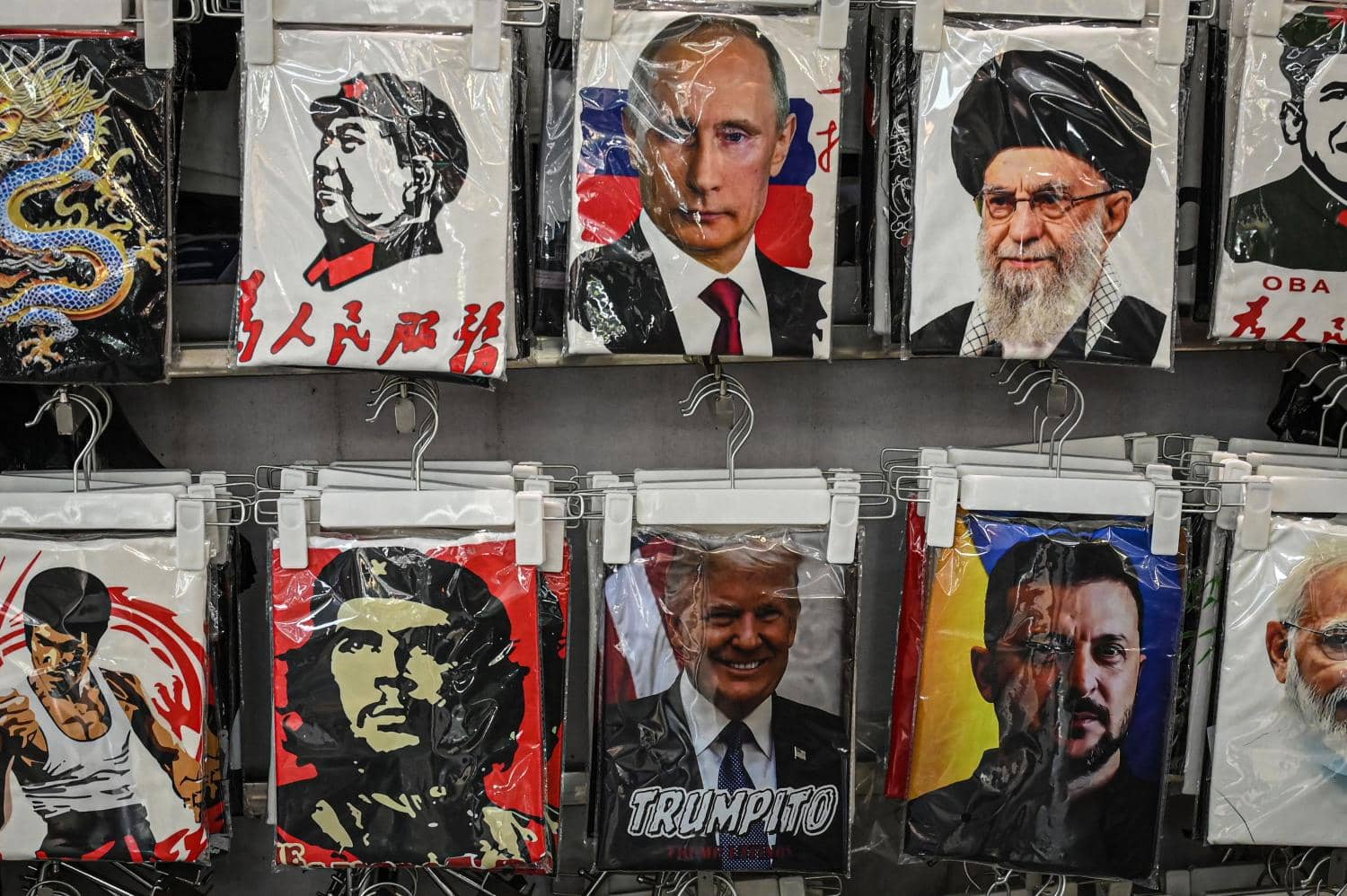
The Bangkok Post article includes a photograph credited to AFP (Agence France-Presse) dated May 18. The image depicts T-shirts featuring Russian President Vladimir Putin at the top center and US President Donald Trump at the bottom center, displayed in a shop in Shanghai. This visual element accompanies the text discussing the shift in global power dynamics.
The presence of these figures on merchandise in Shanghai is noted as a factual detail within the source material. The article uses this image to illustrate the changing perceptions or prominence of these leaders in the context of the shifting world order, although the text itself does not explicitly analyze the symbolism of the T-shirts beyond their visual presence.
Attribution and Source Context
All assertions regarding the end of US monopoly, the loss of European stability, and the prediction of future instability are attributed to Joschka Fischer in this Bangkok Post opinion piece. The article does not include responses from opposing parties or alternative viewpoints within the provided text.
The source material is an opinion column, which means the statements reflect the author’s perspective rather than established factual consensus or official government policy. The Bangkok Post published the piece as part of its Opinion section, specifically under the Columnist category.
The article raises the question "Who will top the next world order?" but does not provide a definitive answer in the provided text excerpt. The focus remains on the conclusion that the previous order has ended and the resulting instability for Europe and the broader world.