


Decades-Long Maritime Victories Yield Limited Returns
More than ten years after winning two major maritime boundary disputes in the Bay of Bengal, Bangladesh has yet to convert its legal victories into significant economic value. The rulings granted Dhaka rights over approximately 118,813 square kilometers of ocean territory, including a 200-nautical-mile exclusive economic zone (EEZ), but the sector’s contribution to the national economy remains minimal.
According to the last official estimate from the 2014–15 fiscal year, the ocean economy contributes slightly more than 3% to Bangladesh’s GDP. The comparable figure for the ocean industry was roughly $6.2 billion during that period, representing about 3.33% of the gross domestic product.
The legal foundations for these territorial rights were established through two separate international tribunal rulings. In 2012, the International Tribunal for the Law of the Sea (ITLOS) ruled in Bangladesh’s favor against Myanmar. Two years later, in 2014, the Permanent Court of Arbitration (PCA) issued a ruling in Bangladesh’s favor against India.
Despite these clear legal mandates defining its maritime borders, the government has not commissioned a national ocean accounting since the 2014–15 fiscal year. This lack of updated data leaves the current state of the sector largely unquantified beyond the decade-old baseline.
Stagnant Industrial Development
The composition of Bangladesh’s current ocean economy is dominated by traditional industries rather than high-value offshore ventures. Most revenue in the sector currently comes from fisheries, shipping, and salt production.
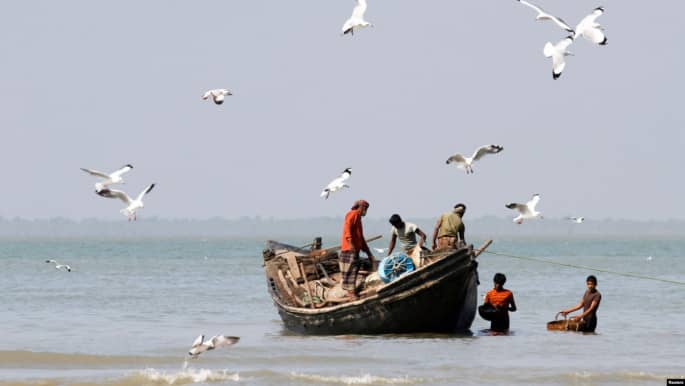
Marine fisheries account for approximately 15–16% of Bangladesh’s total fish production. This output is primarily derived from small boats operating in shallow waters, rather than deep-sea industrial fishing within the newly secured EEZ.
Offshore energy exploration has seen no growth since the legal victories were finalized. Offshore oil and gas exploration remains at its 2014 level. The Sangu field stands as the only offshore gas field ever brought into production in Bangladesh, having operated from 1996 until its shutdown in 2013.
Fragmented Governance Hinders Progress
A primary obstacle to leveraging the Bay of Bengal’s resources is the fragmentation of maritime affairs across multiple government bodies. Responsibility for the sector is split among five distinct bureaucracies: the Navy, the Coast Guard, the Ministry of Fisheries and Livestock, the Ministry of Shipping, and the Energy and Mineral Resources Division.
To address this fragmentation, the government established the Blue Economy Cell in January 2017 under the Energy and Mineral Resources Division. The cell was given a coordination mandate to unify efforts across these disparate agencies.
However, the cell lacks the structural power necessary for effective enforcement or policy implementation. It operates without an independent budget line or legal teeth, limiting its ability to compel cooperation among the various ministries involved in maritime affairs.
Unfulfilled Reform Recommendations
The limitations of the current administrative structure have drawn criticism from legislative bodies. A parliamentary standing committee previously reviewed the situation and recommended upgrading the Blue Economy Cell into a full authority with greater power and autonomy.
Despite this recommendation, the proposal was never acted upon by the government. The cell remains in its original capacity, unable to enforce policies or manage the vast resources now under Bangladesh’s jurisdiction in the Bay of Bengal.