

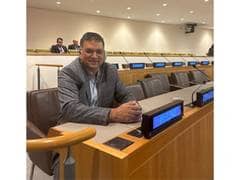

UN General Assembly Deliberations on the Right to Development
New York [US], September 26: Shri Binod Anand, Secretary General of the Confederation of NGOs of Rural India (CNRI) and Founder & Executive President of the World Cooperative Economic Forum (WCOOPEF), participated in United Nations General Assembly deliberations on the Right to Development.
During his engagement at the UN headquarters, Anand presented India’s vision of "Sahkar Se Samriddhi," which translates to "Prosperity through Cooperation," as a practical solution to four linked global challenges: food, fertilizer, fuel, and finance.
Anand argued that geopolitical tensions are currently disrupting supply chains, raising input costs, and tightening credit for the Global South. In this context, he positioned cooperatives as resilient infrastructure designed to keep value and decision-making with producers rather than external entities.
"The world’s crises of food, fertiliser, fuel and finance are no longer separate problems," Anand stated. "They are one geoeconomic chain, and whoever controls that chain controls the fate of billions of small producers."
Proposed Cooperative Economic Framework
Anand highlighted CNRI’s Cooperative Economic Framework (CEF), describing it as strategic economic architecture that involves transparent local markets, member-owned finance, and farmer-controlled supply chains.
He outlined the scope of this framework, noting that discussions covered the value chain from farming, dairy, and fisheries to fertilizer access, rural credit, cooperative insurance, and green energy models like compressed biogas.
Anand emphasized the structural shift required in development economics. "Our Cooperative Economic Framework offers a different answer: when farmers own the chain, from seed and soil to credit and clean energy, supply shocks become shared burdens instead of private windfalls, and development becomes a right exercised rather than a promise awaited," he said.
The proposal extends beyond theoretical architecture to specific operational mechanisms. Anand argued that "Sahkar Se Samriddhi turns people from beneficiaries into stakeholders. That is the cooperative firewall the world needs against market concentration, financial exclusion and economic coercion."
Strategic Collaboration with UN DESA
Beyond the plenary sessions, Anand held high-level meetings with senior management of UN DESA regarding geopolitics and the global economy. These discussions focused on integrating cooperative models into broader development strategies.
In these meetings, Anand proposed strategic collaboration on "Cooperatives as Infrastructure for Inclusive, Digital and Sustainable Development." The proposal included several concrete initiatives: a Global South Cooperative Policy Lab, a Cooperatives & VNRs Toolkit, and a UN–Global South Cooperative Development Dialogue.
Additionally, the discussions covered a Coop-Eco Digital & AI Literacy Mission, which includes a 12-month pilot phase aimed at equipping rural producers with necessary technological tools.
Anand framed these proposals within the broader context of international rights. "As we mark forty years of the Declaration on the Right to Development, the question before the United Nations is not whether the Global South needs growth, but who will own it," he stated during the deliberations.
Institutional Standing and Reach
The proposals were backed by CNRI’s established institutional standing. The organization holds Special Consultative Status with the UN Economic and Social Council (ECOSOC), allowing it to participate in high-level policy discussions.
Furthermore, CNRI has been an Affiliate Member of the OECD International Network on Financial Education (OECD/INFE) since 2011, demonstrating a long-term engagement with global financial education standards.
Through these engagements, Anand sought to position cooperatives not merely as alternative business models, but as essential infrastructure for stabilizing the Global South against volatile global markets and geopolitical disruptions.