

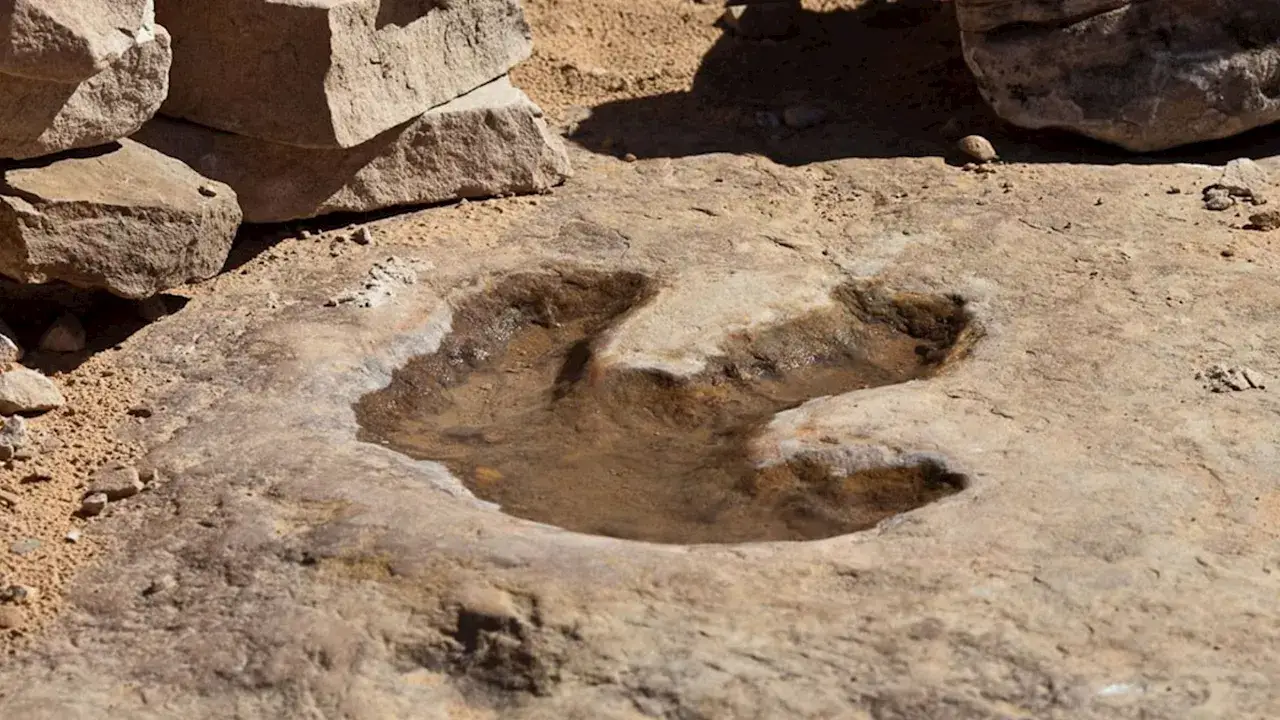

A recent scientific endeavor in China involving the analysis of over 5,000 dinosaur footprints has led to the identification of one of the slowest-moving carnivorous dinosaur trackways ever recorded. This discovery provides new insights into the locomotion and potential hunting strategies of predatory dinosaurs.
Extensive Footprint Analysis in China
The research, conducted by a team of scientists, focused on a vast collection of fossilized footprints discovered across various sites in China. The sheer volume of trackways – exceeding 5,000 individual prints – offered an unprecedented opportunity for detailed ichnological study. Ichnology, the branch of paleontology that deals with trace fossils such as footprints, burrows, and droppings, provides direct evidence of an animal's behavior and movement that skeletal remains often cannot.
These trackways preserve moments from the Mesozoic Era, offering a glimpse into the daily lives of dinosaurs. Each footprint contains a wealth of information, including the shape and size of the foot, the number of digits, and impressions of skin or scales. When multiple prints form a trackway, scientists can deduce further details such as stride length, pace, gait, and estimated speed.
Discovery of a Remarkably Slow Carnivore
Among the thousands of analyzed footprints, one particular trackway stood out due to its exceptionally slow estimated speed. While specific details about the dinosaur species responsible for the trackway have not been publicly detailed in the initial findings, the morphology of the footprints confirmed their origin from a carnivorous dinosaur. Carnivorous dinosaurs, often depicted as swift and agile predators, typically exhibit trackways indicative of moderate to high speeds, especially when hunting.
The identification of a trackway suggesting one of the slowest speeds ever recorded for a carnivorous dinosaur challenges conventional assumptions about the locomotion of these ancient predators. This finding suggests a broader range of movement capabilities and potential ecological roles for theropods than previously emphasized.
Methodology for Speed Estimation
Estimating the speed of a dinosaur from its trackway involves a combination of meticulous measurement and established biomechanical formulas. Scientists typically measure several key parameters from a series of footprints:
- Stride Length: The distance between successive prints of the same foot.
- Pace Length: The distance between successive prints of opposite feet.
- Foot Length: The length of an individual footprint.
These measurements, along with an estimation of the dinosaur's hip height (often derived from foot length or overall body proportions of known skeletal remains), are then fed into mathematical equations. One commonly used formula, developed by R. McNeill Alexander, relates relative stride length (stride length divided by hip height) to relative speed (speed divided by the square root of hip height times gravitational acceleration).
Through this analytical process, the researchers were able to calculate an unusually low speed for the dinosaur that created the identified trackway. This indicates a creature moving at a pace significantly slower than what might be expected for an active predator.
Implications for Dinosaur Behavior and Ecology
The discovery of a slow-moving carnivorous dinosaur trackway carries several implications for understanding dinosaur behavior and paleoecology:
- Diverse Hunting Strategies: Not all carnivorous dinosaurs may have relied on speed for hunting. A slower predator might have employed ambush tactics, targeting less agile prey, or scavenging opportunities. This expands the known spectrum of predatory behaviors.
- Ecological Niche: A slower speed could indicate a specialized ecological niche. For instance, such a dinosaur might have been an opportunistic feeder, or perhaps a predator of very slow-moving or sessile organisms, rather than pursuing fast-moving prey.
- Physiological Constraints: The slow speed could also reflect physiological constraints, such as a heavy build, short limbs relative to body mass, or a metabolism that did not support sustained high-speed locomotion.
- Environmental Factors: The substrate conditions at the time the footprints were made could also play a role. While speed calculations account for typical walking gaits, extremely soft or slippery ground might force even a fast animal to move slowly. However, consistent slow speeds across multiple prints usually indicate inherent locomotion patterns.
This finding adds to the growing body of evidence suggesting that dinosaur ecosystems were highly complex, with a wide array of adaptations and behaviors among their inhabitants, including their top predators.
China's Rich Paleontological Record
China has long been recognized as a global hotspot for paleontological discoveries, particularly regarding dinosaurs. The country's vast geological formations have preserved an extraordinary record of Mesozoic life, including numerous skeletal fossils, eggs, and trace fossils. Significant finds in China have contributed immensely to the understanding of dinosaur evolution, avian origins, and ancient ecosystems.
The continuous discovery and analysis of dinosaur trackways in regions across China, such as those in Shandong, Sichuan, and Xinjiang provinces, consistently provide novel data. These trace fossils offer unique perspectives that complement information derived from skeletal remains, often revealing aspects of dinosaur biology and behavior that cannot be inferred from bones alone. The latest analysis of over 5,000 footprints further solidifies China's role as a crucial region for advancing dinosaur research.